
Yes — U.S. sellers can sell on Amazon’s international marketplaces right now, using Amazon Global Selling and a set of tools that make cross-border listing far more manageable than most sellers expect. The fastest first step is not shipping inventory overseas. It is running the Sell Globally Expansion Research on your top ASINs to see estimated first-year sales and costs before you commit a single unit. If those numbers hold up, your next move is getting inventory FBA-compliant for the destination market, which is where a U.S.-based FBA prep partner like Usiprep removes the most friction.
The two most common fulfillment routes are FBA Export, which ships from your existing U.S. inventory to international buyers, and local FBA programs like Pan-European FBA, which place inventory inside the destination region for faster delivery and lower per-unit fulfillment costs. Each carries different cost and compliance implications, covered in detail below.
Table of Contents
- How Amazon Global Selling works for international sellers
- Which Amazon marketplaces can U.S. sellers access?
- How to register and set up your international selling account
- What fees and costs should you expect?
- What are your fulfillment options for international sales?
- Product prep, labeling, and compliance before you ship internationally
- How to research markets and decide where to expand
- How to estimate revenue, timeline, and when expansion makes sense
- What Amazon programs and incentives are available to international sellers?
- How Usiprep helps U.S. sellers launch internationally with fewer delays
- Common mistakes sellers make when expanding internationally
- Key Takeaways
- Why U.S.-based 3PLs make more sense than you might think for global expansion
- Usiprep cuts the operational friction out of cross-border FBA
- Useful sources and next steps
How Amazon Global Selling works for international sellers
Amazon Global Selling is the umbrella program that lets you list and sell across Amazon’s worldwide marketplaces from a single Seller Central account structure. The mechanics break down into three layers: account linkage, listing workflow, and order management.
Account linkage. Amazon organizes its marketplaces into regional unified accounts. A North America unified account covers the U.S., Canada, and Mexico under one login. Europe has its own unified account spanning the major EU and UK marketplaces. Linking these regional accounts matters financially: when you link global Amazon selling accounts, your combined monthly subscription fee is either the equivalent of $39.99 or the sum of each region’s selling plan fee, whichever is lower. That cap makes multi-region selling cheaper than most sellers assume.

Listing workflow. Build International Listings (BIL) copies your existing listings to target marketplaces and applies automated translation. It also syncs prices according to rules you set. The catch is that BIL’s automated translation often misses local search terms, so your listing goes live but underperforms in organic search. Sellers who manually localize titles, bullet points, and backend keywords consistently outperform those who rely on BIL alone.
Order and payment flow. Each regional store appears as a separate context inside Seller Central. You switch between them using the store selector. Payments settle in the local currency and convert to USD through Amazon’s currency conversion service, or you can route proceeds to a local bank account in the destination currency. Third-party FX providers like Wise or Airwallex often offer better conversion rates than Amazon’s built-in service, particularly at volume.
Build International Listings gets your products live fast, but the sellers who win in new markets are the ones who treat localization as a separate project, not a checkbox. Automated translation is a starting point, not a strategy.
Which Amazon marketplaces can U.S. sellers access?
The short answer is most of them, though a few require extra steps.
- North America: The unified account covers the U.S., Canada, and Mexico. Brazil has its own account structure and requires separate registration, along with local tax compliance that is more complex than the rest of the region.
- Europe: The European unified account spans the UK, Germany, France, Italy, Spain, the Netherlands, Poland, Sweden, and Belgium. VAT registration is required in each country where you store inventory, and the UK requires its own VAT number post-Brexit.
- Asia-Pacific: Japan, Australia, Singapore, and India each require country-specific accounts. India has additional restrictions for foreign sellers and requires a local business entity in many cases.
- Middle East and North Africa: Amazon.ae (UAE) and Amazon.sa (Saudi Arabia) are accessible to U.S. sellers but require country-specific registration and have product category restrictions worth reviewing before listing.
Pro Tip: Start with one or two markets where your product already has clear demand signals from Expansion Research. Canada and the UK are the most common first moves for U.S. sellers because the language overlap reduces localization cost and the regulatory environment is relatively familiar.
The markets to approach carefully are India and China. India restricts foreign direct selling in ways that affect most U.S. sellers, and China’s Amazon.cn marketplace has a separate seller ecosystem with distinct requirements.

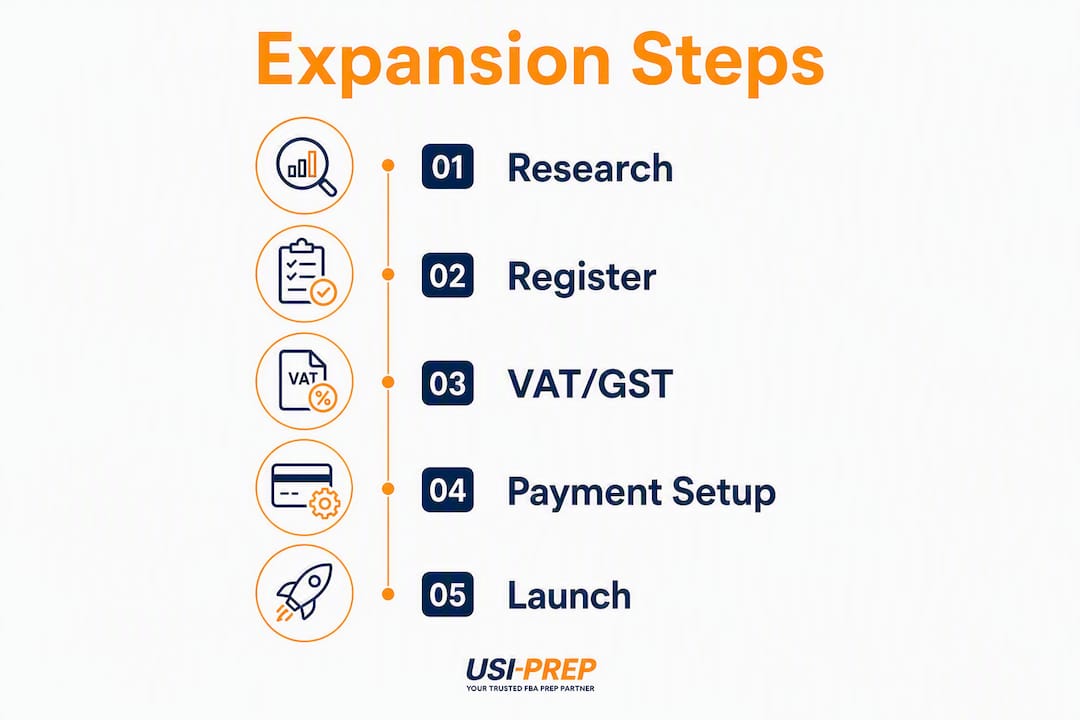
How to register and set up your international selling account
Getting your international footprint live involves more than clicking “add a marketplace.” Here is the practical sequence.
Step 1: Decide on account structure. For Canada and Mexico, simply activate those stores within your existing North America unified account in Seller Central. For Europe, you open a separate European unified account and then link it to your U.S. account. Asia-Pacific and Middle East markets each require individual country account applications.
Step 2: Gather required documents. Amazon’s verification process for international accounts typically requires:
- Government-issued photo ID (passport preferred for international accounts)
- Business registration documents (LLC or corporation paperwork, EIN confirmation)
- Bank account information for the destination currency or a U.S. bank account for Amazon currency conversion
- Credit card for fee billing
- Phone number for two-step verification
Step 3: VAT/GST registration. This is the step most U.S. sellers underestimate. Selling into the EU, UK, Australia, Japan, or Canada above certain sales thresholds triggers a VAT or GST registration obligation. Amazon’s VAT Services on Amazon program can handle registration and filing in supported EU countries for a fee. For markets outside that program, you will need a local tax agent or an international VAT compliance service.
Step 4: Configure payment settings. Choose between Amazon’s built-in currency conversion (convenient, slightly higher FX cost) or a third-party provider. If you expect meaningful volume in a single market, a local bank account in that currency usually pays for itself within a few months.
| Setup Element | North America (CA/MX) | Europe (EU/UK) | Asia-Pacific |
|---|---|---|---|
| Account type | Unified (activate in existing account) | Separate European unified account | Country-specific accounts |
| VAT/GST required | Canada GST above threshold; Mexico RFC | Yes, per country of inventory storage | Yes (AU, JP, SG) |
| Local bank account needed | Optional | Recommended for EU | Recommended |
| Typical setup time | 1–3 days | 2–6 weeks (VAT included) | 2–8 weeks |
For a detailed walkthrough of FBA shipment creation once your account is live, Usiprep’s guide covers the steps that trip up most new international shippers.
What fees and costs should you expect?
International selling adds cost layers that do not exist in domestic U.S. operations. Modeling these before you launch is the difference between a profitable market and an expensive lesson.
Selling plan fees. Linking your regional accounts caps the combined monthly fee at the equivalent of $39.99. Without linking, each region’s Professional plan runs separately. For most sellers adding Europe or Canada, linking accounts is the obvious move.
Referral fees. These vary by marketplace and category. European referral fees are broadly similar to U.S. rates but are denominated in euros or pounds. Japan and Australia have their own fee schedules. Always check the fee schedule for your specific category in each target marketplace before modeling margin.
FBA fees. Local FBA fees in Europe are generally lower per unit than shipping from the U.S. via FBA Export, once you account for the cross-border freight cost to get inventory into the European network. The math shifts depending on unit size and weight.
Pro Tip: Build a landed-cost model for each target market before shipping a single unit. Include referral fee, FBA fee, inbound freight, customs duty, VAT/GST, and currency conversion cost. If the margin after all of those is below 20%, the market needs a different product or a different fulfillment approach.
| Per-Unit Cost Component | FBA Export (from U.S.) | Local FBA (e.g., Pan-EU) |
|---|---|---|
| Inbound freight to FBA | U.S. domestic rate | International freight + customs |
| FBA fulfillment fee | U.S. rate | Local market rate (often lower) |
| Customs/import duty | Buyer pays (varies) | Seller pays on inbound shipment |
| Currency conversion | Amazon FX or third-party | Amazon FX or third-party |
| Delivery speed to buyer | Slower (cross-border) | Faster (local fulfillment) |
For tactics on reducing per-unit fulfillment costs, Usiprep’s cost reduction guide is worth reviewing alongside your landed-cost model.
What are your fulfillment options for international sales?
Four routes exist, and the right one depends on your volume, margin, and how fast you need to move.
FBA Export uses your existing U.S. FBA inventory to fulfill orders from international buyers. Amazon handles the cross-border shipping and customs. The upside is zero additional setup. The downside is that FBA Export has limited product selection eligibility and slower delivery times compared to local fulfillment. It works well for testing demand before committing to local inventory.
Pan-European FBA distributes your inventory across Amazon’s European fulfillment network and fulfills at local European fulfillment costs. Buyers get Prime-speed delivery. The trade-off is that you must be VAT-registered in every country where Amazon stores your inventory, and you must prep inventory to destination-country requirements before it enters the network. This is the most competitive option for established European volume but carries the highest compliance overhead.
Seller-fulfilled international means you ship directly from your U.S. warehouse or a 3PL to international buyers on each order. This avoids the upfront inventory commitment but is operationally demanding and rarely competitive on delivery speed for most product categories.
U.S.-based 3PL with international forwarding is the middle path. A 3PL like Usiprep preps and labels your inventory to destination-market FBA standards, consolidates shipments, and manages the customs documentation for the inbound move into a European or Asia-Pacific FBA center. You get local FBA speed and competitiveness without running your own international logistics operation.
| Fulfillment Method | Best For | Cost Profile | Compliance Burden | Lead Time | Scalability |
|---|---|---|---|---|---|
| FBA Export | Demand testing, low volume | Low upfront; slower delivery | Low (Amazon handles export) | Days (uses existing inventory) | Limited by selection eligibility |
| Pan-European FBA | High-volume EU sellers | Lower per-unit fulfillment; higher inbound cost | High (multi-country VAT) | 4–10 weeks to first sale | High once established |
| Seller-fulfilled international | Niche/oversized products | Variable; often high per-order | Medium | Immediate | Low (manual per order) |
| U.S. 3PL + international forwarding | Scaling sellers entering local FBA | Moderate; predictable per-unit | Medium (3PL manages prep/customs) | 3–8 weeks | High with right partner |
- Specialized 3PLs provide prep, labeling, kitting, and customs paperwork management for consolidated shipments into destination FBA centers.
- FBA Export is the right starting point; local FBA is the right scaling point.
- Pan-EU beats FBA Export on delivery speed and per-unit fulfillment cost once you have enough volume to justify the VAT compliance cost.
Product prep, labeling, and compliance before you ship internationally
Getting inventory into an overseas FBA center is not the same process as sending it to a U.S. fulfillment center. The requirements differ by destination, and the cost of getting them wrong is a rejected shipment or a customs hold.
- Confirm destination-country labeling requirements. Each Amazon marketplace has specific label placement and format rules. European FBA requires CE marking for certain product categories, country-of-origin labeling, and language-specific safety information on packaging. Japan requires Japanese-language product information on the physical product or packaging in many categories.
- Apply correct FNSKU and shipping labels. FNSKU labels must be scannable and placed per Amazon’s specifications. For international shipments, the carton labels also need to comply with the destination country’s import documentation requirements.
- Prepare customs documentation. Every international shipment needs a commercial invoice with accurate HS (Harmonized System) codes, declared value, country of origin, and a packing list. Incorrect HS codes are one of the most common causes of customs delays and unexpected duty assessments.
- Understand who pays duties. For FBA Export, Amazon typically collects import fees from the buyer at checkout. For inbound shipments into local FBA networks (Pan-EU, Japan FBA), you as the seller are the importer of record and pay the duties on the inbound move.
- Check category-specific import restrictions. Electronics, food, supplements, cosmetics, and children’s products all face additional regulatory requirements in the EU, UK, Japan, and Australia. Verify compliance before shipping, not after.
Pro Tip: For Amazon sticker and label requirements by destination, Usiprep’s labeling guide breaks down exactly what changes between U.S. and international FBA prep. Getting this right on the first shipment saves weeks of rework.
- Sellers remain responsible for local tax, compliance, and import rules even when using unified accounts or Amazon-managed fulfillment.
- A freight forwarder or customs broker is worth the cost for your first international shipment into each new market.
- Outsourcing prep and kitting to a specialist 3PL reduces inspection failures and transit delays, particularly for sellers without in-house international logistics experience.
How to research markets and decide where to expand
The Sell Globally dashboard inside Seller Central is the right starting point. It shows three things at a glance: new stores available to launch, global sales in your currently active stores, and Amazon’s worldwide marketplace footprint. From there, Expansion Research gives you estimated first-year sales and estimated first-year costs for your specific top ASINs in each candidate market.
Here is how to use it practically:
- Open the Sell Globally dashboard in Seller Central and navigate to Expansion Research.
- Select your top 5–10 ASINs by U.S. revenue.
- Review the estimated first-year sales and cost figures for each candidate marketplace.
- Check the incentives column — Amazon sometimes offers fee credits or promotional support for new market launches.
- Run Marketplace Product Guidance, which uses machine learning on catalog attributes to project demand and identify which products are likely to succeed in specific countries.
Beyond Amazon’s tools, apply these practical filters before committing:
- Product fit: Does your product require local language packaging or regulatory certification in the target market? What is the cost of that compliance?
- Margin after fees and duties: Run the landed-cost model from the fees section above. If margin falls below your threshold, the market is not ready yet.
- Competitive density: Search your main keywords on the target marketplace. If the top results are dominated by local brands with thousands of reviews, factor in the time and ad spend needed to compete.
- Seasonality: Some products have very different seasonal demand curves outside the U.S. Check historical sales data if available.
- Logistics feasibility: Can you reliably replenish inventory in the target market within a lead time that avoids stockouts?
Decision checklist for choosing your first target market:
- Expansion Research shows positive estimated first-year sales for at least two of your top ASINs
- Landed-cost margin exceeds your minimum threshold
- Regulatory compliance is achievable within your timeline and budget
- You have a fulfillment route confirmed (FBA Export for testing, local FBA or 3PL for scaling)
- VAT/GST registration is either not yet required at your projected volume or is in process
How to estimate revenue, timeline, and when expansion makes sense
The typical path from decision to live listing runs 6–14 weeks, depending on the fulfillment route and destination market.
- Research and market selection: 1–2 weeks using Expansion Research and the decision checklist above.
- Account setup and VAT registration: 1–3 days for North America; 2–6 weeks for Europe (VAT registration is the long pole).
- Inventory prep and labeling: 1–3 weeks depending on volume and whether you use a 3PL.
- International freight and customs clearance: 2–5 weeks for ocean freight to Europe or Asia-Pacific; 1–2 weeks for air freight.
- FBA check-in at destination center: 1–2 weeks after delivery.
For a per-unit profitability estimate, the key assumptions to stress-test are: referral fee in the target marketplace, local FBA fulfillment fee, inbound freight cost per unit, customs duty rate for your HS code, VAT/GST on the inbound shipment, and currency conversion cost. Small errors in any one of these compound quickly at scale.
Expansion makes operational sense when you have:
- Steady domestic sales with at least 6 months of consistent performance
- Gross margin above 40% before international costs (to absorb the additional fee layers)
- Return rates below your category average (high return rates get worse cross-border)
- Inventory planning capacity to manage a second replenishment cycle without stockouts
FBA Export is a low-risk way to test demand in a new market before committing to the full local FBA setup. If FBA Export generates meaningful sales, that is your signal to invest in the local inventory infrastructure.
What Amazon programs and incentives are available to international sellers?
Amazon provides several tools and programs specifically for sellers expanding globally, and a few of them offer real financial upside worth knowing before you launch.
- Sell Globally dashboard: Central hub in Seller Central for managing international stores, reviewing Expansion Research, and tracking global sales performance.
- Expansion Research: Provides estimated first-year sales and costs per ASIN per marketplace, plus any available launch incentives such as fee credits for new market launches.
- Build International Listings (BIL): Automates cross-listing and price synchronization across marketplaces. Use it to get live fast, then manually localize for search performance.
- Marketplace Product Guidance: Machine learning tool that analyzes your catalog and projects demand by country, helping you prioritize which ASINs to launch first.
- VAT Services on Amazon: Handles VAT registration and filing in supported EU countries for a fee. Reduces the administrative burden of EU compliance for sellers without a local tax agent.
For official documentation, the primary resources are:
- Amazon Seller Central Global Selling help pages
- The Global Selling guide on sell.amazon.com
- Amazon’s partner network for vetted logistics providers and customs brokers
Amazon also periodically offers launch incentives visible inside Expansion Research, including referral fee discounts for new marketplace launches. Check the incentives column in Expansion Research for your specific ASINs before you launch, since these change by market and time period.
How Usiprep helps U.S. sellers launch internationally with fewer delays
Usiprep was founded by former Amazon sellers, which means the service is built around the specific failure points that cause international launches to stall: non-compliant labeling, customs documentation errors, slow FBA check-ins, and opaque per-unit costs.
The services that matter most for international expansion:
- FBA prep and labeling to destination-market standards, including country-of-origin labeling, language-specific requirements, and FNSKU placement
- Kitting and bundling for market-specific configurations that differ from your U.S. product setup
- Customs documentation support, including commercial invoices and packing lists with accurate HS codes
- International freight consolidation to reduce per-unit inbound shipping costs into European or Asia-Pacific FBA centers
- Inventory check-in management to catch and resolve discrepancies before they become account-level issues
- Returns processing for cross-border returns, which are operationally more complex than domestic returns
Usiprep’s FBA inventory check-in best practices guide details exactly how check-in errors happen and how proper prep prevents them. The operational proof points: a 98.9% on-time delivery rate and a 30% reduction in fulfillment costs for many brands.
Pro Tip: For your first international shipment, have Usiprep handle the full prep-to-freight sequence rather than splitting responsibilities between your team and a freight forwarder. A single point of accountability catches errors before they reach customs.
Sellers who outsource international prep to a specialist 3PL from the start consistently avoid the two most expensive mistakes in cross-border FBA: customs holds from incorrect documentation and FBA rejections from non-compliant labeling. Both are recoverable, but both cost weeks and margin you cannot get back.
Common mistakes sellers make when expanding internationally
Most international expansion failures are not strategic. They are operational.
- Relying entirely on BIL translation — Automated translation gets your listing live, but local search terms require manual keyword research in the target language. A listing that no one can find does not sell.
- Incorrect labeling or prep. A shipment rejected at an overseas FBA center costs you the return freight, reprocessing time, and potentially weeks of lost sales velocity. Prep to destination-country requirements before the shipment leaves your facility.
Pro Tip: Run a small pilot with FBA Export before committing inventory to a local FBA network. If the market generates real sales at FBA Export’s slower delivery speed, it will perform even better with local inventory. If it does not sell via FBA Export, you have saved the cost of a full international shipment.
Key Takeaways
Amazon Global Selling gives U.S. sellers access to most of Amazon’s worldwide marketplaces, but the sellers who succeed are the ones who validate demand with Expansion Research first, model the full landed cost before shipping, and get inventory prep right from the start.
| Point | Details |
|---|---|
| Start with Expansion Research | Run the Sell Globally dashboard’s Expansion Research on your top ASINs before committing inventory to any new market. |
| Model the full landed cost | Include referral fees, FBA fees, inbound freight, customs duty, VAT/GST, and FX costs before deciding a market is profitable. |
| Linking accounts saves money | Linked global accounts cap your combined monthly subscription at the equivalent of $39.99, whichever is lower than the sum of regional fees. |
| Compliance stays with the seller | Unified accounts simplify management but do not remove VAT/GST registration obligations or import compliance requirements per country. |
| Usiprep accelerates compliant launches | Usiprep handles FBA prep, labeling, customs documentation, and international freight to reduce check-in delays and shipment rejections for international sellers. |
Why U.S.-based 3PLs make more sense than you might think for global expansion
The conventional wisdom is that you need a logistics partner in the destination country to sell there effectively. For some markets, that is true. But for most U.S. sellers entering Europe or Asia-Pacific through Amazon’s FBA network, a U.S.-based 3PL is actually the stronger starting position.
Here is the operational logic. Your supply chain originates in the U.S. or from suppliers shipping to the U.S. A U.S.-based 3PL like Usiprep receives that inventory, preps it to destination-market FBA standards, and consolidates it into an international shipment. That single handoff point means one set of prep standards, one point of accountability for customs documentation, and one team that already knows your product. Splitting that across a U.S. warehouse and a destination-country partner adds a coordination layer that creates more errors, not fewer.
The case for in-house handling is narrow: you have a dedicated international logistics team, you are shipping container volumes regularly, and you have established customs broker relationships in each target market. Below that threshold, outsourcing to a specialist is almost always faster and cheaper per unit.
One thing worth stating plainly: a unified Amazon account simplifies your Seller Central management, but it does not simplify your legal obligations. VAT registration, import compliance, and country-specific product rules apply regardless of how your accounts are structured. Budget for a tax advisor in each target market before you reach material sales volume.
Usiprep cuts the operational friction out of cross-border FBA
Expanding internationally through Amazon’s FBA network means getting inventory prep, labeling, and customs documentation right before a single unit leaves the U.S. That is exactly where most sellers lose time and margin. Usiprep’s FBA prep and fulfillment service handles the full sequence: receiving, labeling to destination-market standards, kitting, customs documentation, and consolidated international freight into European or Asia-Pacific FBA centers.
The operational results are specific: a 98.9% on-time delivery rate and a 30% reduction in fulfillment costs for many brands. Transparent, itemized pricing means you can model your landed cost accurately before you commit inventory. No guessing what prep will cost per unit.
If you are ready to move your first international shipment or want to see exactly what compliant prep looks like for your target market, start with Usiprep’s FBA prep requirements checklist or review Usiprep’s pricing to build your landed-cost model today.
Useful sources and next steps
Amazon official resources:
- Amazon Global Selling overview — account linking, BIL, and program details
- Amazon Seller Central: Global Selling registration help — VAT Services on Amazon and account setup documentation
- Amazon Seller Central: International selling requirements — country-specific compliance and registration requirements
Usiprep resources for international sellers:
- FBA prep requirements checklist for 2026 — destination-market prep standards and compliance checklist
- How to speed up your FBA prep process — workflow tactics for faster, compliant international shipments
- FBA inventory check-in best practices — how to prevent check-in delays at destination FBA centers
- How to choose between 3PL and self-fulfillment — decision framework for outsourcing vs. in-house international logistics
- Usiprep homepage and services — full service overview, contact, and onboarding
Bookmark the Seller Central help pages for each marketplace you plan to enter. Requirements change, and the official documentation is always the authoritative source for registration steps, fee schedules, and restricted product lists.
This article provides general informational guidance on selling internationally through Amazon. It is not legal, tax, or financial advice. Confirm current VAT/GST thresholds, import duty rates, and compliance requirements with a qualified professional or the relevant tax authority in each target market before launching.