
If you sell on Amazon, you need a third-party prep center or 3PL now, not later. Amazon stopped offering U.S. prep services on January 1, 2026, which means FNSKU labeling, poly-bagging, and inbound compliance fell entirely on sellers overnight. Any brand shipping FBA inventory, running multi-channel orders on Walmart or TikTok Shop, or needing buffer storage should be working with a provider like Usiprep.
Here’s why this isn’t optional anymore:
- Amazon warehouses will reject or delay shipments that arrive without proper FNSKU labels.
- Poly-bagging and suffocation warning compliance now falls on sellers, not Amazon
- Check-in delays during Q4 can strand inventory for weeks without a prep partner
The number that matters: Usiprep reports a very high on-time delivery rate for client shipments, a gap that’s widened since Amazon exited the prep business.
Key Takeaways
Outsourcing FBA prep to a specialized provider is now the standard path to Amazon compliance, since Amazon stopped handling U.S. prep work as of January 1, 2026.
| Point | Details |
|---|---|
| Prep is now on sellers | FNSKU labeling, poly-bagging, and inbound compliance are the seller’s job since Amazon’s 2026 exit. |
| Match provider to need | Use a prep center for simple FBA on-ramping; use a full 3PL if you need storage or multi-channel fulfillment. |
| Pilot before you commit | Test one SKU through receiving, prep, and check-in before shipping full volume to any new provider. |
| Price by the component | Compare receiving, per-unit prep, storage, and monthly minimums separately to find your real break-even. |
| Usiprep fits the transition | Founded by former Amazon sellers, Usiprep reports a 98.9% on-time delivery rate with itemized, compliant pricing. |
Table of Contents
- What Does an Amazon Warehouse Service Actually Do?
- What Core Services Should a Prep Center Offer?
- What Changed When Amazon Ended U.S. Prep Services in 2026?
- What Do Sellers Gain From Outsourcing FBA Prep?
- How Do You Choose the Right 3PL or Prep Center?
- What Will Amazon Warehouse Services Cost You?
- How Usiprep Solves the Post-2026 Prep Problem
- How Long Does Receiving to FBA Check-In Actually Take?
- Does Warehouse Location Affect Your Shipping Costs?
- Amazon Warehouse Services vs. FBA: What’s the Real Difference?
- Can Prep Centers Handle a Q4-Sized Demand Spike?
- What Insurance Covers Your Inventory in a Prep Warehouse?
- Start a Pilot Shipment With Usiprep
- Sources
What Does an Amazon Warehouse Service Actually Do?
A prep center handles one job well: making your imported inventory FBA ready and forwarding it to Amazon. It inspects, labels, bags, and ships. A full third-party logistics provider (3PL) does all of that plus long-term storage, multi-channel fulfillment, kitting, and returns processing. That distinction decides which one you actually need.
The workflow looks like this: your supplier ships to the prep center or 3PL, the provider inspects and preps the goods, then forwards them to Amazon FBA or ships directly to customers if you sell direct-to-consumer. Most delays happen at the handoff points, specifically when a shipment arrives without an ASIN match or when a bundle configuration wasn’t confirmed in advance.
Core tasks you should expect from any provider:
- Receiving and quality inspection against your packing list
- FNSKU labeling and barcode verification
- Poly-bagging with suffocation warnings where required
- Kitting and multi-pack bundling
- Storage, whether short-term staging or long-term overflow
- Pick, pack, and ship for non-Amazon orders
Pro Tip: Ask any prep center for a sample photo of a completed unit before your first full shipment. It takes five minutes and catches labeling mistakes before they cost you a rejected pallet.
What Core Services Should a Prep Center Offer?
Not every provider offers the same depth. Use this checklist when you’re vetting one:
- Receiving and inspection: unit counts verified against your PO, damage flagged before it becomes your problem
- FNSKU labeling and barcoding: accurate placement that scans on the first try at Amazon’s warehouse
- Poly-bagging and suffocation warnings: required for loose apparel, small parts, and anything Amazon flags as a choking hazard
- Bubble-wrapping and fragile handling: for glass, ceramics, or anything with a high breakage rate
- Kitting and multi-packs: bundling SKUs into a single sellable unit with a new barcode
- Storage: staging inventory ahead of peak season or holding overflow you can’t fit into FBA allocations
- Pick, pack, and ship: fulfilling Walmart, eBay, TikTok Shop, or your own DTC site from the same warehouse
- Inbound shipping plan creation: building and submitting the Amazon shipment plan so units route correctly
The must-haves that separate a real operation from a garage setup: Seller Central integration, barcode scanning that gives you traceability from receiving dock to Amazon check-in, and some form of inventory insurance. Providers offering real-time inventory visibility and automated alerts cut down on reconciliation headaches and inventory discrepancies considerably compared to email-and-spreadsheet operations.
What Changed When Amazon Ended U.S. Prep Services in 2026?
Amazon’s exit from prep work wasn’t a minor policy tweak. Starting January 1, 2026, Amazon no longer applies FNSKU labels, poly bags, or bundle prep on sellers’ behalf in the United States. Every prep task that Amazon used to handle for a fee is now the seller’s responsibility before the shipment ever reaches a fulfillment center.
The practical fallout: shipments arriving without correct FNSKU labels, missing poly bags, or unlabeled expiration dates now get flagged at check-in, and flagged inventory sits. Stranded inventory during Q4 can mean missed sales windows that don’t come back until January.
What you need in place before your next inbound shipment:
- FNSKU applied to every unit, not just the outer case
- Poly-bagging with correct suffocation warning language
- Expiration or “best by” labeling on any consumable product
- Bundling that matches your approved listing configuration
Pro Tip: Run one test carton through your prep process and photograph every label before the full shipment goes out. A five-minute check now beats a two-week check-in delay later.
What Do Sellers Gain From Outsourcing FBA Prep?
The upside shows up fastest in your check-in times. Sellers who moved prep to experienced third parties after Amazon’s exit reduced check-in errors and avoided inbound delays far more consistently than those handling it in-house for the first time.
What changes when compliance is handled correctly:
- Faster Amazon check-ins because units arrive scan-ready
- Fewer rejected shipments and fewer surprise placement fees
- Time back for you and your team, since prep stops eating a day of warehouse labor
- Lower return and error rates from consistent labeling and packaging
- Room to scale into Q4 or a flash promotion without hiring temp labor
A 3PL setup also opens the door to multi-channel selling, letting the same warehouse ship your Amazon, Walmart, and TikTok Shop orders from one inventory pool instead of three disconnected systems.
How Do You Choose the Right 3PL or Prep Center?
Not all providers are built the same, and the wrong pick costs you more than a bad Yelp review; it costs you stranded FBA inventory during your busiest month. Evaluate candidates against seven dimensions:
- Services offered: Does the provider handle receiving, FNSKU labeling, poly-bagging, kitting, storage, and returns, or just one or two of those?
- Pricing model: Per-unit, per-order, and storage fees should be itemized, not bundled into a vague “prep fee.”
- Speed and processing time: How many business days from receiving dock to Amazon-ready?
- Accuracy and error rate: What’s their historical rejection rate on FBA check-ins?
- Tech integrations and reporting: Do they connect to Seller Central and give you real-time inventory visibility?
- Support and responsiveness: Can you reach a human within a few hours if a shipment gets flagged?
- Scalability: Can they handle 3x your normal volume during Q4 without a service drop?
Questions worth asking on a discovery call:
- What’s your average receiving-to-FBA-ready turnaround?
- Can you show a sample of a labeled and poly-bagged unit before I commit?
- What’s your documented error rate on Amazon check-ins?
- Do you carry insurance on stored inventory, and what does it cover?
- How often do you reconcile inventory counts and reimbursement claims?
- What’s the onboarding timeline for a first pilot shipment?
Red flags that should end the conversation:
- No barcode scanning or traceability from receiving to shipment
- Pricing that’s quoted verbally with no itemized rate sheet
- No prior experience with Amazon Seller Central specifically
- No references from other Amazon sellers they can point you to
Pro Tip: Start with a small pilot, not your full inventory. Send one SKU through receiving, prep, and FBA check-in, then reconcile the count and any reimbursement claims before you commit larger volume. Once that pilot clears cleanly, build a ramp plan that increases volume over 60 to 90 days rather than moving your entire catalog at once. This guide to choosing between a 3PL and self-fulfillment walks through the decision in more depth if you’re still weighing whether to outsource at all.
What Will Amazon Warehouse Services Cost You?
Pricing breaks down into a handful of predictable line items, and understanding each one lets you actually estimate your unit economics before you sign anything.
| Fee Type | What It Covers | Typical Structure |
|---|---|---|
| Receiving | Unloading and counting inbound freight | Per shipment or per pallet |
| Unit prep | FNSKU labeling, poly-bagging | Per unit |
| Pick and pack | Fulfilling non-Amazon orders | Per order |
| Storage | Holding inventory in the warehouse | Per cubic foot, monthly |
| Returns processing | Inspecting and restocking returns | Per unit or flat fee |
| Monthly minimum | Baseline fee regardless of volume | Flat monthly charge |
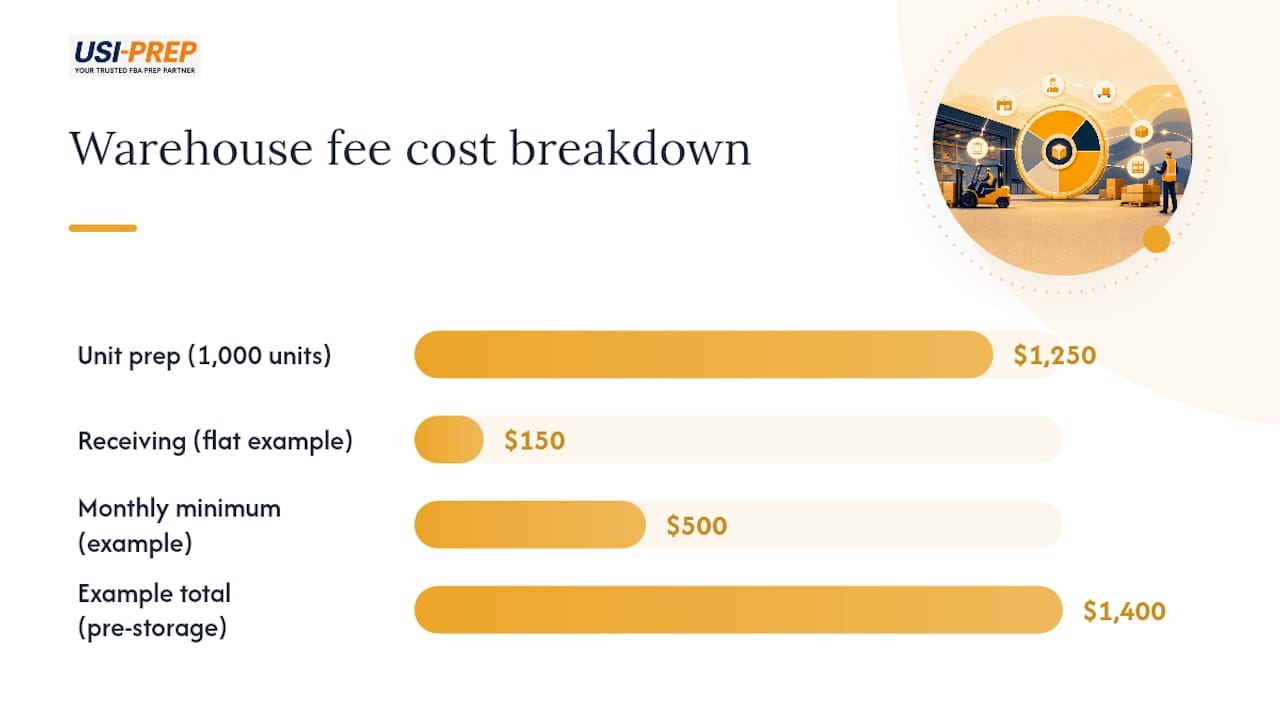
For pure prep work, per-unit fees typically run in the $0.75 to $2 range for standard items, while a full 3PL with storage and broader services often carries a monthly minimum, sometimes illustrated around $500, on top of usage fees.
A worked example: say you’re shipping 1,000 units of a standard, non-fragile SKU. At $1.25 per unit for prep and labeling, plus a flat $150 receiving fee, you’re looking at roughly $1,400 before storage. Add a month of staging at typical per-cubic-foot storage rates and you can model your break-even volume against your product’s margin. Sellers moving higher volume consistently find per-unit models beat subscription tiers, while low-volume sellers sometimes come out ahead on a flat monthly plan.
How Usiprep Solves the Post-2026 Prep Problem
Usiprep was built by former Amazon sellers who got burned by the exact problems this article describes: opaque pricing, slow check-ins, and prep centers that couldn’t explain their own error rates. The services map directly to the checklist above: FBA prep, inventory receiving, FNSKU labeling, kitting, long-term storage, and multi-channel fulfillment for Walmart, eBay, and TikTok Shop orders, all connected to your Seller Central account for real-time visibility.
The numbers back it up. Usiprep reports a very high on-time delivery rate, client-reported notable cost reductions on fulfillment spend, and processing speeds that have measurably cut check-in times for clients moving high volumes of FBA units. Every fee, from receiving to storage to prep, is itemized upfront so you know your cost per unit before you ship a single pallet.
Starting a pilot is simple: share your SKU details, typical monthly volume, and current pain points (usually check-in delays or unclear pricing), and onboarding for a first test shipment typically moves fast enough to have inventory flowing within days, not weeks. If you want the compliance side spelled out first, the FBA prep services guide covers exactly what Amazon now requires sellers to handle themselves.
How Long Does Receiving to FBA Check-In Actually Take?
Timelines vary by provider, but a realistic baseline runs like this: receiving and inspection typically takes one to two business days once your shipment hits the warehouse dock. Prep work, meaning labeling, poly-bagging, and kitting, adds another one to three days depending on unit complexity and volume. From there, the provider builds and submits your Amazon inbound shipment plan, and Amazon’s own check-in process takes over.

That last step is where seasonal variation hits hardest. During normal months, Amazon check-in can clear within a few days of a compliant shipment arriving. During Q4, especially the six weeks bracketing Black Friday and the holiday shopping window, check-in times stretch considerably as Amazon’s own fulfillment centers deal with volume surges across every seller account simultaneously.
The compounding risk: if your prep has any error, a missing FNSKU, a wrong poly bag, an unlabeled expiration date, that shipment doesn’t just get delayed. It gets pulled for correction, which during peak season can mean a multi-week wait to get rescheduled. This is exactly why building in buffer time matters more in October and November than in February.
Pro Tip: Plan your Q4 inventory to arrive at your prep center by early October. That buffer gives you room for one round of correction if something goes wrong, and still gets you into FBA well ahead of the holiday rush. Sellers who ship compliant, error-free cartons the first time consistently see faster check-ins regardless of season, which is the entire argument for outsourcing prep before volume peaks rather than after a shipment gets stuck.
Does Warehouse Location Affect Your Shipping Costs?
Yes, and it’s one of the most underrated variables in fulfillment cost. Where your prep center or 3PL sits geographically determines both how fast inventory reaches Amazon’s fulfillment network and how much you pay in inbound freight.
A warehouse positioned near major ports or a dense cluster of Amazon fulfillment centers cuts the distance your inventory has to travel twice: once from your supplier to the prep center, and again from the prep center to Amazon. Providers located near coastal import hubs typically see faster receiving-to-ready timelines for sellers importing from overseas, simply because the freight leg is shorter.
For sellers running multi-channel operations, particularly ones splitting inventory between Amazon FBA, Walmart, and a direct-to-consumer site, warehouse location also affects how quickly non-Amazon orders ship. A prep center centrally located relative to your customer base shortens transit times for pick-and-pack orders headed straight to a buyer’s door, not just inventory headed into FBA.
Ask any potential provider directly about their warehouse locations and how they route shipments to Amazon’s network. A provider with a single facility far from major ports or population centers might quote competitive per-unit prep fees but cost you more in freight and slower fulfillment on the back end. The trade-off between prep fees and shipping distance is one line item most sellers forget to model until their first freight invoice comes in higher than expected.
Amazon Warehouse Services vs. FBA: What’s the Real Difference?
FBA is Amazon’s own fulfillment network, and it does exactly one job extremely well: getting products from an Amazon warehouse to an Amazon customer’s door. What it doesn’t do is handle your inbound logistics, custom packaging, or non-Amazon orders. FBA’s workflows are standardized because they have to serve millions of sellers identically, which means there’s no flexibility for a seller who needs kitting, custom bundling, or multi-channel fulfillment.
This is exactly why most sophisticated sellers run both: FBA handles the Amazon-facing side, while a 3PL or prep center manages everything upstream, plus any order that isn’t an Amazon order. A hybrid stack like this avoids the trap of overpaying for FBA’s convenience on every single channel when only one channel actually benefits from it.
Other fulfillment options exist too, including self-fulfillment out of your own space or a dedicated DTC-only warehouse, but neither of those solves the FBA prep compliance problem this whole article is built around. Self-fulfillment means you’re the one applying FNSKU labels and poly bags, which is exactly the labor Amazon dropped in 2026. A prep center or 3PL is the only option that both satisfies Amazon’s compliance requirements and gives you the flexibility to fulfill Walmart, eBay, or TikTok Shop orders from the same inventory pool.
Can Prep Centers Handle a Q4-Sized Demand Spike?
Scalability separates the providers worth keeping from the ones that quietly fail you during your highest-revenue month. A prep center or 3PL built for Amazon sellers should be able to absorb a three to five times volume increase during October through December without your check-in times or error rates degrading.
The mechanics behind real scalability come down to a few things: flexible warehouse labor that can be scaled up temporarily, storage capacity that isn’t already maxed out during normal months, and a receiving process that doesn’t bottleneck when five pallets show up on the same day instead of one. Ask any provider directly what their peak-season staffing plan looks like, because a warehouse running at 90% capacity in September has no room left for your November surge.
Seasonal demand isn’t limited to Q4, either. A TikTok Shop viral moment or a Walmart promotional placement can spike your order volume with almost no warning, and a provider with rigid, manual processes will struggle to keep pace. This is where automated inventory tracking and real-time reporting genuinely pay for themselves: a provider that can see a demand spike coming through your Seller Central data can pre-position staff and pull from existing storage buffers instead of scrambling.
The providers worth your long-term business are the ones who can show you a track record of handling exactly this kind of surge, not just a promise that they “can scale.” Ask for a specific example of how they handled last year’s Q4 volume, including whether check-in times or error rates changed during that period.
What Insurance Covers Your Inventory in a Prep Warehouse?
Your inventory sitting in someone else’s warehouse is exposed to real risk: fire, theft, water damage, or simple handling errors that damage product before it ever reaches Amazon. Insurance coverage is one of the must-have flags mentioned earlier, and it deserves a closer look before you sign a contract.
Most reputable prep centers and 3PLs carry general liability insurance covering the physical warehouse facility, but that’s not automatically the same as coverage for the value of your specific inventory while it’s stored there. Ask directly whether the provider carries warehouse legal liability coverage or cargo insurance that protects your goods specifically, and get the coverage limits in writing rather than a verbal assurance.
The gap that catches sellers off guard: a provider’s general liability policy might cap out at a dollar figure well below the value of a full container of inventory sitting in their warehouse during peak season. If you’re shipping high-value goods, ask whether you need to carry supplemental cargo insurance on top of whatever the provider offers, and factor that cost into your overall unit economics.
Also worth clarifying: who’s liable if a labeling error on the provider’s side causes Amazon to reject a shipment, or if a poly-bagging mistake leads to a customer safety complaint? A transparent provider will spell out exactly where their liability starts and stops, and a provider who dodges the question outright is a red flag worth taking seriously, right alongside the pricing and traceability red flags covered earlier in this guide.
Where should sellers focus in the next 30 days?
Get compliant first, then run a small pilot before committing full volume. Send one SKU through receiving, prep, and FBA check-in this month, and centralize your inventory visibility before Q4 volume hits.
Start a Pilot Shipment With Usiprep
You’ve seen the alternatives: handling prep in-house, cobbling together a generic warehouse that’s never touched an FNSKU label, or gambling on a provider with no itemized pricing. Usiprep exists because its founders sold on Amazon themselves and got tired of exactly those problems.
A typical pilot starts small: one SKU, a few hundred units, run through receiving, prep, and FBA check-in so you can verify accuracy and turnaround before committing your full catalog. Onboarding usually moves fast, with most sellers shipping their first test batch within days of initial contact. Check the FBA prep requirements checklist for 2026 to see exactly what your inventory needs before it ships, then get in touch to start your pilot.
Sources
- Prep Center vs 3PL: Which One Does Your FBA Business Need? | Inventory Hero
- Amazon FBA vs. 3PL: Which to Choose? (2026 Guide)