
Per-unit 3PL pricing typically runs $0.25 to $0.75 for the first pick plus $0.25 to $0.50 for each additional unit, with pallet storage landing near a $20 median per month. Blend those line items across a real order profile and effective per-order costs range from roughly fourteen dollars at low volume down toward twelve dollars once you cross a few thousand orders a month. Run the exact math with your own numbers in the worked example below before you sign anything.
TL;DR:
- Fixed costs like minimum monthly fees and storage timing can significantly inflate per-unit costs, especially at low order volumes.
- Transparent, itemized invoicing helps identify hidden surcharges or markup layers, reducing overall fulfillment expenses.
- The actual cost per unit varies greatly depending on order size, shipping zones, and how storage fees are billed, making headline rates misleading.
- Scaling order volume from hundreds to thousands per month typically lowers the effective per-unit rate, with fixed costs becoming less impactful.
- Asking detailed questions about storage billing, surcharges, and carrier rates before signing contracts prevents unexpected inflation of fulfillment costs.
Table of Contents
- What Are the Main 3PL Pricing Models?
- What Fees Make Up a 3PL Invoice?
- How Do You Calculate Your Real Cost Per Unit?
- How Does Order Volume Change Your Effective Per-Unit Cost?
- What Should You Ask a 3PL Before Signing?
- Why Transparent Invoicing Actually Lowers Your Per-Unit Cost
- What the Per-Unit Number Actually Tells You
- Get a Transparent Per-Unit Quote From Usiprep
- Sources
What Are the Main 3PL Pricing Models?
Three pricing structures dominate the fulfillment industry, and picking the wrong one for your order profile is the fastest way to overpay without realizing it.
Per-order pricing charges a flat fee for each order regardless of how many units it contains. This works well if you sell mostly single-item orders, like a DTC brand shipping one shirt per box. Add a second or third unit to that order and the flat fee can start hiding real cost, because the 3PL absorbs (or quietly passes through) the extra picking labor.
Per-unit pricing charges separately for the first item picked and then a smaller fee for each additional unit in the same order. This model fits subscription boxes, kitted bundles, and any business where order size varies month to month. It’s also the model most sellers need to understand well, since it’s what “per unit 3PL pricing” actually refers to in most vendor quotes.
All-in (or blended) pricing wraps picking, packaging, and sometimes even a shipping allowance into a single number per order or per unit. It’s easier to budget against but harder to audit, since you can’t always tell which component moved when your invoice changes.
A fourth variant, cost-plus, passes through actual carrier and labor costs plus a fixed markup. According to WhiteBox’s breakdown of pricing models, no single structure is universally cheaper. The right fit depends on your order profile:
- Low-SKU DTC brands with mostly one-item orders usually do best on per-order pricing.
- Subscription boxes and kitted bundles with variable item counts need per-unit or itemized pricing to avoid subsidizing bigger orders.
- Replenishment and B2B accounts shipping palletized quantities often land on cost-plus or all-in structures tied to freight class.
Watch for bundled fees that make an all-in rate look cheaper than it is. A 3PL can quote an attractive blended per-unit number while quietly building in a shipping markup that only shows up once you compare your actual invoice against the quote.
What Fees Make Up a 3PL Invoice?
A 3PL invoice is really eight separate charges stacked together, and each one scales differently, some per unit, some per pallet, some per order. Knowing which is which lets you spot an inflated line before you sign a contract.
Receiving covers unloading and checking in inventory, usually billed per pallet, per carton, or per hour of labor. Storage is billed per pallet, per bin, or per cubic foot per month, with pallet storage carrying a median of $20 monthly according to the 3PL Pricing & Rates Guide. Pick and pack is the core per-unit fee: a first-pick charge plus a smaller per-additional-unit rate.
Beyond those three, five more categories round out most invoices:
- Packaging materials (boxes, mailers, dunnage), often $0.30 to $0.75 per order depending on box size and fill material.
- Shipping, which is usually pass-through carrier cost plus a handling markup, and typically the largest single line item.
- Returns processing, often billed as a percentage of order value plus a flat inspection or restocking fee.
- Account and technology fees, covering software integrations, EDI, and platform access, billed monthly regardless of volume.
- Projects and surcharges, catch-all charges for kitting, special labeling, peak-season surges, or oversized items.
Benchmark check: competitive quotes show a median order fee near $1.50, with first-pick fees ranging $1.30 to $1.80 and additional units at $0.25 to $0.50 each, based on the 3PL Pricing & Rates Guide. Separately, the GoBolt fees and rates guide puts per-unit ranges at $0.25 to $0.75 and per-pallet storage at $25 to $75 depending on services included.
Two billing traps deserve special attention. First, monthly minimums commonly range from several hundred to a few thousand dollars, per 3PLHub’s benchmark data, which can make your effective per-unit rate spike if you fall short of volume in a slow month. Second, month-start storage billing charges you for a full month of storage even if inventory arrives on the 28th, so ask exactly how the storage meter runs. Our own breakdown of fulfillment cost components for ecommerce digs deeper into how account and tech fees get layered on top of the picking rate.
How Do You Calculate Your Real Cost Per Unit?
The formula is simple even though the invoice rarely looks that way: total monthly 3PL cost equals the sum of every fee category minus any negotiated discounts. From there, divide two ways.
- Cost per order = total monthly cost ÷ monthly order count
- Cost per unit = total monthly cost ÷ monthly unit count
Before you can run either calculation, pull these inputs from your quote or invoice: receiving fees, storage charges, pick and pack rates (first pick plus additional unit), packaging cost per order, shipping cost per order, returns rate and fee, account and tech fees, and any surcharges from the prior month.
Here’s a worked example using typical assumptions drawn from the Freightwaves 3PL cost calculator methodology: first pick $2.75, additional unit $0.50, packaging $0.60, shipping $8.50, and returns running 8% of orders at $2.50 plus a $0.40 restock fee.

Cost per order here comes out to $13.39; cost per unit lands at $6.09 across 2,200 total units. If your quote lists a lower headline per-unit number, check whether shipping is bundled in or billed separately, because that’s usually where the gap hides.
If a quote leaves out storage terms, surcharge triggers, or a clear returns fee, treat that as an incomplete quote, not a favorable one. Ask for those numbers before comparing providers side by side.
How Does Order Volume Change Your Effective Per-Unit Cost?
Scale changes the math more than most sellers expect, and the difference between a 100-order month and a 10,000-order month often isn’t the per-unit rate itself. It’s which fee lines dominate the total.
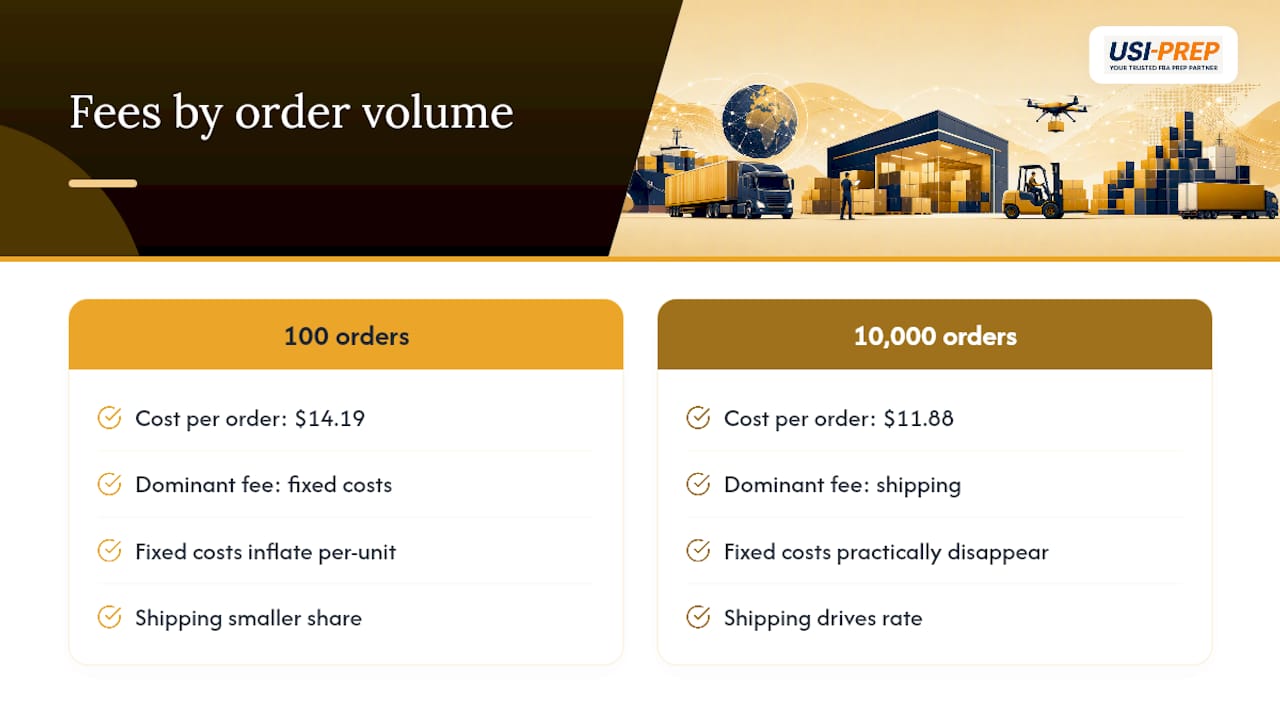
At low volume, fixed costs (account fees, monthly minimums) get spread across fewer orders, inflating the effective per-unit rate. At high volume, those same fixed costs practically disappear into the total, and shipping becomes the dominant line item.
These figures follow the calculator ranges from Freightwaves, which show cost per order falling from $14.19 at 100 orders to $11.88 at 10,000 orders under consistent assumptions.
Brands under 1,000 orders a month often pay roughly 60% more per order than brands shipping over 20,000 a month, according to 3PLHub’s volume benchmarks. That gap comes almost entirely from fixed costs and minimums, not from the 3PL charging small brands a higher per-unit rate outright.
Two variables move the needle fastest. Raise units per order (say, from 2.2 to 3.5 through bundling or kitting) and your per-order cost rises, but cost per unit usually drops, since the first-pick fee gets amortized across more items. Shift shipping zones, say from a regional carrier zone to cross-country, and shipping cost per order can jump by several dollars, which is often the single biggest swing factor in your effective rate. Our analysis of why fulfillment costs eat margins covers how these volume effects compound as brands scale past their first few thousand monthly orders.
What Should You Ask a 3PL Before Signing?
A quote is not a contract, and the gap between the two is where per-unit pricing quietly inflates. Before you sign anything, get clear answers on these points:
- How is storage billed? Ask whether it’s a daily average, a month-start snapshot, or a mid-month meter, since that alone can shift your effective cost by a full month’s charge.
- What triggers a surcharge? Get specifics on fuel surcharges, peak-season fees, and dimensional-weight adjustments rather than accepting “market rate” as an answer.
- What’s the chargeback policy for mis-picks, damaged inventory, or receiving discrepancies?
- Are there volume tiers that automatically lower your per-pick or per-pallet rate as orders scale?
- Is shipping pass-through or cost-plus, and can you see sample carrier rates for your top shipping zones?
Freight cost volatility has pushed some providers to bury markups inside surcharges rather than the headline rate, a pattern flagged in reporting on freight cost surges. That’s exactly why the surcharge question matters more than the base per-unit number.
Red flags worth walking away from: vague line items like “handling fee” with no defined scope, open-ended surcharge language with no cap, and monthly minimums that don’t scale down even after your first few months of proven volume. Our guide to hidden fees in fulfillment contracts breaks down more of these patterns in detail.
Pro Tip: Ask for carrier rate samples covering your five most common shipping zones and weight tiers, not just a single average shipping estimate. A blended average can mask a 3PL that’s expensive for exactly the zones you ship to most.
Why Transparent Invoicing Actually Lowers Your Per-Unit Cost
Every fee category above sounds abstract until you’re the one reconciling an invoice against a quote that didn’t match. Usiprep was built by former Amazon sellers who ran into exactly that mismatch, which is why itemized, transparent billing sits at the center of how the company prices receiving, storage, and pick and pack.
Faster inventory check-in doesn’t just speed up your timeline to sellable stock. It directly shrinks the storage window you’re billed for, since inventory that sits in receiving longer accrues storage charges before it’s even available to pick.
That connection between check-in speed and storage cost is easy to miss on a spec sheet, but it shows up directly on your invoice. Usiprep reports a 98.9% on-time delivery rate and has helped many client brands cut fulfillment costs by roughly 30%, results that trace back to check-in speed and line-item clarity rather than a lower headline rate alone.
What the Per-Unit Number Actually Tells You
Most sellers fixate on the headline per-unit rate because it’s the easiest number to compare across quotes. That’s a mistake. The rate itself tells you almost nothing until you multiply it by your actual units per order, your return rate, and your shipping zone mix, which is exactly why two 3PLs quoting the same $0.40 additional-unit fee can produce invoices $2 apart per order.
The bigger blind spot is storage timing. Sellers negotiate hard over the per-pick fee and barely glance at how storage gets metered, even though a month-start billing policy can quietly add a full month of pallet charges for inventory that arrived on the 27th. If you’re only comparing headline rates, you’re comparing the least volatile number on the invoice and ignoring the ones that actually move.
Run your own numbers before you compare vendors. The total cost of ownership framework applies here: the cheapest per-unit rate on paper can lose to a slightly higher rate that ships faster, damages less inventory, and bills storage honestly. Prioritize getting a real quote with every line item spelled out before you let a single per-unit number decide anything.
— Akbar
Get a Transparent Per-Unit Quote From Usiprep
If the fee breakdown above left you wondering how your current 3PL quote actually stacks up, Usiprep’s pricing is built to answer that question directly, itemized by receiving, storage, pick and pack, and shipping rather than buried in a blended rate. Sellers switching from opaque providers often find the real savings show up in faster check-in and clearer invoicing, not just a lower sticker price, which lines up with the 30% average cost reduction and 98.9% on-time delivery rate many client brands report.

If you’re an Amazon seller specifically, the FBA Prep Requirements Checklist walks through exactly what a compliant, cost-efficient prep workflow looks like before you ship inventory in. For a direct comparison against your current invoice, request a tailored pricing quote and see where the per-unit math actually lands for your order volume.
Sources
- How To Calculate 3PL Costs in 2026: Formula, Fees, and Calculator – Freightwaves Checkpoint
- 3PL Pricing & Rates Guide
- 3PL Pricing Models Explained: Per-Order, Per-Unit and All-In – WhiteBox
- Total cost of ownership (TCO) – Gartner