
Oversize fees hit the moment your packaged item breaks Amazon’s Standard-size limits, and the two charges that actually move your margins are the tiered fulfillment fee and monthly storage. A product that costs $3.50 to fulfill as Standard can jump to $8–$12 once it crosses into an oversize tier, and 2026 added a new wrinkle: a fuel and logistics surcharge applied as a percentage atop the fulfillment fee, plus a reported Overmax charge for dimensional outliers running roughly $17 to $25 per unit.
If you sell anything bulky, this is the fee category most likely to quietly wreck your unit economics. The good news is that it’s entirely calculable. You don’t need to guess.
Here’s what determines whether you pay Standard rates or oversize rates, and what actually drives the total:
- Classification: packaged length, girth (L + 2W + 2H), and weight all have to fit inside Standard limits, or the unit gets bumped to Oversize.
- Fulfillment fee: charged per tier (large bulky, extra-large) using whichever is higher, actual weight or dimensional weight.
- Monthly storage: billed per cubic foot, with steeper rates in October through December.
- 2026 surcharges: the 3.5% fuel/logistics add-on and the Overmax fee for units that blow past standard oversize dimensions.
Measure your packaged dimensions today and run the DIM weight calculation before you send another shipment. It’s the single fastest way to catch a fee problem before it eats your margin.
TL;DR:
- Packaging dimensions and weight must stay within the standardized size thresholds; exceeding any single limit automatically shifts the product into oversize categories.
- Moving from Standard to Oversize classification can increase fulfillment costs by up to 200%, influenced by dimensional weight, actual weight, and tier-specific base fees.
- The 2026 surcharges include a 3.5% fuel and logistics fee and a separate Overmax fee of $17 to $25 for dimensional outliers, raising overall costs.
- Storage fees accumulate quickly for bulky SKUs that sit unsold longer, especially during peak months, and long-term penalties further escalate expenses.
- Small packaging adjustments, such as resizing boxes or reducing void fill, often provide the highest return on cost reduction and should be your first focus for cost control.
Table of Contents
- What Are the FBA Oversize Fees and Size Thresholds?
- How Much Do FBA Fulfillment Fees Cost by Oversize Tier?
- How Do You Calculate FBA Fulfillment Fees for Oversize Items?
- What Are Amazon’s Monthly Storage Fees for Oversize Items?
- What Other Surcharges and Handling Fees Apply to Oversize Units?
- How Do You Estimate Total FBA Costs for an Oversize Product?
- How Can You Reduce or Avoid Oversize Fees?
- How Usiprep Helps Lower Oversize and Fulfillment Costs
- Key Takeaways
- Why Calculation Beats Guesswork on Oversize Fees
- Sources
What Are the FBA Oversize Fees and Size Thresholds?
Amazon decides your fee tier using three measurements taken on the packaged unit, not the bare product: longest side, median side, shortest side, and length-plus-girth (L + 2W + 2H). Weight is the fourth gate. Cross any single one of these limits and the whole unit gets reclassified, even if everything else about it looks Standard.
A typical Standard-size ceiling looks like this: longest side no more than 18 inches, median side no more than 14 inches, shortest side no more than 8 inches, and weight capped around 20 pounds, with L+G limits that vary by category. Go a half-inch over on any dimension, or add an extra layer of bubble wrap that tips the weight over the line, and you’re paying oversize rates on a product you priced as Standard.
The oversize subtiers, roughly ordered by cost
- Small oversize — modest size or weight overage, the mildest tier and the easiest to slip into without noticing.
- Medium oversize — larger dimensions or heavier weight, typically furniture-adjacent or bulky home goods.
- Large bulky — big, awkward items where at least one dimension is substantial even if the item isn’t especially heavy.
- Extra-large — the top tier, which itself splits into weight bands, with a distinct threshold once a unit crosses 150 pounds.
Weight has its own separate escalation. Once a unit gets heavy enough, Amazon requires special inbound handling labels: Team Lift for items that need two people to move safely, and Mech Lift for anything that requires equipment like a pallet jack or forklift. Miss the label and fulfillment centers can refuse the shipment or bounce it back for relabeling, which stalls your inventory and adds unplanned transit time.
Pro Tip: Weigh and measure the fully packaged unit, including any dunnage or void fill, not the bare product spec sheet. Sellers consistently underestimate packaged weight because they measure the item alone and forget the box, tape, and protective material adds real ounces.
How Much Do FBA Fulfillment Fees Cost by Oversize Tier?
Oversize fulfillment fees follow a base-plus-increment structure: a flat charge for the tier, then additional per-pound charges once you cross a weight breakpoint within that tier. Large bulky and extra-large items carry meaningfully higher base fees than anything in the Standard-size categories, and the per-pound adders compound fast on heavier SKUs.
Published fee-breakdown tables show the pattern clearly even before you get into exact dollar figures: base fees step up at each tier boundary, and every pound above the tier’s included weight allowance adds a fixed per-pound charge on top. A 15 pound large bulky item and a 45 pound large bulky item are not close in fulfillment cost, even though both sit in the same size tier.
What actually surprises most sellers is how small a dimensional nudge has to be before it triggers a full tier jump.
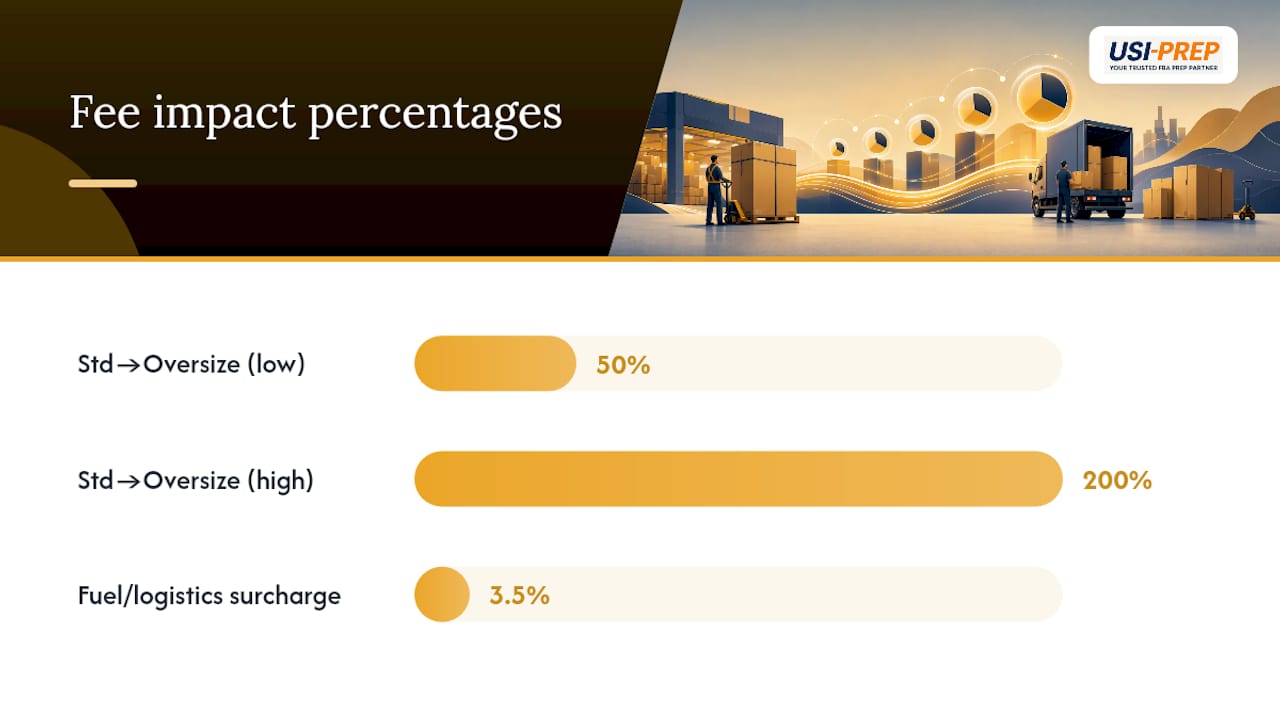
The math that matters: moving from Standard to Oversize classification can raise per-unit fulfillment cost by 50% to 200%, depending on which oversize subtier you land in and how much the weight increment adds on top of the base fee.
Three things determine your final oversize fulfillment fee for 2026:
- Base tier fee — set by which oversize subtier your packaged dimensions and weight land in.
- Per-pound increment — additional charge for every pound (or partial pound) above the tier’s base weight allowance.
- 3.5% fuel/logistics surcharge — applied on top of the calculated fulfillment fee across FBA and multi-channel fulfillment orders, effective in 2026.
- Overmax surcharge — a separate charge, reported in the $17–$25 range, that applies specifically to dimensional outliers that exceed even the extra-large tier’s normal bounds.
Dimensional weight is where this gets genuinely tricky. Amazon calculates DIM weight by multiplying length times width times height (in inches) and dividing by a standard divisor, then compares that number against the item’s actual scale weight. Whichever is higher becomes your billable weight. A large, light item like a beach umbrella or a foam pool float can have a DIM weight far above its actual weight, and Amazon bills the higher number every time. That’s the mechanism that quietly inflates fulfillment costs on anything bulky but light, and it’s exactly why two products with identical actual weight can carry very different fulfillment fees.
Industry coverage of the 2026 fee changes keeps circling back to the same warning: DIM-weight interactions and Overmax outliers are now the most common source of a seller opening their monthly statement and finding a fee bigger than expected. If you haven’t recalculated billable weight on your bulky SKUs since last year’s packaging redesign, that’s worth doing this week.
How Do You Calculate FBA Fulfillment Fees for Oversize Items?
Here’s the actual math, step by step, so you can run it on your own SKUs instead of trusting a vague estimate.
The DIM weight formula:
Length (in) × Width (in) × Height (in) ÷ 139 = Dimensional weight in pounds
Amazon then compares DIM weight to actual scale weight and bills whichever is higher. That single comparison is the crux of the entire oversize fee structure.
- Measure the fully packaged item’s length, width, and height in inches.
- Multiply the three dimensions together, then divide by 139 to get DIM weight.
- Weigh the packaged item on a scale to get actual weight.
- Compare the two numbers. The higher one is your billable weight.
- Find the fee tier and base charge that matches your billable weight and size classification.
- Add per-pound increments for any weight above the tier’s included allowance.
- Add the 3.5% fuel/logistics surcharge to the subtotal.
Example A: large but light. A packaged inflatable kayak measures 24" × 18" × 8". DIM weight comes out to (24 × 18 × 8) ÷ 139, or roughly 25 pounds. The actual scale weight is only 14 pounds. Because DIM weight is higher, Amazon bills the unit at 25 pounds, not 14, pushing it into a higher fee band than the physical weight alone would suggest.
Example B: compact but heavy. A packaged cast-iron plant stand measures 14" × 12" × 10", giving a DIM weight of around 12 pounds. But it actually weighs 32 pounds on the scale. Here, actual weight wins, and Amazon bills at 32 pounds regardless of the compact footprint.
| SKU example | Dimensions (packaged) | DIM weight | Actual weight | Billable weight | Cost driver |
|---|---|---|---|---|---|
| Inflatable kayak | 24" × 18" × 8" | ~25 lb | 14 lb | 25 lb | Dimensional weight |
| Cast-iron plant stand | 14" × 12" × 10" | ~12 lb | 32 lb | 32 lb | Actual weight |
If the kayak’s base large-bulky fee before surcharge lands around $9.50, the surcharge adds roughly $0.33, bringing the total fulfillment fee to about $9.83 per unit. Run both directions of this calculation on every bulky SKU before you assume you know which number is driving your cost.
What Are Amazon’s Monthly Storage Fees for Oversize Items?
Storage fees for oversize inventory are billed per cubic foot, calculated by multiplying the item’s packaged length, width, and height in feet (not inches) and charging monthly based on your average daily inventory volume for that SKU. Rates step up seasonally, with October through December typically priced higher than January through September to reflect peak holiday warehouse demand.
A single large item sitting on the shelf for one month is a manageable line item. The real damage comes from oversize SKUs that don’t sell through fast enough, because cubic footage times a higher per-unit rate times several months adds up quickly on furniture, exercise equipment, and anything else with real bulk.
Two consequences compound the base storage rate:
- Storage-utilization surcharge: applied when your overall account inventory volume relative to your sales rate crosses certain thresholds, penalizing sellers who hold too much slow-moving stock relative to how fast it’s selling.
- Aged inventory / long-term storage fees: triggered once units sit in a fulfillment center beyond a set number of days, and these charges apply on top of, not instead of, standard monthly storage.
A single oversize SKU stored for one month might run a modest per-unit storage charge. Leave that same unit sitting for six months without a sales velocity to justify the space, and the seasonal rate bump in Q4 plus long-term storage penalties can multiply that cost several times over.
Run the math before peak season, not during it. A detailed breakdown of how storage fees are calculated month to month makes it easier to spot which SKUs are quietly bleeding cash on the shelf.
What Other Surcharges and Handling Fees Apply to Oversize Units?
Beyond the base fulfillment fee, oversize inventory carries a handful of situational charges that can spike a single shipment’s cost without warning.
- Overmax surcharge: reported in the $17 to $25 range for 2026, applied to units that exceed even extra-large tier dimensions, essentially a penalty for genuinely oversized outliers.
- Team Lift labeling: required once a unit’s weight crosses the threshold needing two-person handling; missing the label risks refusal at the fulfillment center.
- Mech Lift labeling: required for units heavy enough to need equipment like a pallet jack; fulfillment centers can bounce shipments that arrive unlabeled or reschedule the receiving appointment entirely.
- Inbound placement fees: charged when Amazon splits your shipment across multiple fulfillment centers instead of a single location, which happens more often with bulky inventory.
- Returns handling: oversize returns typically cost more to process and restock than Standard-size returns, and damaged bulky items are more likely to be written off rather than resold.
Pro Tip: Check your labeling requirements in Seller Central before you finalize packaging design, not after. A Team Lift or Mech Lift label that gets missed at the warehouse door doesn’t just cost you the surcharge, it costs you the appointment slot and pushes your inbound date back, sometimes by a week or more.
How Do You Estimate Total FBA Costs for an Oversize Product?
Run this checklist before you send inventory, not after you get the invoice:
- Referral fee — Amazon’s category-based percentage of your sale price.
- Fulfillment fee — base tier fee plus per-pound increments on billable weight.
- Fuel/logistics surcharge — 3.5% applied to the fulfillment fee subtotal.
- Overmax surcharge — add $17 to $25 if the unit qualifies as a dimensional outlier.
- Monthly storage — cubic feet times the current per-cubic-foot rate for that month.
- Inbound prep and placement — labeling, polybagging, and any split-shipment fees.
- Returns reserve — a per-unit estimate based on your category’s typical return rate.
The one-line version: Total per-unit cost = Referral fee + Fulfillment fee (with surcharges) + Prorated monthly storage + Prep/inbound costs + Returns reserve.
For the kayak example above, that might look like a $9.83 fulfillment fee, roughly $0.60 in prorated monthly storage, a $1.50 referral fee on a modest price point, and $0.75 in prep and reserve costs, landing total per-unit cost somewhere near $12.68 before you’ve even priced in profit margin.
Verify every rate against current Seller Central fee schedules before finalizing pricing, and use a DIM-capable oversize calculator to sanity-check your own math against published numbers.
How Can You Reduce or Avoid Oversize Fees?
Packaging engineering is the single highest-return move available to most sellers, because small changes in dimensions determine tier classification more often than the product itself does. An extra inch of void fill, a slightly larger box than necessary, or packing material that adds a few ounces can be the entire difference between Standard rates and oversize rates on a product that didn’t need to change at all.
Start here, roughly in order of ease and payoff:
- Right-size the box. Measure the smallest box that safely fits the product and use it, instead of defaulting to whatever carton is on hand. This is the fastest fix and it’s usually free.
- Reduce packaging weight. Swap heavy void fill for lighter alternatives, and weigh the finished package, not just the product, before finalizing your spec.
- Repack or unbundle multi-packs. A bundled kit that trips into oversize as a single unit might sell just as well split into two Standard-size listings, especially if the bundle wasn’t driving a meaningful price premium anyway.
- Reconsider orientation. Some products can be packed on a different axis, folded, or nested to shave a critical dimension below the Standard-size threshold.
- Switch to polybags where safe. For soft goods and anything that doesn’t need rigid protection, polybagging instead of boxing can cut both dimensional footprint and weight.
Beyond packaging, the operational side matters just as much. Getting inventory checked in accurately and quickly reduces the number of days a unit sits accruing storage charges, and errors in dimensional data at receiving are a common reason sellers get billed at a higher tier than their actual packaging justifies. Working with a 3PL that specializes in accurate FBA prep closes that gap, because dimensioning gets verified before the unit ever ships to Amazon, not discovered after the fee already posted.
For genuinely low-margin, bulky SKUs, it’s also worth running the numbers on alternative fulfillment entirely. Some oversized products simply don’t pencil out through FBA once storage and fulfillment fees are stacked together, and a hybrid approach, using Amazon for your compact, fast-moving SKUs while routing bulky items through a different channel, can protect margin without pulling the product from your catalog altogether. Reviewing your FBA packaging requirements against your current SKU lineup is a reasonable first pass before making that call.

Pro Tip: Audit your top 10 SKUs by unit volume for dimensional risk first. That’s usually where the fee savings from a packaging change compound the fastest, since you’re multiplying a small per-unit savings across your highest-volume products.
How Usiprep Helps Lower Oversize and Fulfillment Costs
Usiprep works directly on the operational side of this problem: getting packaging right and inventory checked in accurately before oversize fees ever get the chance to apply. Founded by former Amazon sellers, the company built its prep process around the exact pain points that generate surprise oversize charges, imprecise dimensioning, slow check-ins, and packaging that wasn’t tested against Amazon’s actual thresholds before shipping.
Services that address oversize risk directly include:
- Packaging optimization during prep, catching dimensional overages before units ship to a fulfillment center.
- Accurate, fast inventory check-in, reducing the days a unit sits accruing storage charges.
- Prep checklists built around current Amazon size and labeling requirements, including Team Lift and Mech Lift compliance.
- Dimensional governance across your catalog, flagging SKUs that sit close to a tier threshold before a packaging change pushes them over it.
Usiprep reports a 98.9% on-time delivery rate and clients seeing up to a 30% reduction in fulfillment costs, figures worth validating against your own catalog with a small pilot rather than taking on faith. Start with a repack run on one or two borderline SKUs, measure the fee difference on your next statement, then scale from there.
If you’re ready to see what accurate prep does to your fee exposure, the FBA prep requirements checklist is the practical next step.
Key Takeaways
Oversize fees are driven primarily by three levers: packaged dimensions and weight, monthly storage duration, and 2026’s added fuel and Overmax surcharges.
| Point | Details |
|---|---|
| Classification is dimension-driven | Breaching longest side, girth, or weight limits on the packaged unit triggers oversize rates regardless of the product itself. |
| Billable weight uses the higher number | Compare DIM weight (L×W×H÷139) against actual weight; Amazon always bills whichever is greater. |
| 2026 added two new surcharges | A 3.5% fuel/logistics fee applies to all fulfillment fees, and Overmax outliers face a separate $17–$25 charge. |
| Storage cost compounds with time | Per-cubic-foot rates rise in Q4, and aged inventory triggers additional long-term storage penalties. |
| Packaging changes are the fastest fix | Right-sizing boxes and reducing packaging weight often moves a SKU back into Standard-size pricing. |
Why Calculation Beats Guesswork on Oversize Fees
Most advice on oversize fees stops at “measure your product,” which is true but useless without the actual math behind it. The sellers who avoid margin surprises aren’t the ones who vaguely know oversize costs more. They’re the ones who run the DIM weight formula on every SKU, know their billable weight before they ship, and check that number against current Seller Central rates instead of a fee table from two years ago.
The conventional wisdom also underweights how much the 2026 changes shifted the math. What sellers should prioritize first isn’t a dramatic sourcing change. It’s a dimensional audit of their current catalog, this week, before another shipment goes out priced on assumptions instead of numbers.
— Akbar
Sources
- Amazon FBA Oversize Calculator — Check Size Tier & Surcharges | LogisticsCalc
- Warehousingcosts
- Amazon FBA Fees: Complete Breakdown (2026) | True Margin
- Amazon Seller Central measurement and fee guidance