
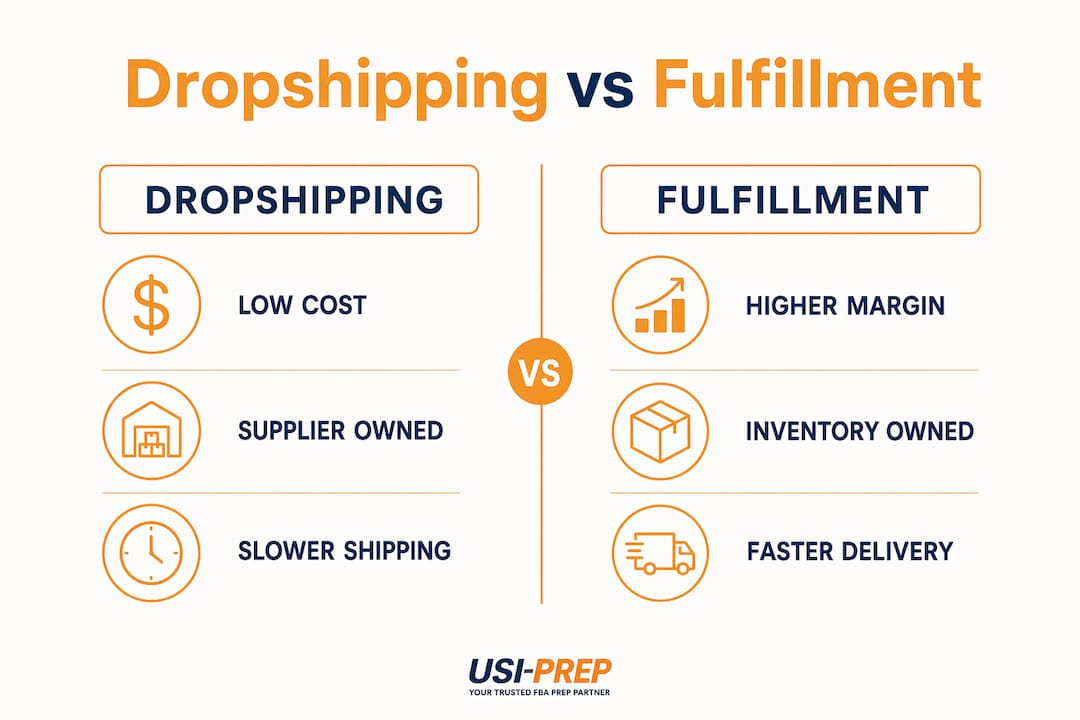
The single biggest difference between dropshipping and fulfillment is inventory ownership: in dropshipping, the supplier owns and ships the stock; in fulfillment, you own the inventory and control how it moves to the customer. If you’re testing a new product with limited capital, dropshipping gets you to market fast. If you’re building a brand that customers return to, fulfillment, whether in-house, through a 3PL, or via FBA prep, is where the real leverage lives.
Quick trade-off summary:
- Upfront cost: Dropshipping requires near-zero inventory investment; fulfillment requires buying stock in advance.
- Control: Dropshipping hands control to the supplier; fulfillment keeps branding, packaging, and quality in your hands.
- Speed: U.S.-based fulfillment centers ship faster and more predictably than most dropshipping suppliers.
- Margins: Dropshipping margins are often thinner because the supplier includes warehousing and logistics costs in the unit price.
- Risk: Dropshipping carries almost no inventory risk; fulfillment exposes you to unsold stock.
TL;DR next steps:
- Testing a new product? Start with dropshipping to validate demand before committing capital.
- Scaling a proven SKU? Move to fulfillment for better margins, faster shipping, and brand control.
- Unsure? Use the decision checklist in Section 8 to map your situation.
Table of Contents
- How dropshipping vs fulfillment actually compare, side by side
- How dropshipping works: the order flow, real costs, and what goes wrong
- What order fulfillment means and the four variants you can use
- Cost and cash flow: what each model actually costs you
- How your fulfillment choice shapes the customer experience
- Risks and red flags to watch before you commit to either model
- How to choose: a decision checklist and simple matrix
- If you choose U.S.-based fulfillment: how Usiprep approaches it
- Key Takeaways
- The model switch most sellers make too late
- Usiprep handles the fulfillment side so you can focus on selling
- Useful sources and further reading
How dropshipping vs fulfillment actually compare, side by side
| Dimension | Dropshipping | Fulfillment (in-house / 3PL / FBA prep) |
|---|---|---|
| Upfront cost / startup capital | Near zero; no inventory purchase | Moderate to high; inventory buy-in required |
| Inventory risk | None; supplier holds stock | You absorb unsold stock risk |
| Control over branding / unboxing | Minimal; supplier ships plain packaging | Full; custom boxes, inserts, kitting |
| Shipping speed | Slower; often extended due to overseas suppliers | Faster; U.S.-based stock ships in 1–3 days |
| Quality control & returns | Hard to inspect; returns go back to supplier | You set QC standards; returns managed in-house or by 3PL |
| Margins & fees | Lower; supplier premium built into unit cost | Higher potential; bulk discounts offset storage fees |
| Scalability | Easy to add SKUs; hard to differentiate | Scales with capital; strong brand differentiation |
| Best for | Beginners, product testing, broad catalog | Growing brands, repeat-purchase products, Amazon FBA |
How dropshipping works: the order flow, real costs, and what goes wrong
Dropshipping separates sales from fulfillment: you market and sell the product, a third-party supplier stocks and ships it. The customer never knows the difference, but the operational reality behind the scenes is very different from owning your own inventory.
The step-by-step order flow
- A customer places an order on your store and pays the retail price.
- Your store (manually or via automation) forwards the order details to your supplier.
- The supplier picks, packs, and ships the item directly to the customer, sometimes under your brand name via blind or private-label shipping.
- You keep the difference between what the customer paid and what the supplier charged you, minus platform and marketing fees.
Types of dropshipping partners
- Manufacturer: You buy direct; best margins, but minimum order requirements can apply even in dropship arrangements.
- Wholesaler: Middle layer; broader catalog, slightly higher unit cost than manufacturer direct.
- Dedicated dropshipper: Platforms built specifically for the model; easy integration, but many sellers use the same catalog, which compresses prices.
- Marketplace arbitrage: Buying from one marketplace and shipping to a customer on another. This is the riskiest method and the one most likely to get your account suspended.
Pros and cons
Pros:
- Low upfront capital; no warehouse, no bulk purchase
- Fast product testing; list a new SKU in hours
- Broad catalog without storage constraints
Cons:
- Lower margins; the supplier’s warehousing cost is priced into every unit
- Shipping times outside your control, especially with overseas suppliers
- Packaging is usually plain; branded unboxing is rarely possible
- Returns are complicated; the customer contacts you, but the product goes back to a supplier you may not have a tight SLA with
- Dropshipping is not passive income; you still own marketing, customer service, and supplier management
Typical cost areas to plan for
- Per-unit supplier cost (includes their warehousing and logistics markup)
- Shipping fees (often passed through at cost, sometimes with a handling surcharge)
- Marketplace or platform fees (Shopify subscription, Amazon referral fees, etc.)
- Customer acquisition costs, which tend to be the biggest expense in a dropshipping business
- Returns handling and refund costs when the supplier’s quality falls short
Pro Tip: Before committing to a supplier, place three test orders under a fake customer name. Check packaging quality, actual shipping time, and whether tracking updates are accurate. What you see in those three orders is what your customers will see.
Marketplace arbitrage, where a seller fulfills an order by purchasing from another online marketplace and shipping it to the customer, can violate platform terms of service and result in account suspension. Validate your supplier’s sourcing method before you list a single product.
What order fulfillment means and the four variants you can use
Order fulfillment is the complete lifecycle from the moment a customer clicks “buy” to the moment the package lands at their door, including receiving inventory, storage, pick-and-pack, shipping, and returns processing. It is not a single thing; it is a set of operational tasks that can be handled several different ways depending on your business size and goals.
The four main fulfillment variants
1. Self-fulfillment (merchant-operated)
You receive inventory at your own location, store it, pick and pack orders yourself, and hand them off to a carrier. Works well when order volume is low and you want maximum control. The ceiling is your own time and space.
2. Third-party logistics (3PL / outsourced fulfillment)
You own the inventory; a 3PL partner handles receiving, storage, pick-and-pack, and shipping from their warehouse. You pay per-order handling fees and storage fees. This is the most common scale-up path for U.S. e-commerce brands. For a deeper look at how to evaluate these partners, the 3PL provider guide from Usiprep covers the key integration criteria.
3. Direct fulfillment (manufacturer ships brand-owned product)
The manufacturer ships under your brand, but you own the inventory and set the terms. Closer to dropshipping operationally, but you control pricing, packaging specs, and quality standards because you own the product.
4. FBA prep services
You send inventory to a prep center that inspects, labels, kits, and packages it to Amazon’s exact specifications before forwarding it to an Amazon fulfillment center. The prep step is critical; Amazon rejects non-compliant shipments, which delays your inventory and costs money.
Pros and cons by variant
| Variant | Pros | Cons |
|---|---|---|
| Self-fulfillment | Full control, no 3PL fees | Time-intensive, doesn’t scale |
| 3PL / outsourced | Scalable, faster shipping, branded packaging | Monthly/per-order fees, requires integration |
| Direct fulfillment | Brand control with manufacturer efficiency | Requires strong supplier relationship |
| FBA prep | Access to Amazon Prime badge, fast delivery | Strict compliance requirements, prep fees |
Technology that keeps fulfillment running
Most growing sellers rely on an order management system (OMS) to route orders and a warehouse management system (WMS) to track inventory locations and picking accuracy. Carrier integrations, typically built into the OMS or the 3PL’s platform, automate label generation and rate shopping. OMS and WMS tools reduce picking errors and give you visibility across inventory locations, which matters more as SKU count grows. For sellers managing product listings alongside their fulfillment setup, a tool like MerchUp can speed up product description creation when you’re adding new SKUs to your catalog.
Cost and cash flow: what each model actually costs you
The financial gap between dropshipping and fulfillment is widest at the start and narrows as volume grows. Here is where the money goes in each model.
Upfront capital requirements
- Dropshipping: No inventory purchase. Your startup costs are a storefront (Shopify starts at $39/month), marketing spend, and any app subscriptions. You can be live with minimal startup costs.
- Fulfillment: You buy inventory before you sell it. Add storage fees, inbound shipping to the warehouse, and any prep costs. An initial inventory purchase can require several thousand dollars before any sales are made.
Per-order economics: a mini example
Assume you sell a $45 phone case.
| Cost item | Dropshipping | Owned-inventory fulfillment |
|---|---|---|
| Unit cost (supplier / landed) | — | $8 (bulk purchase, no markup) |
| Outbound shipping | — | $6 (carrier cost) |
| Platform / referral fee | $4 | $4 |
| Storage fee (monthly, per unit) | — | —.50 |
The fulfillment model yields roughly 17 more gross margin dollars per unit on the same $45 sale. That gap funds better packaging, faster shipping, and customer acquisition at scale. Buying inventory in bulk reduces per-unit cost but creates storage costs and exposure to unsold stock, so the math only works if your sell-through rate is solid.
Cash flow timing
Dropshipping has a structural cash flow advantage: the customer pays you before you pay the supplier, so you operate with negative working capital. Fulfillment inverts that. You buy inventory weeks or months before it sells, tying up cash. A $10,000 inventory buy might sit in a warehouse for 60 days before it converts to revenue. Plan your working capital accordingly, especially around peak seasons when reorder cycles compress.
How your fulfillment choice shapes the customer experience
Order fulfillment is an extension of customer service: every failure in picking, packing, or shipping shows up as a negative review, a refund request, or a customer who never comes back. The model you choose determines how much of that experience you actually control.

Shipping speed and predictability
Dropshipping from overseas suppliers commonly produces delivery windows of 10–30 days. That was tolerable in 2015; today’s customer, conditioned by two-day delivery expectations, reads a 15-day shipping estimate as a red flag. U.S.-based fulfillment centers ship most domestic orders much faster than typical dropshipping suppliers, which directly affects conversion rates and repeat purchase likelihood. Fast fulfillment also reduces costs by cutting the volume of “where is my order” support tickets and return requests driven by impatience.
Packaging, unboxing, and brand loyalty
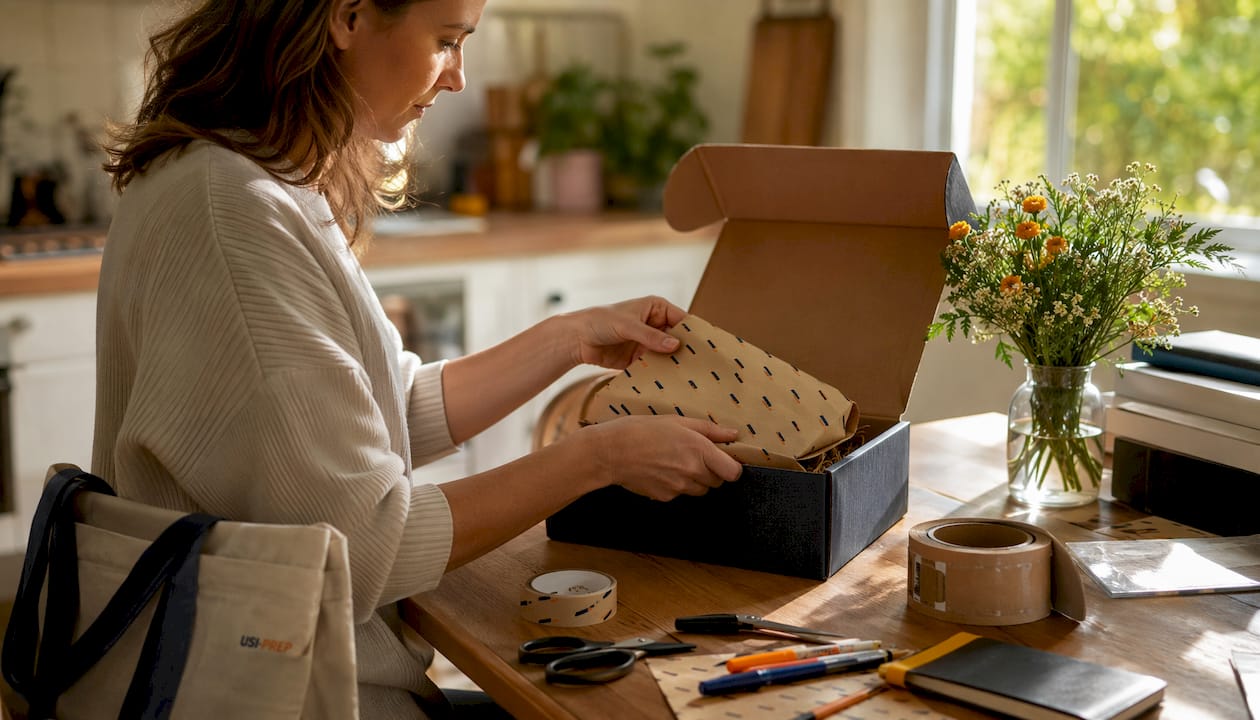
Branded unboxing is straightforward when you own inventory or work with a vetted 3PL: custom boxes, tissue paper, thank-you inserts, discount cards, and kitting are all on the table. With most dropshipping suppliers, customers receive plain packaging with no indication of your brand. That single detail materially reduces repeat-purchase rates because there is nothing in the box to remind the customer who sold it to them.
Pro Tip: If you’re dropshipping and can’t control the outer box, at minimum negotiate with your supplier to include a plain insert card with your store’s name and a QR code to your site. It costs pennies and keeps your brand in the customer’s hands.
Quality control and returns: a vetting checklist
Use this checklist when evaluating a supplier or a 3PL:
- Does the supplier allow pre-shipment sample inspections?
- What is the stated defect rate, and how are defective units handled?
- Who pays return shipping on defective items?
- Does the 3PL provide real-time inventory accuracy reporting?
- What is the SLA for processing inbound returns and restocking?
- Are returns inspected and graded before being relisted?
- Does the partner carry liability insurance for lost or damaged inventory?
Risks and red flags to watch before you commit to either model
Both models have failure modes that are predictable and avoidable if you know what to look for.
Dropshipping red flags
- Supplier lists products as “in stock” without real-time inventory data; back-orders appear after the customer has already paid.
- No tracking updates after shipment, or tracking numbers that don’t resolve in carrier systems.
- Supplier sources from another marketplace to fulfill your orders. This violates eBay’s terms of service and similar platform policies, and can result in account suspension.
- Return policy is vague or requires the customer to ship internationally at their own cost.
- Quality inconsistency across batches; the sample you approved looks nothing like what customers receive.
3PL red flags
- Fee schedules with vague line items (“handling surcharges,” “special project fees”) that aren’t defined in the contract.
- No published SLA for on-time shipment rate or inventory accuracy.
- Weak or no integration with your sales channels (Shopify, Amazon, WooCommerce); manual order entry at scale is an error factory.
- No real-time inventory dashboard; you find out about stockouts when customers complain.
- Poor inbound receiving speed; inventory sits unprocessed for days after it arrives at the warehouse.
Legal and tax considerations in the U.S.
Sales tax nexus rules in the U.S. are complex for both models: as the seller of record, you are generally responsible for collecting and remitting sales tax in states where you have nexus, regardless of whether a 3PL or a dropshipping supplier physically ships the order. Consult a U.S. sales tax specialist or a platform like TaxJar or Avalara to map your nexus obligations before you scale.
Mitigation steps
- Place test orders before going live with any supplier or 3PL.
- Request a sample inspection policy in writing.
- Negotiate SLAs with financial penalties for missed targets.
- Reconcile inventory counts monthly against your OMS records.
- Verify the 3PL carries cargo insurance and understand the claims process.
- Check platform terms of service for any dropshipping restrictions before listing.
How to choose: a decision checklist and simple matrix
Work through these questions before picking a model. Honest answers here save months of operational pain.
Questions to ask yourself
- Budget: Can you commit $3,000 or more to inventory before your first sale?
- Product certainty: Do you know this SKU will sell, or are you still testing?
- Delivery speed: Does your target customer expect 2-day shipping, or is a week acceptable?
- Brand importance: Is the unboxing experience part of your brand promise?
- Margin goals: Can your business model survive a 40–45% gross margin, or do you need 55%+?
- Return volume: Are you prepared to manage returns directly, or do you need a partner to handle them?
- Scale timeline: Are you planning to grow to 500+ orders per month within 12 months?
Questions to ask suppliers and 3PLs
- What is your on-time shipment rate, and do you have a written SLA?
- What integrations do you support (Shopify, Amazon, WooCommerce, EDI)?
- How do you handle returns, and what is the restocking turnaround?
- Do you allow sample orders or pre-shipment inspections?
- What are all the fees, including receiving, storage, pick-and-pack, and special projects?
Decision matrix
| Business goal | Dropshipping | Fulfillment (3PL / FBA prep) |
|---|---|---|
| Validate a new product with minimal risk | ✓ Better fit | — |
| Build a recognizable brand with repeat buyers | — | ✓ Better fit |
| Launch quickly with minimal upfront capital | ✓ Better fit | — |
| Compete on shipping speed in the U.S. | — | ✓ Better fit |
| Offer a broad catalog without storage | ✓ Better fit | — |
| Maximize gross margin on proven SKUs | — | ✓ Better fit |
| Scale to high order volume without adding headcount | Partial | ✓ Better fit |
The hybrid approach
Many successful U.S. sellers use both models in sequence. Dropshipping handles new and unproven SKUs; once a product demonstrates consistent demand, it moves into owned-inventory fulfillment for better margins and brand control. That transition point is typically when a SKU hits reliable monthly volume and the margin improvement from bulk purchasing outweighs the capital tied up in inventory.
If you choose U.S.-based fulfillment: how Usiprep approaches it
Usiprep was founded by former Amazon sellers who experienced firsthand what bad fulfillment does to a brand: late check-ins, opaque processes, and costs that only become clear on the invoice. The company’s model is built around three things most sellers say they can’t find together: transparent pricing, fast inventory check-ins, and complete visibility throughout the order lifecycle.
Usiprep reports a 98.9% on-time delivery rate and a 30% reduction in fulfillment costs for brands that have moved their operations to their U.S.-based warehouse network. Those numbers reflect what happens when the people running the warehouse have actually sold on Amazon themselves and understand what a delayed shipment costs a seller.
What Usiprep handles:
- FBA prep: inspection, labeling, kitting, and packaging to Amazon’s compliance specifications
- Direct-to-consumer order fulfillment with same-day or next-day processing
- Inventory check-in with faster turnaround than most 3PLs
- Returns processing with real-time status updates
- Full integration with Shopify, Amazon, and other major sales channels
When to reach out to a U.S.-based fulfillment partner:
- Your dropshipping supplier has missed delivery windows more than twice in a quarter.
- A SKU is generating 100+ orders per month and the margin gap between dropshipping and owned inventory is material.
- Customer reviews are mentioning slow shipping or poor packaging.
- You’re preparing to send inventory to Amazon FBA and need compliant prep.
The first question to ask any fulfillment partner: “What is your average inventory check-in time, and what happens if you miss it?” The answer tells you everything about how they operate.
Key Takeaways
Fulfillment beats dropshipping on margin, speed, and brand control once a product is proven; dropshipping wins on capital efficiency and speed to market when you’re still testing.
| Point | Details |
|---|---|
| Inventory ownership is the core difference | Dropshipping: supplier owns stock. Fulfillment: you own stock and control the customer experience. |
| Dropshipping suits product validation | Near-zero upfront cost makes it the right tool for testing demand before committing capital. |
| Fulfillment delivers higher margins | Owned-inventory fulfillment typically yields higher gross margin per unit than dropshipping. |
| Customer experience depends on your model | Shipping speed, branded packaging, and returns quality are all directly controlled in fulfillment, rarely in dropshipping. |
| Usiprep for U.S.-based fulfillment | Usiprep offers FBA prep and direct-to-consumer fulfillment with a 98.9% on-time delivery rate and a 30% cost reduction for brands scaling off dropshipping. |
The model switch most sellers make too late
The conventional advice is to start with dropshipping and move to fulfillment when you’re “ready.” The problem is that “ready” is never clearly defined, so sellers stay in dropshipping longer than they should, leaving margin on the table and training their customers to expect slow shipping.
Here’s a more useful frame: the moment a single SKU hits consistent monthly demand and your supplier’s unit price is more than double what you’d pay buying 200 units direct, the math has already flipped in favor of fulfillment. Most sellers don’t run that calculation until a competitor with faster shipping starts eating their reviews.
The other thing worth saying plainly: dropshipping is not a business model you grow into forever. It is a research tool. The sellers who treat it that way, using it to find what sells and then moving those products into owned inventory, tend to build actual brands. The ones who treat dropshipping as the destination usually find themselves stuck competing on price with hundreds of other stores selling the exact same supplier catalog.
The decision checklist in Section 8 is the fastest way to know which side of that line you’re on right now.
Usiprep handles the fulfillment side so you can focus on selling
Brands that have validated their products through dropshipping and are ready to compete on speed, packaging, and margin have one practical problem: finding a U.S.-based fulfillment partner that doesn’t bury them in hidden fees or slow check-ins. Usiprep was built specifically for that transition. Former Amazon sellers run the operation, which means the team understands FBA compliance, inventory accuracy, and what a missed delivery window actually costs a brand’s ranking.
Usiprep handles FBA prep, direct-to-consumer fulfillment, and returns processing from U.S.-based warehouses, with full integration into Shopify and Amazon. Brands working with Usiprep report a 30% reduction in fulfillment costs and a 98.9% on-time delivery rate. If you’re preparing your first FBA shipment or moving hero SKUs off a dropshipping supplier, start with the FBA prep requirements checklist to see exactly what compliant prep looks like, then reach out to Usiprep for a quote on your specific SKU volume.
Useful sources and further reading
- What Is Dropshipping and How Does It Work? — Shopify: Core definitions, pros and cons, and model comparisons for U.S. sellers.
- What Is Order Fulfillment? — Shopify: Detailed walkthrough of the fulfillment lifecycle and OMS/WMS tooling.
- What Is Dropshipping and How Does It Work? — NetSuite: Fulfillment as customer service; operational framing for growing brands.
- Dropshipping — Wikipedia: Neutral overview of the model, including platform policy risks and blind-shipping mechanics.
- Order Fulfillment — Wikipedia: Broad definition of the fulfillment lifecycle and supply chain context.
- What Is Dropshipping? — PayPal: Practical seller perspective on managing suppliers and customer service obligations.
- eBay Policies on Dropshipping: Platform terms covering prohibited dropshipping methods, including marketplace arbitrage.
- Fulfillment vs Dropshipping — Reachship: Side-by-side comparison with working capital and margin analysis.
- What Is Ecommerce Fulfillment: A 2026 Guide — Usiprep: Operational primer for sellers moving into owned-inventory fulfillment.
- How to Choose Between 3PL and Self Fulfillment — Usiprep: Decision framework for sellers at the outsourcing threshold.
- FBA Prep Requirements Checklist 2026 — Usiprep: Step-by-step compliance guide for sellers preparing Amazon FBA shipments.