
International eCommerce brands entering the U.S. market have three primary fulfillment models to choose from: third-party logistics providers (3PLs), dedicated warehouses, and hybrid arrangements that combine elements of both. Each model handles the core job of getting inventory stored, picked, packed, and shipped to U.S. customers, but they differ sharply in cost structure, control, and how well they scale. Choosing the wrong one early can mean paying too much per order, missing delivery windows, or getting stuck with a warehouse location that adds two days to every shipment.
Here is a quick orientation before the full breakdown:
- 3PLs handle warehousing, pick-pack-ship, returns, and carrier management under one roof, usually with negotiated carrier rates that smaller brands cannot match on their own.
- Dedicated warehouses give you direct control over space and operations, but require more capital and management overhead.
- Hybrid models split inventory across your own space and a 3PL network, useful when you have one high-volume SKU category and a long tail of slower movers.
- Geography matters more than most brands expect. A single centrally located fulfillment center in Dallas, Chicago, or the Ohio/Indiana corridor can reach a large majority of the U.S. population within a few days’ ground shipping.
- Carrier mix typically involves FedEx, UPS, and USPS as the national backbone, with regional carriers filling last-mile gaps at lower cost in specific zones.
- Returns management is a non-negotiable service component for international sellers, since cross-border return flows add complexity that a domestic-only provider may not handle well.
Table of Contents
- ## 1. What are the main types of U.S. fulfillment models?
- ## 2. What core services do U.S. fulfillment providers actually offer?
- ## 3. What challenges do international brands face entering U.S. fulfillment?
- ## 4. How are U.S. fulfillment costs structured?
- ## 5. How does technology improve U.S. fulfillment for international sellers?
- Key Takeaways
- Usiprep: fulfillment built for international brands that need real results
## 1. What are the main types of U.S. fulfillment models?
The three core models each suit a different stage of U.S. market entry, and understanding their structure saves you from expensive pivots later.
Third-party logistics (3PL) providers are the most common starting point for international brands. You ship your inventory to their warehouse, and they handle everything from receiving and storage to picking, packing, and shipping each order. The real advantage beyond convenience is carrier pricing. 3PL providers bundle volume across dozens of clients to negotiate rates with FedEx, UPS, USPS, and regional carriers that a brand shipping a few hundred orders a month simply cannot access on its own.
Dedicated warehousing means leasing or owning your own U.S. storage space. You control the layout, staffing, and processes entirely. This model makes sense once you have enough volume to justify the fixed overhead, typically when you are shipping thousands of orders per month and have predictable SKU velocity. Before that threshold, the per-unit cost is almost always higher than a 3PL.

Hybrid models are more nuanced. Some brands keep a small owned or leased space for high-velocity, high-margin SKUs while routing slower movers through a 3PL. Others use a hybrid carrier arrangement: a major provider like DHL eCommerce moves parcels on its network, then hands off to USPS for last-mile delivery. This is common for lightweight international shipments where USPS last-mile costs are hard to beat.
| Model | Structure | Best For | Scalability |
|---|---|---|---|
| 3PL | Outsourced warehousing + fulfillment | Early-stage and mid-volume international brands | High — add nodes as volume grows |
| Dedicated warehouse | Owned or leased space, self-managed | High-volume brands with stable SKU mix | Moderate — requires capital investment |
| Hybrid | Mix of 3PL and owned space or carrier networks | Brands with mixed SKU velocity | Flexible — adjust split as volume shifts |

Regional warehouse placement is where many international brands make their first mistake. Starting with a single node in the Midwest, specifically the Ohio/Indiana corridor, Dallas, or Chicago, gives you the broadest reach before you need to invest in a second location. A central fulfillment node lets you add regional warehouses on the coasts later without rebuilding your entire network.
## 2. What core services do U.S. fulfillment providers actually offer?
Storage and shipping are the headline services, but the full picture matters when you are evaluating providers. The key services in U.S. eCommerce fulfillment cover a wider range than most international brands initially expect.
- Inventory receiving and check-in: Providers accept inbound shipments from your overseas manufacturer or freight forwarder, count and inspect units, and log them into their warehouse management system. Fast, accurate check-in directly affects how quickly you can start selling.
- Pick, pack, and ship: Staff or automated systems pull individual units from storage, pack them to your specifications, and hand them to the carrier. For apparel, this often includes poly-bagging and hang-tag insertion. For electronics, it means anti-static packaging and serial number logging.
- Returns and reverse logistics: A U.S. return address is table stakes for selling to American consumers. Good providers inspect returned units, restock sellable inventory, and flag damaged goods for disposition. For international sellers, this is especially worth vetting, since managing returns efficiently requires clear disposition rules and fast processing to protect your inventory position.
- Order tracking integration: Most providers connect directly to Shopify, WooCommerce, Amazon, and other platforms via API, pushing tracking numbers back to your storefront automatically.
- Value-added services: Kitting, bundling, personalization inserts, and cross-docking are offered by many 3PLs as add-ons. Cross-docking is particularly useful for time-sensitive promotions where inventory arrives and ships within 24 hours without going into long-term storage.
Pro Tip: Ask any prospective provider for their average inventory check-in time from receipt to available-to-ship. A provider that takes five or more business days to check in inbound freight is a bottleneck you will feel every time you restock.
## 3. What challenges do international brands face entering U.S. fulfillment?
Getting inventory into a U.S. warehouse is only half the problem. The regulatory and logistical layer around cross-border fulfillment catches many international brands off guard.
Importer of record (IOR) designation is the first hurdle. When goods enter the U.S., someone must be legally responsible for customs clearance and duty payment. International brands that do not have a U.S. legal entity often need to work with a customs broker or a fulfillment partner that can act as or facilitate the IOR relationship. Getting this wrong delays your inbound shipment and can trigger penalties.
DDP versus DDU is a decision with direct customer experience consequences. Choosing DDU (Delivered Duty Unpaid) means your U.S. customer may receive a surprise customs bill at their door, even on domestic-looking shipments. Opting for DDP (Delivered Duty Paid) shifts that cost and complexity to you, but it eliminates a major source of cart abandonment and negative reviews. For most consumer brands, DDP is the right call.
- Transit time variability affects conversion rates. U.S. shoppers expect 2–3 day delivery as a baseline. If your fulfillment node is on the wrong coast for your customer concentration, you are paying for 5-day ground shipping and losing sales to competitors who can promise faster.
- Regulatory compliance covers product labeling (FTC and CPSC requirements), import restrictions by category, and state-level sales tax nexus triggered by warehouse presence.
- Customer expectations on fees are unforgiving. Unexpected shipping charges at checkout are the leading cause of cart abandonment in U.S. eCommerce. Transparent, flat-rate or free shipping thresholds are worth building into your pricing model from day one.
Pro Tip: Partner with fulfillment providers that have direct experience handling international compliance, including IOR facilitation and dynamic carrier selection. A provider that has done this before will flag problems before they become customs holds.
## 4. How are U.S. fulfillment costs structured?
Fulfillment pricing is rarely a single line item, and the gap between a quoted rate and your actual monthly invoice can be significant if you do not understand what drives each charge.
The main cost components break down like this:
- Storage fees: Charged per pallet, per bin, or per cubic foot per month. Costs rise during Q4 peak season, and some providers add long-term storage surcharges for slow-moving SKUs after 90 or 180 days.
- Pick-and-pack fees: A per-order or per-unit charge covering the labor to pull items from shelves and package them. Multi-SKU orders typically carry a higher rate than single-SKU shipments.
- Inbound receiving fees: Charged when your freight arrives at the warehouse, either per pallet, per carton, or per unit. Fast check-in providers often charge more here but save you money downstream by getting inventory live faster.
- Outbound shipping charges: The carrier cost passed through to you, either at cost or with a markup. This is where 3PL negotiated rates matter most.
- Returns processing fees: Per-unit charges for receiving, inspecting, and restocking returned items.
Billing models vary. Flat-rate pricing is predictable but rarely the cheapest at high volume. Per-order pricing scales with your sales, which is useful early on. Tiered volume discounts kick in once you hit monthly order thresholds, which is where established 3PLs earn their keep.
Geography shapes your shipping cost more than almost any other variable. A warehouse in New Jersey is ideal for East Coast customers but adds a day and real dollars to every West Coast shipment. Multi-node fulfillment, splitting inventory between an East and West Coast location, cuts average shipping distance but adds complexity and duplicate storage costs. For most international brands starting out, a single central node is the right tradeoff until volume justifies the split. You can find a detailed breakdown of fulfillment cost components to model your own numbers before committing to a provider.
## 5. How does technology improve U.S. fulfillment for international sellers?
Modern fulfillment is not just warehousing with a website portal. The technology layer is where international brands gain or lose margin, and where the gap between providers becomes most visible.
Dynamic rate-shopping is the clearest example. Rather than defaulting to a single carrier contract, dynamic rate-shopping technology compares carrier rates per shipment in real time and selects the best combination of cost and transit time automatically. For a brand shipping 500 orders a day across 48 states, this can meaningfully reduce per-shipment cost without any manual intervention.
Regional carrier integration is a related advantage. The national carriers, FedEx, UPS, and USPS, cover the whole country but are not always the cheapest option in specific regions. Regional carriers like OnTrac, LSO, and Pitt-Ohio offer lower last-mile costs in their coverage zones and are increasingly integrated into 3PL carrier mixes. A hybrid carrier approach, using FedEx and UPS for heavier packages and USPS for lighter items, is a common recommendation for balancing cost and tracking reliability.
Platform integrations matter for international sellers managing orders across multiple storefronts. Direct API connections to Shopify, Amazon, TikTok Shop, and wholesale EDI systems eliminate manual order entry and reduce error rates. Tracking inventory across fulfillment centers in real time becomes critical once you operate more than one warehouse node.
Data analytics close the loop. Providers that surface transit-time data by zone, carrier, and SKU category give you the evidence to justify adding a second warehouse node or switching carriers in a specific region. Without that data, you are guessing.
Usiprep clients have achieved a 98.9% on-time delivery rate and a 30% reduction in fulfillment costs, results that reflect what happens when transparent processes, fast inventory check-ins, and carrier rate-shopping work together rather than in isolation.
For brands running revenue intelligence across their logistics spend, tools like Signal Engine’s logistics revenue intelligence can surface carrier cost leakage that standard 3PL reporting misses entirely.
Key Takeaways
The most effective U.S. fulfillment strategy for international brands combines a centrally located 3PL with dynamic carrier rate-shopping, DDP shipping terms, and a clear returns process from day one.
| Point | Details |
|---|---|
| Start with a central warehouse node | Dallas, Chicago, or the Ohio/Indiana corridor reaches 80% of U.S. consumers within 2–3 day ground shipping. |
| 3PLs unlock better carrier rates | Bundled volume gives 3PLs negotiated rates that low-to-mid volume brands cannot access independently. |
| DDP beats DDU for customer experience | Delivered Duty Paid eliminates surprise customs charges that drive cart abandonment and negative reviews. |
| Technology drives margin | Dynamic rate-shopping and regional carrier integration reduce per-shipment costs without manual effort. |
| Usiprep delivers proven results | Usiprep clients report a 98.9% on-time delivery rate and 30% lower fulfillment costs through transparent, tech-driven operations. |
Usiprep: fulfillment built for international brands that need real results
Most international brands researching U.S. fulfillment options eventually face the same problem: generic 3PLs are built for domestic sellers, and the nuances of cross-border compliance, fast inventory check-ins, and transparent cost reporting get treated as afterthoughts.
Usiprep was founded by former Amazon sellers who experienced exactly that frustration. The result is a fulfillment operation built around the specific needs of brands scaling into the U.S. market: faster inventory check-ins, complete visibility at every stage of the logistics process, and pricing that does not bury fees in the fine print. The benefits of a U.S.-based fulfillment center are real, but only when the provider actually delivers on them.
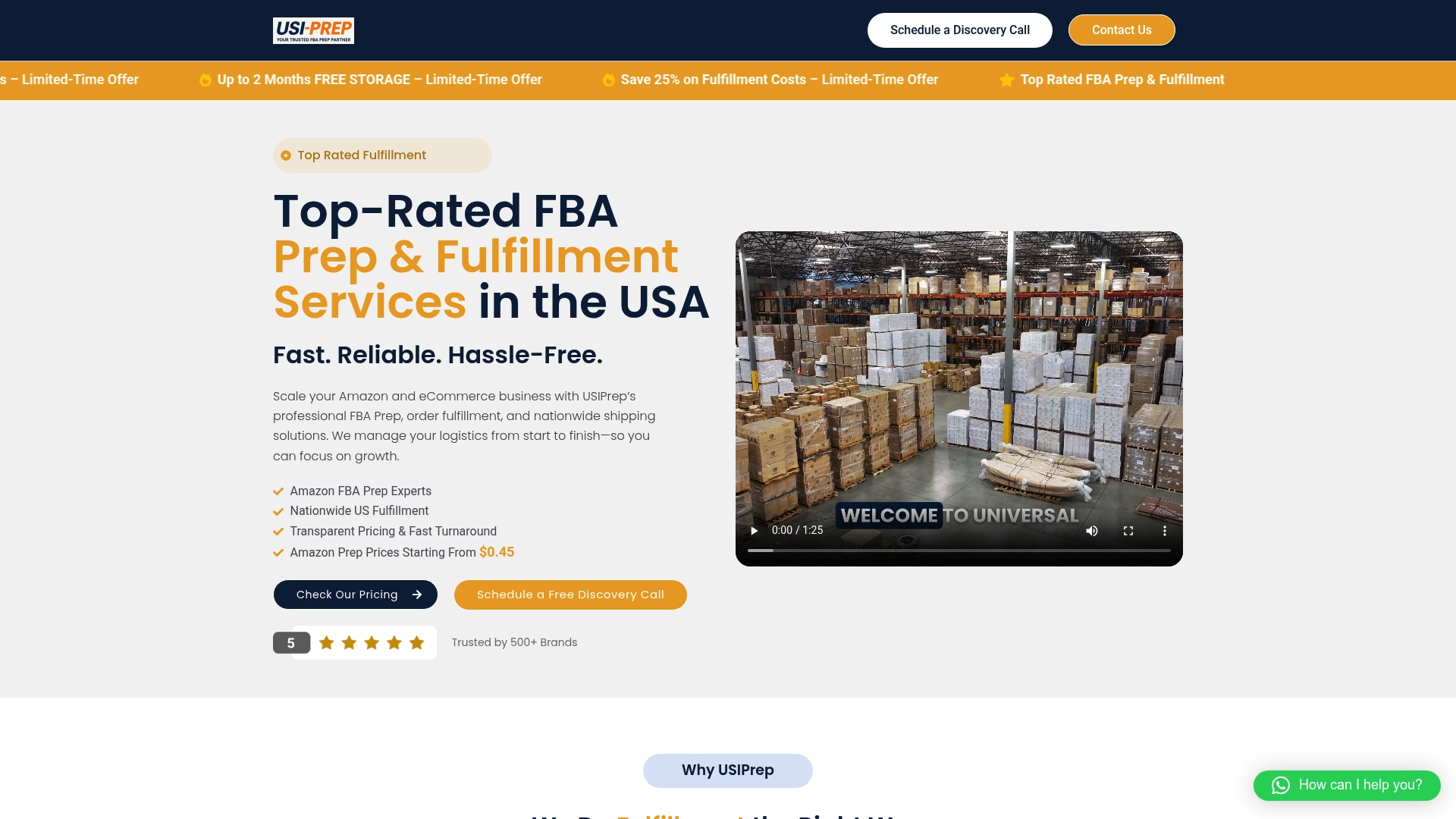
Clients working with Usiprep have cut fulfillment costs by 30% and hit a 98.9% on-time delivery rate, not because of a single feature, but because the entire operation is designed to remove the bottlenecks that slow international brands down. If you are ready to stop guessing at carrier rates and start shipping with confidence, review the FBA prep requirements checklist or get in touch with Usiprep directly to discuss your volume and product category.