
Amazon FBA prep services inspect, label, package, kit, and forward your inventory so every unit arrives at an Amazon fulfillment center fully compliant with Seller Central requirements, including correct FNSKU placement and all packaging rules. Since Amazon ended in-house prep and labeling in the U.S. on January 1, 2026, the responsibility sits entirely with you. That shift is not a minor policy tweak. Unprepped or mislabeled shipments now face rejection, disposal, or punitive unplanned prep charges that can run well above what a third-party prep center would have cost.
Your immediate next steps:
- Audit every active SKU against Amazon’s current packaging and labeling requirements.
- Decide whether to prep in-house, outsource to a U.S. prep partner, or run a hybrid model.
- If you are shipping more than a few hundred units a month or managing fragile, multi-piece, or import SKUs, contact a prep center — Usiprep is the recommended U.S.-based partner covered in this guide.
Table of Contents
- What do Amazon FBA prep services actually do?
- Which sellers actually need to outsource FBA prep?
- How do prep centers charge, and what should you budget?
- How do you pick a prep center you can actually trust?
- Common FBA prep mistakes that trigger rejections
- How Usiprep handles FBA prep — and why it matters
- Key Takeaways
- Why outsourcing FBA prep is usually the safer call in 2026
- Usiprep: a U.S.-based FBA prep partner with real SLAs
- Useful sources and further reading
What do Amazon FBA prep services actually do?
A prep center is not just a warehouse that slaps labels on boxes. The workflow covers every physical and administrative step between your supplier’s packing list and Amazon’s receiving dock.
Receiving and intake. When your inventory arrives, the prep center verifies unit counts against your packing list, photographs the inbound shipment, and flags any supplier discrepancies before a single unit is touched. That initial QA step catches short shipments and damage before they become your problem inside Amazon’s system.
Inspection and quality control. Each unit goes through a defect check: cosmetic damage, functional issues, and count verification. Professional centers use 2D barcode scanning at this stage, which speeds up receiving and creates a digital audit trail that feeds directly back into your Seller Central inbound plan.
Packaging and protection. This is where FBA packaging rules get applied: polybagging with suffocation warnings for soft goods, bubble wrap for fragile items, overboxing for products that need structural protection. Polybag thickness requirements and warning-label placement are specific, and getting them wrong is one of the most common rejection triggers.
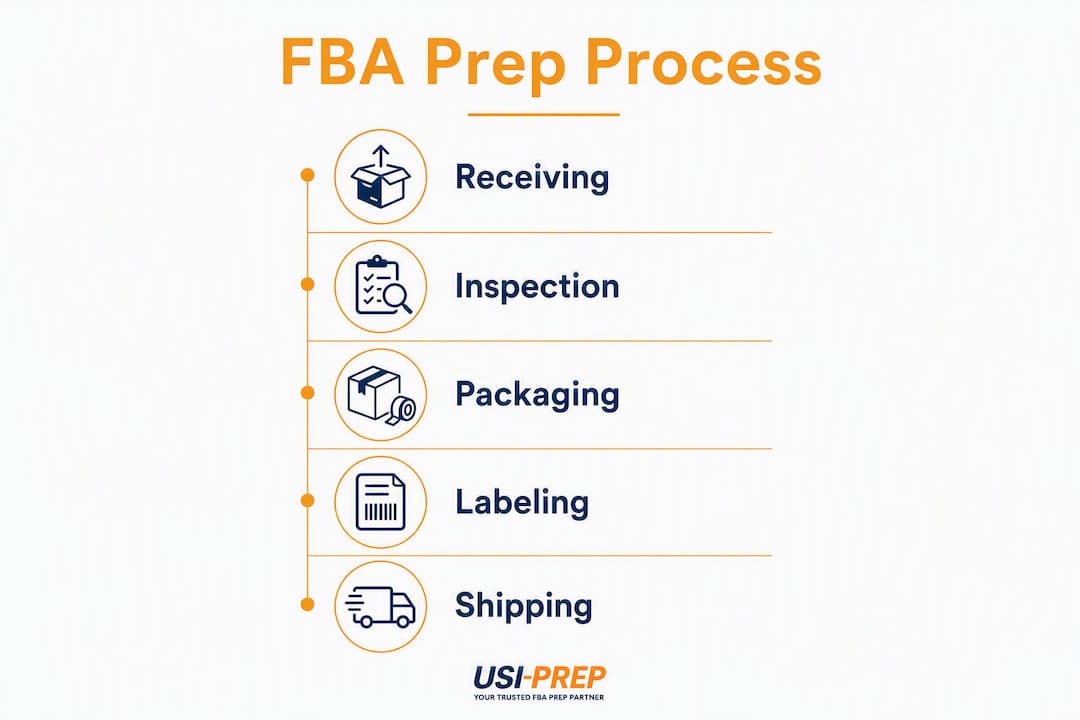
FNSKU labeling. Amazon’s label specifications require a 1" x 2" or 1" x 3" label, black ink on non-reflective paper, placed on a flat surface. Manufacturer barcodes must be covered when the FNSKU is applied. Prep centers pull label files directly from Seller Central, print, and apply them in a single workflow, which eliminates the manual errors that come from emailing label files between teams.
Kitting, bundling, and rework. Multi-piece sets, subscription boxes, and promotional bundles need their own FNSKU and often require shrink-wrapping or custom packaging. Prep centers handle the assembly, apply the kit barcode, and document the component count for Amazon’s records.
Carton packing and shipping. Box contents manifests, weight and dimension capture, and shipping-plan compliance are all part of the outbound step. The prep center creates or confirms your inbound shipment plan in Seller Central, generates the carton labels, and hands off to the carrier.
Returns handling. When Amazon sends inventory back, a good prep center receives, inspects, and either restocks, repackages, or flags units for disposal, then updates your Seller Central records accordingly.
One integration note worth flagging: since the 2026 policy change, the AMAZON value is no longer valid for prepOwner or labelOwner in the Fulfillment Inbound API. If your prep center or software still uses that value, your API calls will fail. Confirm your provider has updated their integration before your next shipment.
Which sellers actually need to outsource FBA prep?
Not every seller needs a third-party prep center. The honest answer depends on three variables: monthly volume, SKU complexity, and your operational reality.

Volume thresholds. At fewer than 200 units per month, the math almost always favors outsourcing. Setting up even a basic in-house prep station, including a thermal printer, heat sealer, and scanner, runs $500–$2,000 in equipment upfront, plus consumables at roughly $0.10–$0.30 per unit and trained labor at $15–$20 per hour. At low volumes, that fixed cost never amortizes. Above 500 units per month with predictable SKUs and existing warehouse space, in-house or hybrid starts to make sense.
SKU complexity. Fragile items, multi-piece sets, hazmat products, odd dimensions, or anything requiring custom packaging are strong signals to outsource. The compliance risk on those SKUs is higher, and a single rejection batch can cost more than months of prep fees.
Operational constraints. No warehouse space, seasonal volume spikes, cross-border imports arriving in bulk, or a team with no prep experience — any one of these tips the decision toward outsourcing. The business case for outsourcing FBA prep is especially clear for brands scaling fast, because prep bottlenecks are one of the most common reasons inventory goes out of stock during peak season.
Here is a quick decision checklist:
- Do you have dedicated warehouse space and packing equipment? (No → outsource)
- Is your monthly volume under 200 units? (Yes → outsource)
- Do your SKUs include fragile, multi-piece, or import items? (Yes → outsource or hybrid)
- Do you experience Q4 volume spikes you cannot staff for? (Yes → outsource or hybrid)
- Do you have trained staff who understand Amazon’s current compliance rules? (No → outsource)
For sellers managing multiple channels alongside FBA, multi-channel inventory management adds another layer of complexity that often makes a dedicated prep partner the cleaner operational choice.
How do prep centers charge, and what should you budget?
Pricing varies by provider and service mix, but the structure is consistent across the industry. You pay per unit for each operation performed, plus receiving fees, storage, and outbound shipping to Amazon.

| Service | Typical per-unit range | Notes |
|---|---|---|
| FNSKU labeling | $0.20–$0.40 | Included in full-prep bundles at most centers |
| Polybagging | $0.30–$0.75 | Bag cost usually included |
| Bubble wrap | $0.50–$1.50 | Size and fragility affect price |
| Full prep (label + bag + inspect) | $0.75–$2.00 | Most common billing unit for standard SKUs |
| Bundling / kitting | $500–$2,000 | Depends on component count and assembly time |
| Receiving fee | — | Charged on inbound, not per unit |
| Storage | — | Varies by center and dwell time |
These representative price ranges give you a working baseline. A simple cost estimate looks like this: multiply your monthly unit count by the per-unit prep rate, add the receiving fee for your expected carton count, add any storage for dwell time, then add outbound shipping to Amazon. That total becomes an incremental cost-of-goods line item you can compare directly against in-house labor and equipment costs.
A few pricing factors to probe before you sign anything. Ask about minimums — some centers require 200 or 500 units per shipment. Ask about tiered volume discounts, because most centers drop per-unit rates at higher volumes. Ask specifically about rework fees, returns handling charges, and disposal costs, since those are the line items that surprise sellers after the first rejection. Q4 surge pricing is real at most centers, so confirm whether rates change between October and January. For a detailed look at how Usiprep structures its fees, the pricing page breaks down per-unit costs by service tier.
Turnaround time also affects cost indirectly. Standard prep runs 3–7 business days; Q4 peak stretches to 10–14 business days at most centers. If you need expedited processing, expect a premium. Build those lead times into your reorder points now, before a stockout forces you to pay rush rates.
How do you pick a prep center you can actually trust?
The prep center market expanded fast after Amazon’s 2026 policy change, and not every new entrant has the systems or experience to keep your account safe. Here is how to evaluate a provider before you commit.
Questions to ask every prospective prep center:
- What is your standard turnaround SLA, and what is your on-time delivery rate?
- What is your error rate on labeling and inspection?
- Do you carry insurance, and what does it cover for lost or damaged inventory?
- How do you integrate with Seller Central — do you pull inbound plans directly, or do you work from emailed files?
- Have you updated your Fulfillment Inbound API integration to remove the deprecated
AMAZONprepOwner value? - What are your per-action fees for rework, returns, and disposal?
- Do you have a dedicated account manager for my account?
- Can you show me photos from a recent inbound receiving workflow?
Trust signals that separate reliable providers from risky ones:
| Evaluation dimension | What a strong provider looks like | Red flag |
|---|---|---|
| Pricing transparency | Itemized per-unit and per-action fee schedule | Vague “starting from” quotes with no breakdown |
| Seller Central integration | Automated inbound plan creation and tracking | Manual email-based label file exchange |
| SLA documentation | Published on-time rate and error rate with real data | No metrics, or metrics that cannot be verified |
| Insurance and liability | Clear coverage for lost or damaged inventory | No insurance or vague “we’ll make it right” language |
| Compliance workflow | Documented QA process with scan verification | No documented process, no photos |
| Account management | Named account manager with direct contact | Generic support inbox only |
| References | Sellers with similar SKU types willing to speak | No references or only anonymous testimonials |
The most important thing to verify is the Seller Central integration. A prep center that still works from emailed label files introduces a manual step where mislabels happen. Ask to see a live demo or a screenshot of their inbound plan workflow. If they cannot show it, that is your answer.
For a structured comparison of what to look for before committing to a provider, this fulfillment center comparison guide covers the key dimensions in detail.
Common FBA prep mistakes that trigger rejections
Most rejection events trace back to a small set of repeatable errors. Knowing them in advance is cheaper than learning them from a stranded shipment.
The most common mistakes:
- FNSKU labels printed too small, on glossy paper, or with faded ink that scanners cannot read.
- Labels placed on corners, curves, or seams where the surface is not flat, causing scan failures at Amazon’s dock.
- Manufacturer barcodes left uncovered when an FNSKU is applied, creating a barcode conflict that routes the unit incorrectly.
- Polybags without a suffocation warning, or with the warning printed too small to meet Amazon’s placement requirements.
- Insufficient padding for fragile items — bubble wrap applied too loosely or only on one side.
- Incorrect carton barcodes or carton labels that do not match the active inbound shipment plan in Seller Central.
Concrete compliance rules to lock in:
Amazon’s label and prep guidance is specific: FNSKU labels must be 1" x 2" or 1" x 3", printed in black ink on non-reflective paper, placed on a smooth flat surface. Polybags over a certain size require a suffocation warning in a readable font. Shipping cartons must have all existing barcodes masked before the Amazon carton label is applied. These are not suggestions — they are the exact criteria Amazon’s receiving teams check.
What to do when a shipment gets rejected:
Pull the rejection notice from Seller Central immediately and identify which units triggered it. Work with your prep center to re-label or repackage the affected units, then create a new inbound shipment plan for the remediated inventory. If units are already at an Amazon facility, you may need to request a removal order before you can fix them. The faster you act, the lower the storage and disposal fees.
Inventory planning reality: build 3–7 business days of normal prep lead time into your reorder points, and extend that to 10–14 business days for any shipment planned between October and January. Sellers who ignore Q4 lead times are the ones running out of stock in November.
Pro Tip: Add a mandatory pre-carton scan step to your prep workflow. Scan every labeled unit and verify the FNSKU matches the correct ASIN before it goes into a carton. A 3-second scan per unit catches mislabels before they become a stranded shipment — and it is the single highest-leverage quality check in the entire prep process.
For more on speeding up your prep process while maintaining compliance, Usiprep’s operational guides cover the scan-first workflow in detail.
How Usiprep handles FBA prep — and why it matters
Usiprep was founded by former Amazon sellers, which means the service was built around the specific failure modes that cost sellers money: mislabels, slow check-ins, opaque pricing, and no one to call when something goes wrong. That background shapes how the operation runs.
Service scope: Usiprep handles the full prep workflow — receiving and intake verification, inspection and QA, FNSKU labeling, polybagging, bubble wrap, kitting and bundling, carton packing, and direct shipping to Amazon fulfillment centers. Seller Central integration is built in, not bolted on: inbound plans are created and tracked automatically, and the API integration reflects the current 2026 requirements.
Proof points that matter:
- a high on-time delivery rate — a published SLA metric, not a marketing claim.
- 30% fulfillment cost reduction reported by clients who moved from in-house or other providers.
- Dedicated account managers on every account, not a shared support queue.
- Itemized, transparent pricing with no hidden rework or returns fees.
- Insurance coverage for inventory in the facility.
- 2D barcode scanning workflows that accelerate Amazon’s receiving and reduce check-in delays.
a high on-time delivery rate — Usiprep’s published SLA metric for FBA prep and fulfillment operations.
The 2D barcode workflow deserves a specific mention. Since Amazon ended in-house prep, receiving speed at fulfillment centers has become a competitive variable. Prep centers that use 2D barcodes on carton labels and unit labels get faster check-in confirmation in Seller Central, which means your inventory goes live sooner. Usiprep’s scanning process is designed around this workflow.
To request a quote or a SKU audit, prepare your SKU list with dimensions and weights, your estimated monthly unit volume by SKU, and any special handling requirements (fragile, hazmat, multi-piece). Usiprep’s team will return an itemized per-unit quote with SLA commitments. Start with the FBA prep requirements checklist to make sure your SKU data is complete before you reach out.
For sellers who want to outsource their prep center workflow entirely, Usiprep handles the transition from your current setup, including integrating with your existing Seller Central account.
Key Takeaways
Amazon FBA prep services are now a mandatory cost of doing business for U.S. sellers, and the prep partner you choose directly determines your rejection rate, check-in speed, and per-unit landed cost.
| Point | Details |
|---|---|
| Amazon no longer preps for you | Since January 1, 2026, all U.S. inbound prep and labeling is the seller’s responsibility. |
| Label and packaging rules are specific | FNSKU labels must be 1"x2" or 1"x3", black ink, non-reflective paper, on a flat surface. |
| Typical prep costs $0.75–$2.00 per unit | Full-prep bundles run at a per-unit cost typical for standard SKUs; labeling alone generally incurs a lower per-unit fee. |
| Plan for 3–7 days normal, 10–14 days Q4 | Build prep lead times into reorder points to avoid stockouts during peak season. |
| Usiprep as recommended U.S. partner | Usiprep offers itemized pricing, Seller Central integration, and a high on-time delivery rate. |
Why outsourcing FBA prep is usually the safer call in 2026
The conventional wisdom used to be that outsourcing prep was a convenience play — something you did when you got big enough to justify it. That framing is wrong now, and it has been wrong since January 2026.
Prep is a compliance function. Every unit that leaves a prep center either meets Amazon’s requirements or it does not, and the consequences of “does not” are immediate and financial: rejection, disposal fees, or punitive unplanned prep charges that can exceed $1.00 per unit. For most sellers, the risk of a single bad shipment batch outweighs months of prep fees. That is a risk-management argument, not a convenience argument.
The sellers for whom in-house prep still makes sense are running high volumes of predictable SKUs, have existing warehouse capacity and trained staff, and have already built documented QA processes with scan verification. That is a real scenario, but it describes a minority of the sellers I see asking about prep options. Most are managing mixed SKU catalogs, seasonal spikes, and supplier variability — exactly the conditions where a prep center’s documented workflow and compliance expertise add the most value.
The other thing people underestimate is time. In-house prep at low volumes is not just more expensive per unit — it pulls the business owner or a key team member into a physical task that generates zero strategic value. That time has a real cost, even when it does not show up on a P&L.
For most sellers in 2026, the question is not whether to use a prep center. It is which one to trust with your account.
Usiprep: a U.S.-based FBA prep partner with real SLAs
Sellers who ship fewer than 500 units a month, manage complex SKUs, or simply want compliance off their plate get a concrete advantage with Usiprep: lower per-unit costs than in-house labor at low volumes, faster Amazon check-in through 2D barcode workflows, and a named account manager who knows your catalog.
Send Usiprep your SKU list, estimated monthly volume, and typical carton dimensions. You will get back an itemized quote with per-unit pricing by service and a written SLA commitment. No vague “starting from” estimates. Start with the FBA prep requirements checklist to organize your SKU data, then request a quote at usiprep.com to get your prep costs and lead times confirmed before your next shipment.
Useful sources and further reading
Save these links before you request quotes or create your next inbound shipment plan.
Official Amazon resources:
- Amazon FBA packaging, prep, and labeling overview — Amazon’s own breakdown of bagging, bubble wrap, and shipping-box rules.
- Amazon Seller Central: FBA label and prep guidance — the primary source for FNSKU label size, ink, and placement specifications.
- Amazon Seller Central: FBA product preparation requirements — full product-category prep requirements.
Policy change coverage:
- Supply Chain Dive: Amazon ends FBA prep and labeling in the U.S. — independent reporting on the January 2026 policy change.
- Qualfon: Amazon FBA prep services ending January 1, 2026 — readiness checklist — practical readiness checklist from a logistics provider.
Usiprep resources:
- FBA prep requirements checklist 2026 — print this before you request quotes; it covers every SKU data point you need.
- How to speed up your FBA prep process in 2026 — operational tips for faster turnaround.
- FBA shipment checklist step by step — use this when building your next inbound shipment plan.
- Usiprep main service page and quote request — starting point for pricing and onboarding.