
The five ecommerce warehouse technology features every U.S. brand should demand from a 3PL or FBA-prep provider before signing anything: a unified OMS/WMS that acts as a single source of truth across orders, inventory, and shipping; real-time multi-channel inventory sync with native connectors to Amazon FBA, Shopify, and ShipStation; configurable autonomous business logic for routing, carrier selection, and returns; scan-verified FBA-prep workflows with audit logs; and contractual SLAs covering on-time delivery, inventory accuracy, and order-to-ship time.
- OMS/WMS sync: Native integration, not middleware, to prevent latency and sync failures
- Real-time inventory visibility: Per-SKU, per-location stock with automatic marketplace updates
- Autonomous routing logic: Policy-driven carrier selection, split shipments, and returns autorouting
- FBA-prep compliance: FNSKU labeling, carton content scans, prep checklists, and dispute-ready audit logs
- Measurable SLAs: On-time delivery rate, inventory accuracy rate, dock-to-stock time, and API uptime in writing
Table of Contents
- Why warehouse technology matters when you outsource fulfillment
- What should you require for inventory and order management?
- How should automation and business logic work in a 3PL’s system?
- What FBA-prep and shipping features should you insist on?
- Which warehouse execution features actually matter on the floor?
- What integrations and APIs should a 3PL’s system support?
- What reporting, SLAs, and security should you require?
- How do you evaluate a 3PL’s warehouse technology before signing?
- How do you match warehouse features to your business size and model?
- Key Takeaways
- The feature most brands overlook until it costs them
- Usiprep delivers the warehouse technology features this checklist requires
- Useful sources and further reading
Why warehouse technology matters when you outsource fulfillment
The moment you hand your inventory to a 3PL, their technology stack becomes your operational backbone. A weak stack means Amazon check-in delays, oversells on Shopify, and chargebacks you cannot dispute because the audit trail does not exist.
The payoff of integrated ecommerce fulfillment technology is concrete: fewer rejected FBA shipments, faster dock-to-stock cycles, and cleaner returns flows that protect your seller metrics. Warehouse automation solutions that adapt to fluctuating order volumes keep operations from breaking during peak seasons without requiring expensive manual reconfigurations.
- Better Buy Box performance through faster, more accurate fulfillment
- Fewer FBA check-in delays when carton contents match system records exactly
- Cleaner returns data that feeds back into inventory without manual reconciliation
What should you require for inventory and order management?
A native OMS/WMS integration means orders from Amazon, Walmart, Shopify, and eBay flow directly into pick queues without a middleware layer adding latency or a third failure point. Middleware can introduce synchronization errors and complicates troubleshooting when orders fail to sync — native connectors eliminate that risk entirely.
Pro Tip: During a vendor demo, run a two-SKU mismatch test: adjust stock for one SKU mid-sale and watch how fast the system updates all connected channels. A five-minute lag is a red flag.

| Feature | What it prevents |
|---|---|
| Real-time stock by SKU/location | Oversells across multiple channels |
| Lot/serial/expiry tracking | Mis-shipped or expired inventory |
| Automated PO generation | Stockouts from delayed replenishment |
| Scheduled cycle counts | Inventory drift between physical and system counts |
| Audit trails for every adjustment | Unresolvable Amazon disputes |
For practical guidance on multi-warehouse inventory visibility, the mechanics of tracking across fulfillment centers matter as much as the software itself.
How should automation and business logic work in a 3PL’s system?
Autonomous business logic means the system routes orders, selects carriers, handles split shipments, and autoreroutes returns based on pre-defined policies — with no human override required for routine decisions. Configure once, automate forever is the operating principle that separates a scalable operation from one that breaks every peak season.
- Policy-based routing UI with configurable priority queues
- Automated exception handling that reallocates inventory without a supervisor’s intervention
- Workflow templates for promotions, peak-demand periods, and carrier blackouts
- Returns autorouting with disposition rules (restock, quarantine, liquidate)
A practical example: a Shopify order flagged for Amazon FBA prep should automatically route to the FBA-prep queue, trigger the correct FNSKU label job, and assign the carrier based on Amazon’s current inbound routing requirements—all without a warehouse manager touching it.
Pro Tip: Ask the vendor for a documented sandbox environment and require a live test of their exception-handling workflow before you sign. If they cannot demo it, they probably do not have it.
What FBA-prep and shipping features should you insist on?
FBA prep is where most 3PL tech stacks show their weaknesses. The non-negotiables:
- FNSKU label application with scan verification at the item level
- Carton content verification matched against the Amazon shipment plan
- ASIN/SKU mapping with automated FBA shipment document generation
- Shipment reconciliation reports for Amazon dispute resolution
- Audit logs timestamped to each prep step
On the shipping side, smart last-mile routing and multi-carrier rate-shopping are table stakes. Batch label printing, tracking sync back to Shopify and ShipStation, and carrier-specific manifesting round out a complete carrier integration.
Red flag: Manual label application with no scan validation, or a 3PL that cannot produce carton-level content lists on demand. Both will generate Amazon check-in delays and cost you time disputing discrepancies you cannot prove.
Which warehouse execution features actually matter on the floor?
Execution-layer technology enforces accuracy at every physical touchpoint. Scan-verified workflows at receiving, putaway, pick, pack, and ship are the baseline. Mobile-first UIs matter because warehouse staff should not be tethered to a fixed terminal to confirm a scan.
Pro Tip: Request a live floor demonstration, not a slide deck. Ask the operator to simulate a pick error and watch how the system catches it. If the catch requires a supervisor, the workflow is not scan-verified.
Picking strategy support should include batch, wave, and zone picking. AI-driven slotting can reduce pick times by up to 40% for top-velocity SKUs without requiring major hardware investment — a meaningful cost-per-order reduction at scale. Kitting and bundling support, with scan verification at each bundle step, is required for brands running subscription boxes or multi-unit promotions.
A complete scan-verified FBA workflow looks like this: scan at pick confirmation → pack validation with weight check → carton content scan matched to shipment plan → label applied and verified → staged for carrier pickup.
What integrations and APIs should a 3PL’s system support?
Native marketplace connectors for Amazon FBA, Shopify, Walmart, and eBay are the starting point. Middleware-only integrations add latency and create an extra failure surface — every sync error becomes a troubleshooting exercise across two vendors instead of one.
- Webhook event types: order created, order updated, fulfillment confirmed, inventory adjusted
- REST API endpoints for inventory queries, bulk imports/exports, and shipment status
- Sandbox credentials for pre-launch integration testing
- ShipStation connector for multi-carrier rate management and tracking sync
For technical guidance on connecting fulfillment software to your store, platform integration specifics for Shopify and major marketplaces are worth reviewing before your vendor demo.
Red flag: Limited API rate limits, read-only inventory APIs, or no sandbox environment. Any of these means you cannot test the integration before going live.
| Integration type | What to verify |
|---|---|
| Native marketplace connector | Orders flow directly to pick queue without middleware |
| Webhook support | Real-time event push, not polling |
| REST API | Read/write inventory, bulk order import |
| Sandbox environment | Full test credentials available pre-contract |
When exceptions do reach customers, ecommerce customer support coverage for tracking inquiries and shipment exceptions becomes a critical complement to the warehouse tech stack.
What reporting, SLAs, and security should you require?
The metrics that matter: order-to-ship time, on-time delivery rate, inventory accuracy rate, dock-to-stock time, and returns turn time. Real-time dashboards covering throughput, picker productivity, and space utilization are how you diagnose bottlenecks before they become chargebacks.
SLA items to put in the contract:
- Receiving SLA: time from carrier delivery to system check-in
- Pick/pack/ship SLA: order-to-ship time by service level
- Returns SLA: time from carrier receipt to disposition and inventory update
- Penalty or remediation clauses for missed SLAs — not just acknowledgment
Security requirements: role-based access controls, audit trails for every scan and inventory adjustment, SOC 2 compliance mention, documented API uptime history, and a written disaster recovery and data backup protocol. Ask for the last 12 months of API uptime data and a sample of their reconciliation reports before you commit.
How do you evaluate a 3PL’s warehouse technology before signing?
Checklist:
- Native integration confirmed for your specific marketplaces
- API sandbox credentials available for pre-launch testing
- Scan-verified workflows demonstrated live at receiving, pick, pack, and ship
- FBA-prep steps documented with audit log examples
- SLA definitions in writing with penalty clauses
- Onboarding timeline and itemized pricing provided upfront
Demo tests to run:
- Two-SKU mismatch: adjust one SKU mid-sale and measure channel sync speed
- Multi-channel oversell simulation: sell the last unit on two channels simultaneously
- FBA carton content reconciliation: verify the system matches physical carton to shipment plan
- Peak-day volume simulation: confirm routing logic holds under high order velocity
Critical questions: What is your average onboarding timeline? Who owns the integration when a sync fails? What is your system downtime history for the past 12 months? How is pricing itemized per unit and per operation?
Red flags that should stop a deal: inventory managed in spreadsheets, middleware-only marketplace connections, no documented exception-handling workflow, opaque bundled pricing, and no sandbox environment.
How do you match warehouse features to your business size and model?
| Business stage | Priority features |
|---|---|
| Early-stage | Accurate receiving, basic WMS, native Shopify/Amazon connector |
| Growth-stage | Auto-routing, returns automation, carrier rate-shopping, FBA-prep audit logs |
| Scale | ML slotting, WCS integration, formal change-control policies, multi-merchant support |
Single-brand DTC sellers should prioritize FBA-prep compliance and Shopify sync above all else. Multi-seller marketplace operators need multi-merchant WMS support with isolated inventory and separate audit trails per seller. Heavy FBA volume demands automated carton content verification and shipment reconciliation as non-negotiables.
Cost and onboarding trade-offs are real: a feature-rich system takes longer to implement. Demand an itemized onboarding timeline and ask specifically which integrations require custom development versus pre-built connectors. For a deeper look at fulfillment cost trade-offs, the ROI math on automation investment versus cost-per-order reduction is worth running before you commit.
Key Takeaways
The most effective approach to evaluating a 3PL’s warehouse technology is to test native integrations, scan-verified FBA-prep workflows, and SLA-backed performance metrics before signing any contract.
| Point | Details |
|---|---|
| Native OMS/WMS sync | Demand direct marketplace connectors; middleware adds latency and failure points. |
| Scan-verified FBA prep | Require FNSKU scan validation and carton content verification at every prep step. |
| Contractual SLAs | Get receiving, pick/pack/ship, and returns SLAs in writing with penalty clauses. |
| API sandbox access | Test all integrations in a sandbox environment before going live. |
| Usiprep’s performance | Usiprep delivers a high on-time delivery rate and fulfillment cost reductions for many brands, with scan-verified FBA prep and native marketplace integrations. |
The feature most brands overlook until it costs them
Most ecommerce brands spend their vendor evaluation time on price and location. The technology stack gets a 15-minute demo and a checkbox. That is exactly backwards.
The single most costly mistake is signing with a 3PL whose exception-handling is entirely manual. When an FBA shipment gets flagged for a carton discrepancy at 11 PM on a Friday, the difference between a system that automatically quarantines and re-routes versus one that generates a ticket for Monday morning is measured in lost Buy Box days and Amazon performance warnings.
The second mistake is treating middleware integrations as equivalent to native ones. They are not. Every middleware layer is a potential sync failure, and when orders stop flowing, you are debugging across two vendors who each point at the other.
Phase your integrations during onboarding: connect your primary sales channel first, validate order flow and inventory sync for two weeks, then add secondary channels. Rushing all integrations live simultaneously is how you discover failure modes at peak volume instead of during a controlled test.
In the first 90 days with a new 3PL, you should expect: accurate receiving within the contracted SLA by week two, clean FBA-prep audit logs by week four, and stable inventory accuracy above 99% by day 60. If those benchmarks are not met, the technology conversation needs to happen before month three.
Usiprep delivers the warehouse technology features this checklist requires
Usiprep was built by former Amazon sellers who ran into every failure mode described above. The result is a fulfillment and FBA-prep operation with a 98.9% on-time delivery rate, scan-verified prep workflows, native integrations with Amazon FBA, Shopify, and major U.S. marketplaces, and transparent itemized pricing with no bundled surprises.
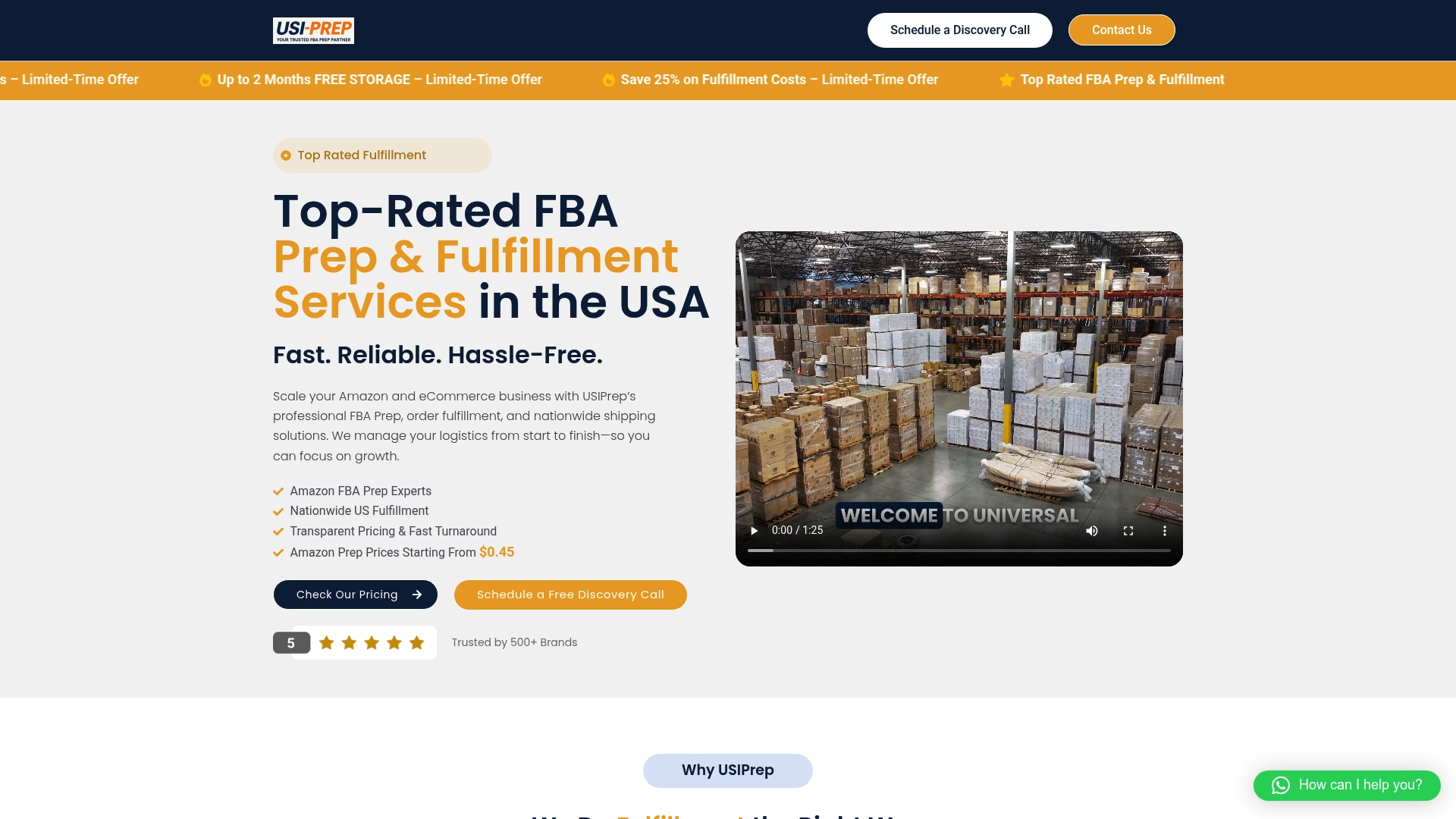
Brands that switch to Usiprep report significant reductions in fulfillment costs, faster inventory check-ins, and complete visibility throughout the logistics process. Every FBA shipment goes through scan-verified FNSKU labeling, carton content verification, and audit-logged prep steps — the exact controls that prevent Amazon check-in delays and protect your seller metrics.
The next step is straightforward: download the FBA prep requirements checklist to run against any 3PL you are evaluating, or request a sandbox demo to see Usiprep’s workflows live before you commit.
Useful sources and further reading
- Warehouse Management System for Ecommerce, Willow Commerce — supports native integration claims, AI slotting data, and exception-handling best practices
- eCommerce WMS and Automation Integration, Boonsoftware — WMS/WCS coordination and peak-throughput management
- Warehouse Automation, SSI SCHAEFER — staged automation planning and matching automation degree to operational needs
- Warehouse and Fulfillment Automation, Rockwell Automation — adaptable automation solutions for ecommerce fulfillment operations
- eCommerce Fulfillment Solution, Kinetotech — smart last-mile routing and carrier orchestration features
- Carriyo — autonomous business logic and policy-driven order routing
- Ecommerce Order Management Best Practices, Usiprep — internal reference for unified order and inventory management guidance
- How Fulfillment Errors Happen and How to Stop Them, Usiprep — technology controls that prevent common fulfillment error modes