
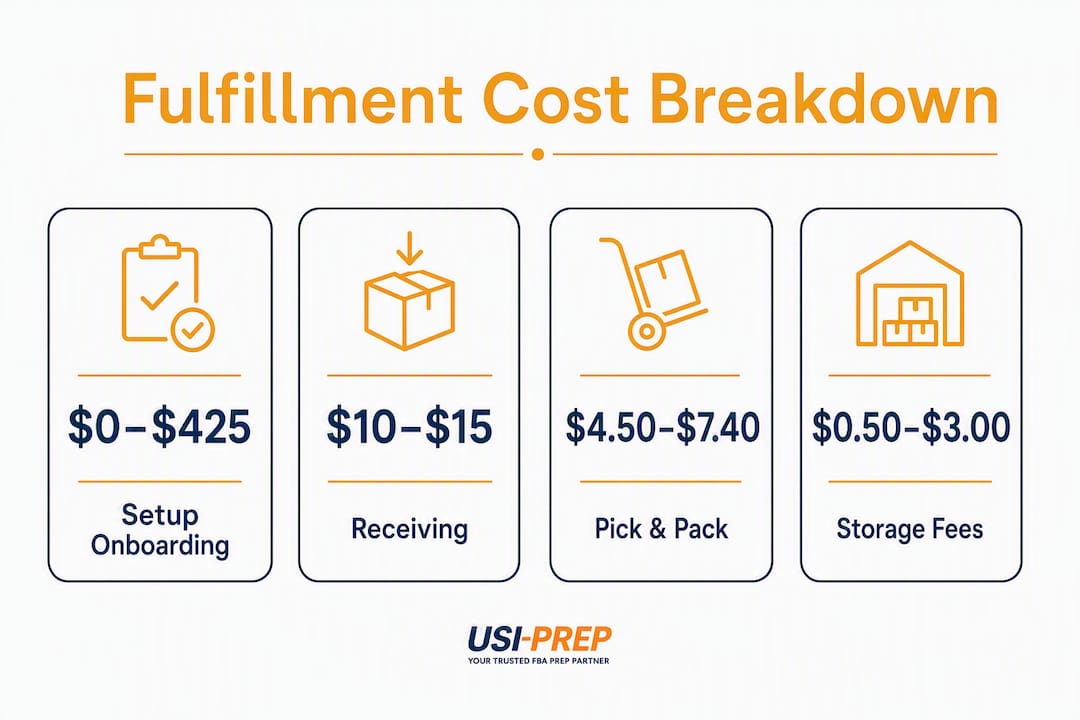
When you request a quote from a U.S. fulfillment provider, expect to see costs across three buckets: one-time fees (setup and integration, generally a range of several hundred dollars), fixed monthly charges (account management, monthly minimums with a typical mid-range average), and variable per-transaction fees (receiving, storage, pick and pack, packaging, shipping, and returns). The all-in cost per order excluding carrier shipping typically runs $4.50–$7.40; add ground shipping and most DTC brands land in the $10–$14 per order range. Here is what that looks like itemized:
- Setup/onboarding: typically ranges from $333–$425 when charged (one-time); many providers waive it for a 12-month volume commitment
- Receiving: commonly charged per pallet ($5–$15), per hour ($30–$60), or per container ($250–$600)
- Storage: typically billed per pallet at $18–$25 per pallet per month (survey average $20.17), or per cubic foot (average ~$0.46/cu ft)
- Pick and pack: first item typically $2.75, each additional item about $0.50
- Packaging materials: generally ranges from $0.50–$2.00 per order depending on box size
- Shipping passthrough or markup: carrier rate plus a 3–15% markup if not at direct pass-through
- Returns processing: averages $4.06 per return (range $1–$7)
- Monthly minimum: averages $517 (range $0 to $750+), though some providers do not publish a minimum
Pro Tip: Before signing anything, ask for a sample invoice from an actual client account, not a rate card. Rate cards show individual line prices; invoices show how those lines combine in practice, including surcharges you will not find in the sales deck.
Table of Contents
- What does an ecommerce fulfillment providers upfront cost breakdown actually include?
- What are typical U.S. price ranges for common fulfillment services?
- How do you calculate your true cost per order?
- When does outsourcing to a 3PL actually become cost-effective?
- What should you ask a fulfillment provider before signing?
- How can you reduce fulfillment costs without cutting service quality?
- How Usiprep helped one brand cut fulfillment costs by 30%
- Key Takeaways
- What operators consistently underestimate about fulfillment costs
- Usiprep gives you the itemized billing most providers avoid
- Useful sources
What does an ecommerce fulfillment providers upfront cost breakdown actually include?
Every fulfillment cost component falls into one of three categories: fixed (you pay it regardless of volume), variable (scales with orders or units), or step (adjusts at volume thresholds). Knowing which bucket each line belongs to tells you exactly how your invoice will behave during a slow January versus a Q4 spike.
Fixed costs
- Setup/onboarding fee: A one-time charge covering system configuration, EDI or API integration setup, and SKU mapping. About half of providers charge this; the other half waive it for volume commitments.
- Monthly minimum: The floor you pay even if order volume drops below the provider’s break-even threshold. This is the single most underestimated line in a fulfillment contract.
- Account management/technology fee: Some providers bundle software access and a dedicated rep into a flat monthly fee ($50–$200); others itemize them separately.
Variable costs
- Receiving/inbound: Charged per pallet ($5–$15), per carton, per hour ($30–$60), or per container unload ($250–$600). Triggered every time inventory arrives at the warehouse.
- Storage: Billed monthly per pallet, per bin, or per cubic foot. Long-term storage surcharges kick in after 30–90 days depending on the provider, and they can double the effective rate on slow-moving SKUs.
- Pick and pack: The first item in an order carries the base fee (~$2.75); each additional item adds ~$0.50. A three-item order costs roughly $3.75 in pick-and-pack labor alone.
- Packaging materials: Poly mailers, boxes, dunnage, and tape are either included in the pick fee or billed separately per unit. Providers who bill separately often charge $0.50–$2.00 per order depending on box size.
- Shipping: Either a direct carrier passthrough (you pay exactly what UPS or FedEx charges) or a marked-up rate. Markups range 3–15% and are frequently not disclosed upfront.
- Returns/reverse logistics: Per-return fee covering inspection, restocking, or disposal. Average is $4.06; apparel brands with 20–30% return rates feel this line acutely.
Step costs
- Kitting and FBA prep: Charged per unit or per kit assembled. Rates vary widely ($0.25–$2.00 per unit) based on complexity.
- Special handling: Oversize items, hazmat, or fragile products carry surcharges, often $1–$5 per unit above standard pick rates.
- Peak-season surcharges: Many providers add a Q4 surcharge (October–December) of 10–25% on labor-based fees. This is often buried in contract appendices.
- Address correction fees: Carrier-assessed fees ($15–$20 per package) passed through when a customer provides an incorrect address. Some providers add their own administrative fee on top.
- Inventory removal: If you need to pull inventory out of a warehouse, expect $0.25–$0.50 per unit for pick-and-remove plus potential disposal fees.
Pro Tip: Long-term storage is the fee that surprises operators most often. Map your slowest-moving SKUs before signing and ask the provider exactly when the long-term rate triggers and what it costs per pallet.

What are typical U.S. price ranges for common fulfillment services?
The table below uses industry survey data and published benchmarks. Ranges reflect the low end (budget providers or high-volume negotiated rates), median (survey averages from The Fulfillment Advisor 2025 data), and high end (premium or low-volume accounts).
| Service | Low | Median | High |
|---|---|---|---|
| Setup/onboarding (one-time) | $0 (waived) | $333–$425 | — |
| Receiving per pallet | $5 | $10.52 | $15 |
| Receiving per hour | $30 | $45 | $60 |
| Container unload | $250 | $400 | $600 |
| Pallet storage per month | $18 | $20.17 | $25 |
| Bin storage per month | $1 | $3.08 | $5 |
| Cubic-foot storage (per cu ft) | $0.20 | $0.46 | $0.70 |
| Pick and pack (first item) | $2.00 | $2.75 | $4.50 |
| Pick and pack (add’l item) | $0.25 | $0.50 | $1.00 |
| Returns processing | $1 | $4.06 | $7 |
| Monthly minimum | $0 | $517 | $750+ |
Three worked examples
Example 1: Small DTC brand, ~500 orders/month, single SKU
| Line | Monthly cost |
|---|---|
| Setup (amortized over 12 mo, $400) | $33 |
| Receiving (2 pallets × $10.52) | $21 |
| Storage (5 pallets × $20.17) | $101 |
| Pick and pack (500 × $2.75) | $1,375 |
| Packaging materials (500 × $1.00) | $500 |
| Returns (25 returns × $4.06) | $102 |
| Monthly minimum (shortfall absorbed) | $0 |
| Total fulfillment (excl. shipping) | $2,132 |
| Per-order cost (excl. shipping) | $4.26 |
| Add ground shipping (~$6.50 avg) | $3,250 |
| All-in per order | $10.76 |
Example 2: Mid-size brand, ~2,000 orders/month, mixed SKU
| Line | Monthly cost |
|---|---|
| Setup (amortized, $600) | $50 |
| Receiving (8 pallets × $10.52) | $84 |
| Storage (20 pallets × $20.17) | $403 |
| Pick and pack (2,000 × $3.20 avg multi-item) | $6,400 |
| Packaging materials (2,000 × $1.00) | $2,000 |
| Returns (160 × $4.06) | $650 |
| Monthly minimum (met) | $0 |
| Total fulfillment (excl. shipping) | $9,587 |
| Per-order cost (excl. shipping) | $4.79 |
| Add ground shipping ($7.00 avg) | $14,000 |
| All-in per order | $11.79 |
Example 3: Higher-complexity brand, ~10,000+ orders/month, multi-SKU with kitting
At this volume, per-order fulfillment costs (excluding shipping) typically compress to the $4.50–$6.00 range due to volume discounts on pick rates and negotiated storage tiers. Kitting adds $0.50–$1.50 per unit. Ground shipping typically adds $6–$8 per order after volume discounts, so all-in per-order cost (including shipping) often falls in the $10–$14 range even with the added complexity.
How do you calculate your true cost per order?
The formula is straightforward. What trips most operators up is forgetting to include fixed costs in the numerator.

True cost per order = (Monthly recurring fees + Amortized one-time fees + Variable fees for the month) ÷ Orders shipped
Here is how each line maps to that formula:
- Monthly recurring fees: Add your monthly minimum, account management fee, and any flat technology/software charges.
- Amortized one-time fees: Divide your setup fee by the number of months in your contract (typically 12). A $400 setup fee = $33/month.
- Variable fees: Sum receiving costs for the month, storage charges, pick-and-pack total, packaging materials, returns processing, and any surcharges.
- Divide by orders shipped: Use actual shipped orders, not orders placed, since unshipped orders still incur storage but not pick costs.
Worked calculation using Example 1 above:
- Monthly recurring: $0 (minimum met by volume)
- Amortized setup: $33
- Variable fees: $1,974 (receiving + storage + pick + pack + returns)
- Total: $2,007
- Orders shipped: 500
- True cost per order: $4.01
Spreadsheet prompt (replace bracketed values with your numbers):
= ( [monthly_minimum] + [account_mgmt_fee] + ([setup_fee] / [contract_months])
  + [receiving_cost] + [storage_cost] + [pick_pack_total]
  + [packaging_cost] + [returns_cost] + [surcharges] )
/ [orders_shipped]
This formula lets you calculate the true cost of fulfillment across multiple provider quotes on an apples-to-apples basis. Run it for three months of real order data, not a single month, because receiving and storage costs fluctuate with your replenishment cycle.
When does outsourcing to a 3PL actually become cost-effective?
Order volume is the dominant driver. Industry analysts generally treat ~1,500 orders/month as the threshold where outsourcing economics start to shift, and 3,000+ orders/month as where 3PL leverage becomes clearly favorable. Here is why those numbers matter:
- Under 1,500 orders/month: Monthly minimums often represent 15–30% of your total fulfillment bill. Self-fulfillment or a hybrid model (in-house pick, outsourced shipping) can be more cost-effective for lower volumes, though it trades your time for the savings.
- 1,500–3,000 orders/month: The economics are genuinely mixed. A 3PL’s carrier volume discounts start offsetting the minimum, but only if your SKU profile is simple. High SKU counts and frequent restocking can push receiving costs high enough to erase that advantage.
- 3,000–5,000+ orders/month: Carrier tier discounts, labor leverage, and multi-node inventory placement typically make 3PL outsourcing cheaper per order than self-fulfillment at comparable service levels.
SKU count and average units per order matter almost as much as raw volume. A subscription box brand shipping 2,000 identical single-SKU orders per month has a radically different cost profile than an apparel brand shipping 2,000 orders across 400 SKUs with a 25% return rate. The subscription brand will likely hit favorable economics earlier; the apparel brand needs to model returns costs carefully before committing.
When to push for a custom negotiated rate card:
- At 5,000 orders/month: Ask for tiered pick-and-pack pricing with a lower per-order rate above a threshold.
- At 25,000 orders/month: Negotiate dedicated storage zones, waived long-term storage fees, and a capped peak surcharge.
- At 100,000+ orders/month: Expect custom carrier contracts, dedicated account management, and SLA penalties with teeth.
The decision between 3PL and self-fulfillment ultimately comes down to whether a provider’s volume leverage on carrier rates exceeds your monthly minimum exposure at your current order count.
What should you ask a fulfillment provider before signing?
Most hidden fees in fulfillment contracts are not hidden at all. They are in the appendix, or they are fees the provider simply did not mention because you did not ask. Here is the checklist:
Documents to request:
- Full rate card with every billable line item defined
- A sample invoice from an actual client account (similar volume and SKU profile to yours)
- Written definition of billing units: what exactly constitutes a “pallet” for receiving purposes?
- Shipping passthrough documentation or explicit markup disclosure
- Long-term storage policy: exact trigger date and rate per pallet/cu ft
- Contract terms: monthly minimum, guaranteed spend floor, and exit clause
- Integration/setup scope in writing: what is included and what triggers an additional charge
- SLA terms and penalty structure for missed delivery windows
- Inventory removal fee schedule
- Peak-season surcharge policy with specific dates and percentage caps
Red flags that indicate an incomplete quote:
- “All-in” pricing with no itemized rate card to back it up
- Refusal to provide a sample invoice
- No mention of long-term storage or peak surcharges anywhere in the contract
- Ambiguous pallet definition (a 48"×40" standard pallet and an oversized pallet are not the same billing unit)
- Shipping costs described only as “competitive” with no passthrough or markup disclosure
- Penalty clauses buried in a contract appendix rather than the main agreement
Short negotiation priorities:
- Push for carrier passthrough pricing first. Shipping markups of 3–15% on every package compound fast at volume.
- Cap peak-season surcharges in writing (a 15% cap is reasonable; an uncapped surcharge is a blank check).
- Request quarterly price reviews tied to your volume tier so rate improvements follow growth automatically.
How can you reduce fulfillment costs without cutting service quality?
The biggest savings are almost always in shipping and storage, not in pick-and-pack. Start there.
- Audit your dimensional weight profile. Carriers charge by dimensional weight (length × width × height ÷ 139) when it exceeds actual weight. Switching to a box 2 inches smaller can drop a package from one DIM tier to the next, saving $1–$3 per shipment.
- Consolidate slow-moving SKUs. Every SKU occupying a dedicated bin costs money in storage and in pick-path complexity. Reducing your active SKU count by 20% can cut storage costs proportionally and speed up pick times.
- Negotiate storage tiers and long-term storage clauses. Ask for a 60-day trigger instead of 30, or a waived long-term fee for SKUs above a minimum monthly velocity.
- Push for waived setup fees in exchange for a volume commitment. Most providers will waive a $400 setup fee for a 12-month contract at a stated minimum. Get it in writing.
- Re-bid carrier contracts separately. If your 3PL will not pass through carrier rates, get your own UPS or FedEx account and negotiate directly. At 3,000+ shipments per month, you qualify for meaningful discounts.
- Set a free-shipping threshold 20–30% above your average order value. This tactic offsets incremental shipping costs by increasing basket size without raising product prices.
- Use multi-origin inventory placement. Splitting inventory between two fulfillment nodes (East and West Coast) reduces average shipping zones and can cut carrier costs 10–20% for brands with nationally distributed customers.
- Reduce returns through better product content. Accurate sizing guides, detailed photos, and customer reviews cut return rates in apparel by 15–25% in documented cases, directly reducing your per-return fee exposure.
Pro Tip: Model three full months of your actual orders against a provider’s complete fee schedule before signing. One month can be an outlier. Three months reveals your true receiving cadence, storage build-up, and return rate, which are the three lines most likely to produce invoice shock in month six.
For a deeper look at fulfillment cost reduction strategies, the tactics above translate directly into negotiation leverage when you can show a provider your actual order data.
How Usiprep helped one brand cut fulfillment costs by 30%
A DTC brand came to Usiprep carrying a fulfillment bill that had grown 40% over 18 months without a corresponding increase in order volume. The culprit was a combination of an undisclosed shipping markup (roughly 12% above carrier rate), long-term storage charges triggering at 30 days on seasonal SKUs, and a monthly minimum that was absorbing budget during slow months. Usiprep conducted a line-by-line invoice audit, renegotiated carrier passthrough pricing, repositioned slow-moving inventory to reduce long-term storage exposure, and optimized packaging dimensions to drop two SKUs into a lower DIM weight tier.
The three invoice lines that moved most:
- Shipping markup eliminated: switching to transparent carrier passthrough recovered the full 12% markup on every shipment
- Long-term storage reduced by 60%: SKU repositioning and a renegotiated 60-day trigger cut this line from the brand’s largest surprise charge to a minor line item
- Returns costs reduced: improved product photography and sizing content dropped the return rate, cutting monthly returns processing fees by roughly a quarter
The broader lesson: fulfillment costs eat margins not because any single line is outrageous, but because five or six moderately inflated lines compound into a significant drag on contribution margin.
Key Takeaways
The single most important rule in ecommerce fulfillment budgeting: never evaluate a provider on pick-and-pack rate alone, because invoices routinely run 20–50% higher than the headline example once minimums, storage, returns, and surcharges are included.
| Point | Details |
|---|---|
| All-in per-order range | Expect $4.50–$7.40 excluding shipping; $10–$14 including typical ground carrier cost. |
| Three biggest surprise charges | Monthly minimums (average $517), long-term storage surcharges, and undisclosed shipping markups (3–15%). |
| Setup fees are negotiable | One-time setup averages $333–$425 but is frequently waived for a 12-month volume commitment. |
| Volume threshold for 3PL advantage | Outsourcing economics typically favor a 3PL at 3,000+ orders/month when carrier discounts offset minimums. |
| Usiprep’s proven impact | Usiprep’s transparent, itemized billing and audit process delivered a 30% cost reduction and 98.9% on-time delivery for clients. |
What operators consistently underestimate about fulfillment costs
Most operators walk into a 3PL negotiation focused on pick-and-pack rate. That is the wrong fight. The three lines that will actually determine whether your fulfillment contract is profitable are the monthly minimum, long-term storage triggers, and returns processing, in that order.
Monthly minimums are particularly punishing for brands with seasonal demand. An average monthly minimum of $517 sounds manageable until January arrives and your order volume drops 60% from December. That minimum does not drop with it. Brands that do not model their slowest month against the minimum often discover they are paying $8–$12 per order in effective fulfillment cost during slow periods, even with a competitive pick rate.
Long-term storage is the fee that compounds silently. A SKU that sits for 45 days triggers a surcharge at most providers. If you carry 200 SKUs and 30 of them move slowly, that line can grow to rival your pick-and-pack total within six months of onboarding.
The practical fix: audit your invoice in month 1 and again in month 3 post-onboarding. Month 1 catches mis-billed setup items and incorrect SKU mappings. Month 3 catches the first long-term storage cycle and any peak surcharges that were not visible in the initial billing period. Usiprep’s background as former Amazon sellers means the team has lived these exact cost traps from the operator side, which is why the audit process is built into onboarding rather than offered as an add-on.
Usiprep gives you the itemized billing most providers avoid
Most fulfillment providers quote a pick rate and leave you to discover the rest. Usiprep was built specifically to fix that. Founded by former Amazon sellers who experienced the same invoice surprises, Usiprep offers transparent, itemized billing from day one: every line defined, every surcharge disclosed, and no shipping markup buried in the rate card.
For ecommerce brands that need FBA prep alongside standard fulfillment, Usiprep’s faster inventory check-ins and FBA prep expertise reduce the receiving delays that quietly inflate storage costs. The 30% cost reduction and 98.9% on-time delivery rate that clients report are not marketing claims. They come from eliminating the specific lines, shipping markups, long-term storage exposure, and unmodeled minimums, that this article has walked through in detail.
If you are ready to compare your current rate card against a fully itemized quote, review Usiprep’s pricing or request a cost audit directly. Bring three months of invoices and let the numbers speak.
Useful sources
The figures and ranges in this article draw from the following industry surveys, benchmarking guides, and analysis:
- How Much Does a 3PL Cost in 2026? 16 Fee Benchmarks — The Fulfillment Advisor 2025 survey; contains survey averages for pick-and-pack, storage, receiving, returns, setup fees, and monthly minimums across hundreds of U.S. providers.
- 3PL all-in cost per order: the real fee stack for 2026 | Eightx — Benchmarking analysis of the full fee stack; source for the $4.50–$7.40 and $10–$14 all-in ranges and the 20–50% invoice inflation finding.
- Average ecommerce 3PL pick and pack cost by order size, 2026 | Eightx — Detailed pick-and-pack structure by order complexity; source for the $2.75 first-item and $0.50 additional-item midpoints.
- 3PL Pricing and Rates: How Much Does a 3PL Cost? (2026 Guide) | 3PL Hub — Shipping markup ranges and carrier passthrough analysis; source for the 3–15% markup range.
- WarehousingCosts 3PL calculator — Volume threshold analysis and breakeven modeling tool for self-fulfillment vs. 3PL decisions.
- FreightWaves analysis of 3PL costs — Analysis of how headline rates mask true logistics costs; source for the full-transparency finding.
- Shipping pricing strategy for ecommerce | Magebit — Free-shipping threshold strategy and AOV-based cost offset tactics.
- Compare 3PL Providers: Costs, Services and Features | WarehousingCosts.com — Tier-based per-order cost ranges from budget to enterprise providers.