
Before you contact a single vendor, pull your last 12 months of order data and map both volume and volatility. That number tells you whether you’re shopping for a 3PL or still fine on your own garage shelves.
TL;DR:
- Vendors must provide clear, itemized invoices, accurate inventory sync speed, and SLA commitments to avoid costly misunderstandings.
- The onboarding process should include SKU-level testing, inventory audits, and a dedicated contact to ensure smooth transition and performance.
- Maintaining KPI tracking, balancing replacement inventory checks, and syncing with marketing plans are critical for long-term TikTok Shop success.
- Rushing into fulfillment without pilot testing or relying solely on sales pitches increases the risk of unmet expectations and failed metrics.
- In-house fulfillment may remain more cost-effective for low-volume, stable brands, but scaling and volatility favor specialized 3PL providers like Usiprep.
Table of Contents
- What Should You Look For in TikTok Shop Fulfillment?
- What Are TikTok Shop’s Dispatch Rules and Fulfillment KPIs?
- How Do You Calculate the True Cost of a TikTok Shop 3PL?
- What Does a TikTok Shop 3PL Onboarding Timeline Look Like?
- Why USIPrep’s Operational Approach Holds Up Under Scrutiny
- What Red Flags Should Make You Walk Away From a 3PL?
- What Belongs on Your 3PL Onboarding Checklist?
- How Do You Keep TikTok Shop Metrics Healthy Long-Term?
- The Real Lesson Behind Every TikTok Shop Fulfillment Failure
- Ready to Run the Numbers on a TikTok Shop 3PL Pilot?
- Sources
What Should You Look For in TikTok Shop Fulfillment?
Choosing a 3PL for TikTok Shop fulfillment starts with knowing your own numbers, not the vendor’s pitch deck. Before you take a single sales call, write down your average order value, SKU count, average units per order, and your peak-to-average order ratio during launches or viral spikes. If you sell anything requiring special handling (fragile goods, liquids, apparel with size runs), note that too. Vendors size their warehouse space and staffing around this profile, and a mismatch here causes most of the horror stories you’ll read about 3PL relationships gone wrong.
Once you know your profile, three things are non-negotiable for TikTok Shop specifically:
- A native integration to your storefront, not a third-party middleware patch that breaks during platform updates
- Webhook-based inventory sync so stock levels update automatically instead of on a batch delay
- A written dispatch SLA with published cutoff times, not a vague promise to “ship fast”
A 3PL evaluation framework built around this kind of operational profile, combined with published accuracy and ship-time standards, filters out roughly half the vendors on any shortlist before you even ask for pricing.
Beyond the basics, ask about:
- Node geography and whether the provider offers multi-node redundancy in case one facility gets overwhelmed
- WMS integration depth, specifically whether their system pushes inventory in real time or only nightly
- Reference clients operating at your revenue scale, not their biggest logo
- A full itemized quote broken out by receiving, storage, pick and pack, and returns, not a single bundled number
Pro Tip: *Ask every finalist for their SKU-level error reporting, not just an aggregate accuracy percentage.
What Are TikTok Shop’s Dispatch Rules and Fulfillment KPIs?
TikTok Shop requires dispatch within two business days of purchase, and dispatch is only registered when the carrier actually scans the package. Printing a label or dropping it at the counter doesn’t count. That distinction catches sellers off guard constantly, and it’s the single biggest driver of a rising Late Dispatch Rate. A 3PL that schedules guaranteed carrier pickups, rather than relying on drop-off runs, removes most of that risk entirely.
Your contract should lock in measurable targets, not vague assurances:
- Order accuracy: 99.5% or higher
- On-time ship rate: 95% or higher
- Receiving speed: inbound inventory checked in within 72 hours
- Inventory accuracy: discrepancy tolerance under 0.3%
On the technology side, expect a direct connector to your storefront platform, webhook-based order push (not polling), and inventory sync that reflects sold units back to your Shopify storefront in under 60 seconds. Anything slower creates a window where you sell inventory you don’t actually have, which triggers cancellations and further damages your dispatch metrics.
Returns deserve their own scrutiny. A 3PL that takes five days to process a return and restock it is quietly starving your available inventory, which increases oversell risk and, eventually, your LDR. Ask exactly how fast returns get inspected, restocked, and reflected in your live count. If they can’t give you a number, that’s your answer.
How Do You Calculate the True Cost of a TikTok Shop 3PL?
Most sellers price a 3PL by asking one question: “What’s your pick-and-pack fee?” That’s the fastest way to get blindsided by your first invoice. A complete landed cost model includes:
- Receiving fees (per unit or per hour, depending on the provider)
- Storage, priced per cubic foot, not per pallet, since the two measurements can produce wildly different bills for the same inventory
- Pick-and-pack labor per order
- Packaging materials
- Carrier access fees and any fuel surcharges
- Returns processing
- Monthly account minimums
Brands that model only pick-and-pack routinely underestimate their true costs by 22% to 31%. Build in that buffer before you compare quotes, or you’ll be comparing numbers that were never apples to apples in the first place.
Pro Tip: If your monthly order count sits comfortably under 150 to 200 with low volatility, in-house fulfillment often still wins on pure cost. The math flips once volume climbs or swings hard from month to month, because idle warehouse capacity and seasonal staffing eat your margin either way.
What Does a TikTok Shop 3PL Onboarding Timeline Look Like?
Migrating fulfillment mid-growth is risky only if you skip the testing phase. Treat onboarding as a controlled experiment, not a light switch.
- Build a SKU-level manifest covering every active listing, including dimensions, weight, and any special handling notes
- Send a small SKU cluster to the new 3PL and run live orders through it for at least 30 days in parallel with your existing setup
- Confirm inventory sync, tracking numbers, and return routing all work correctly during that test window
- Audit inbound inventory counts within 72 hours of delivery, and flag anything with more than a 0.5% discrepancy
- Once the pilot clears, time the full transfer to a low-velocity window, such as late January through February, when order volume is naturally lighter
During the first 90 days, insist on:
- A single named point of contact, not a rotating support queue
- A weekly call reviewing order accuracy, ship times, and any inventory discrepancies
- Written confirmation of who owns each KPI if targets slip
Pro Tip: Never move your full inventory on faith. Parallel testing with real orders, not sample shipments, is the only way to confirm a 3PL’s promises match reality before you’re locked in. You can find a fuller outsourced fulfillment setup guide if you want a week-by-week breakdown of this process.
Why USIPrep’s Operational Approach Holds Up Under Scrutiny
Usiprep was built by former Amazon sellers who got burned by the same unreliable 3PLs this article warns you about. That background shapes how the company runs check-ins, communicates delays, and reports errors, because the founders lived the alternative first.
The results back it up:
- A reported 98.9% on-time delivery rate across client shipments
- An average 30% reduction in fulfillment costs for brands that switch
- Faster inventory check-ins than industry-standard receiving windows
- Dedicated communication instead of a rotating support ticket queue
A vendor that can run your DTC orders, your Amazon FBA prep, and your marketplace fulfillment from a single inventory pool eliminates the split-inventory headaches that quietly inflate storage costs and create oversell risk during a launch.
Usiprep structures onboarding around exactly the parallel-run model this article recommends: SKU-level test orders, transparent inbound audits, and a dedicated point of contact through the first 90 days, mirroring the order management practices that keep TikTok Shop metrics healthy long after the migration ends.
What Red Flags Should Make You Walk Away From a 3PL?
Some warning signs show up before you’ve even signed a contract, and they’re worth taking seriously.
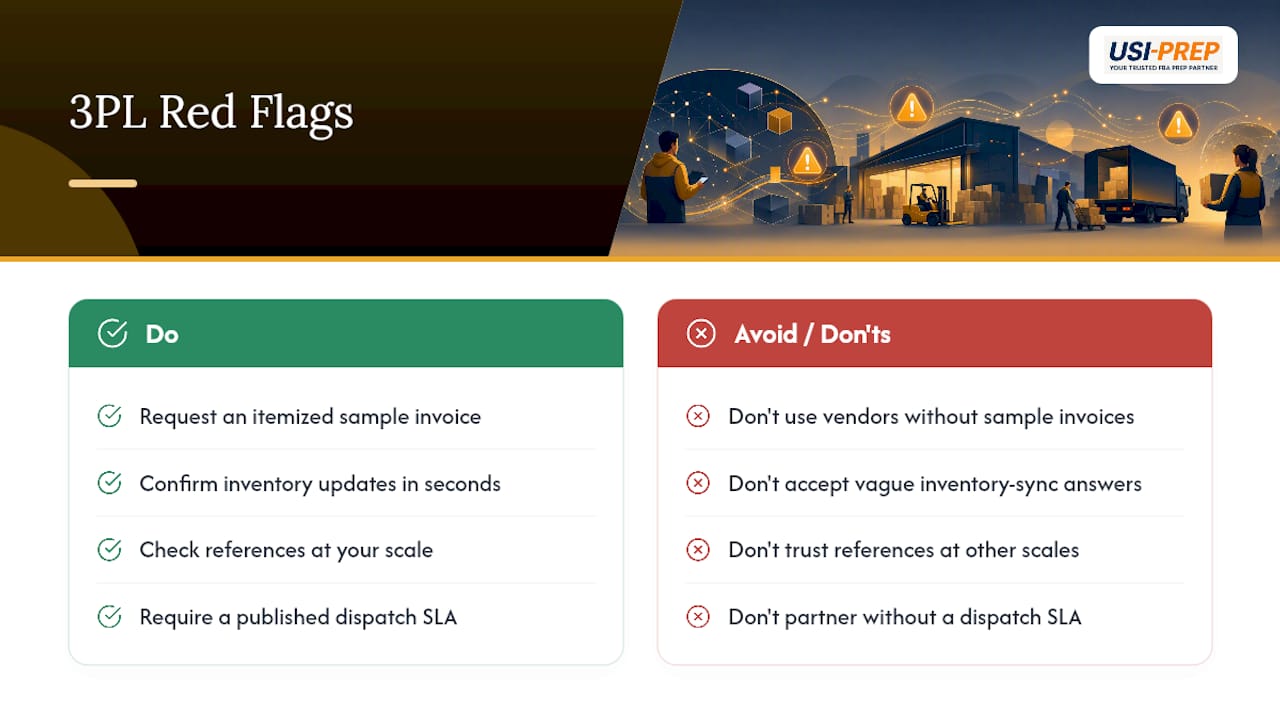
A vendor that can’t produce a sample itemized invoice is hiding something. Every legitimate 3PL should be able to show you a real client bill, with fees broken out by receiving, storage, pick-and-pack, and returns, on request.
Vague answers about inventory sync speed matter more than they seem. If a sales rep can’t tell you whether inventory updates in seconds or hours, assume it’s hours, and assume that gap will cost you oversells during your next viral moment.
Watch for reference clients who all operate at a much smaller or much larger scale than you. A 3PL comfortable with 50 orders a day may buckle at 500, and one built for enterprise volume may bury a smaller brand in minimum fees.
No published SLA for dispatch times is a dealbreaker for TikTok Shop specifically, since your Late Dispatch Rate is tracked against carrier scan timestamps, not warehouse promises. And any provider unwilling to commit to a written termination window, typically 30 to 45 days, is signaling they expect you to have trouble leaving.
Finally, be wary of contracts that value lost or damaged inventory at wholesale cost instead of landed cost. That difference determines what you actually get reimbursed when something goes wrong.
What Belongs on Your 3PL Onboarding Checklist?
A rushed onboarding is where most fulfillment relationships go wrong, usually within the first 60 days. Documentation comes first: your product catalog with dimensions and weights, any hazmat or FDA disclosures your SKUs require, your branded packaging specs, and your return policy in writing so the 3PL’s team isn’t guessing when a customer sends something back.
Compliance verification comes next. Confirm the provider carries adequate warehouse insurance, ask for their SOC 2 or equivalent security documentation if you’re sharing customer data through an integrated fulfillment platform, and get their inventory loss and damage policy in writing rather than taking a verbal assurance.
Training is the piece brands skip and regret. Walk the 3PL’s team through any kitting instructions, bundle assembly steps, or gift-note requirements specific to your TikTok Shop listings, since generic pick-and-pack training won’t catch brand-specific packaging rules. Confirm who handles customer-facing tracking questions and whether the 3PL or your team owns TikTok Shop’s Seller Center messaging during the transition.
Finally, set a 30-day and 90-day review checkpoint on the calendar before you ship a single unit. Waiting until something breaks to schedule that conversation defeats the purpose of having one.
How Do You Keep TikTok Shop Metrics Healthy Long-Term?
Fulfillment performance doesn’t stay fixed once you sign a 3PL contract. TikTok Shop’s algorithm rewards consistency, and a single bad week of late shipments during a promotional spike can suppress your visibility for weeks afterward.
Review your KPI dashboard weekly, not monthly. Order accuracy, on-time ship rate, and inventory accuracy all drift quietly if nobody’s watching, and monthly reviews catch problems too late to fix before they hit your Seller Center scorecard. Build a standing relationship with your account manager rather than only calling when something’s on fire; providers respond faster to sellers they talk to regularly.
Sync your marketing calendar with your 3PL before any planned spike, not after. Give them at least 48 hours’ notice on any planned promotion or influencer push you expect to drive volume.
Audit your return rate by SKU, not just in aggregate. A single product with a high return rate can quietly drag down your average processing time and customer satisfaction scores, even when everything else runs clean. Catching that pattern early, and either fixing the listing or the packaging, protects the metrics that matter most to TikTok Shop’s ranking system.
The Real Lesson Behind Every TikTok Shop Fulfillment Failure
Most advice on this topic treats 3PL selection like a one-time decision: pick a vendor, sign a contract, move on. That framing is backwards. The sellers who get burned aren’t the ones who chose badly on day one. They’re the ones who never built a system to catch drift after the honeymoon period ended.
The conventional wisdom oversells the sales call and undersells the parallel test. A vendor can say anything in a pitch meeting. Only a 30-day run with real orders, real returns, and real inventory audits tells you whether their promises match their systems. If there’s one thing this research makes clear, it’s that the brands who skip that step are the ones writing the angry reviews six months later.
Prioritize the boring stuff first: your own order data, your webhook sync speed requirements, and a written SLA with teeth. The flashy parts of fulfillment, kitting, branded unboxing, same-day promises, mean nothing if the basic dispatch clock keeps tripping your Late Dispatch Rate.
— Akbar
Ready to Run the Numbers on a TikTok Shop 3PL Pilot?
Usiprep gives you what most 3PL contracts hide until after you sign: itemized pricing you can actually model against your own order data, plus check-in speeds and communication that come from a team that ran their own Amazon storefronts before building this business.
The next move is simple. Run your break-even worksheet using your last 12 months of order data, build your SKU-level manifest, and request a pilot before your next TikTok Shop promotion. Usiprep’s FBA prep requirements checklist is a solid starting point if you’re prepping inventory for FBA and TikTok Shop from the same pool, and it walks through exactly what documentation to have ready before your first shipment lands.