
For most SMB ecommerce brands, an integrated provider that handles both custom packaging and fulfillment beats juggling separate vendors, since it cuts handoff errors and shortens time-to-customer. USIPrep, founded by former Amazon sellers, reports a 98.9% on-time delivery rate and up to 30% lower fulfillment costs for clients. Skip it only if you’re pre-revenue or testing a product with no committed order volume yet.
TL;DR:
- Choosing a single vendor for custom packaging and fulfillment reduces delays, errors, and costs, with reported fulfillment savings of up to 30 percent.
- The entire packaging lifecycle, from design to delivery, can take 8 to 12 weeks or longer, especially when special finishes or overseas manufacturing are involved.
- Verify a fulfillment provider’s SLA metrics, test sample quality, and negotiate a pilot run before committing to avoid surprises and ensure performance.
- Pricing should be itemized across setup, per-unit costs, storage, and labor, with domestic production costing more per unit but offering faster speed for testing new SKUs.
- Focus on provider transparency, reliable support with clear response times, quality control, damage prevention, and sustainable material options to minimize risks and meet brand values.
Table of Contents
- What Does Custom Packaging Fulfillment Actually Include?
- Why Combine Packaging and Fulfillment Under One Vendor?
- How Long Does the Packaging Fulfillment Process Take?
- How Do You Choose the Right Fulfillment Partner?
- What Does Custom Packaging Fulfillment Cost?
- What Proof Should You Ask a Packaging Fulfillment Provider For?
- How Should Customer Support and SLAs Work?
- How Are Returns and Exchanges Handled?
- What Sustainable Packaging Options Are Available?
- How Do Providers Prevent Damage and Quality Issues?
- What This Guide Gets Right That Most Advice Misses
- If You’re Ready: How USIPrep Can Help
- Sources
What Does Custom Packaging Fulfillment Actually Include?
The term covers more ground than “printing a logo on a box.” A full-service partner typically owns the entire chain from design through delivery, which is why brands increasingly favor one vendor over three.
Here’s what’s normally on the table:
- Custom boxes, mailers, and inserts — structural design, printing, foil or matte finishes, tissue paper, thank-you cards
- Kitting — assembling multi-item bundles or subscription boxes before they ship
- Pick-and-pack — pulling individual SKUs and packing orders as they arrive
- FBA prep — labeling, poly-bagging, and boxing units to Amazon’s inbound specs
- Returns processing — receiving, inspecting, and restocking or disposing of returned goods
The lifecycle runs design, then prototype, then approval, then production, then warehouse receiving, then fulfillment. Most providers plug directly into Shopify, BigCommerce, and Amazon, and they usually manage the carrier relationship on your behalf rather than leaving you to negotiate freight rates solo.
What’s often out of scope: retail shelf-ready packaging or planogram compliance, unless you specify it up front. If you’re selling into big-box retail as well as direct-to-consumer, confirm that separately. Bundled service offerings like this are common across the industry, as vendor listings show, but the exact mix varies enough that assuming coverage is a mistake worth avoiding.
Why Combine Packaging and Fulfillment Under One Vendor?
The marketing case is obvious: a branded unboxing moment drives social shares, referrals, and a sense that your product is worth more than its price tag. The operational case is where most owners underestimate the payoff.
Consolidating packaging fulfillment under one team reduces the number of handoffs between design, production, and shipping, and fewer handoffs generally means fewer delays and fewer costly mistakes. When a fulfillment center already stocks your custom boxes, you’re not waiting on a separate print vendor to ship inventory before an order can go out.
Watch these numbers monthly, not quarterly:
- On-time delivery rate
- Order accuracy rate
- Cost per order, fully loaded
- Average shipping days from order to doorstep
- Repeat purchase rate
Pro Tip: Track cost per order before and after switching to an integrated vendor for at least 60 days. A single month can be skewed by a bad SKU mix or a one-time setup fee.
A brand hitting 95% on-time delivery with a fragmented vendor setup usually has room to close that gap simply by removing a step, not by spending more.
How Long Does the Packaging Fulfillment Process Take?
Launch timing is where most owners get blindsided. Design and prototyping alone commonly run 8 to 12 weeks, and production and shipping stack on top of that depending on complexity and where the boxes are made.
- Brief and dieline — you specify dimensions, materials, and print requirements (1 to 2 weeks)
- Prototype — the vendor produces a physical sample for sign-off (2 to 4 weeks)
- Pilot production — a short run validates print quality, fit, and kitting accuracy before scaling
- Full production — 2 to 8+ weeks depending on finish complexity, tooling needs, and whether manufacturing is domestic or overseas
- Warehouse receiving — inbound inventory checked against purchase orders
- Fulfillment go-live — orders start shipping from stocked, branded inventory
Special finishes (foil stamping, embossing, custom tooling) add weeks. Overseas production adds freight transit time on top of manufacturing, and carrier choice between parcel and freight changes both cost and speed of getting finished packaging into the warehouse. Kitting and FBA prep don’t usually add to the critical path if the vendor schedules that labor in parallel with receiving, but it’s worth confirming that explicitly rather than assuming it.
How Do You Choose the Right Fulfillment Partner?
Skip the vendor-by-vendor spreadsheet comparison. Use a checklist instead, and make every vendor answer the same questions.
Confirm these capabilities before signing anything:
- Printing methods and finishing options they actually run in-house versus outsource
- Kitting and assembly capacity, including how they staff seasonal spikes
- Label and FBA prep experience, specifically with Amazon’s current inbound requirements
- Warehouse footprint and whether it matches your customer geography
- Integration suite: does it connect natively to your storefront and shipping software
Questions worth asking on the first call:
- What’s your sample policy, and is there a fee?
- What SLA metrics do you report, and how often?
- What’s the fee structure per activity (receiving, storage, pick, pack, kitting)?
- Are you insured for lost or damaged inventory?
- What does onboarding actually look like week by week?
Red flags include vague answers on SLA numbers, no willingness to share references, and reluctance to send sample photos before you commit. Any vendor confident in their process will hand over specifics without hesitation.
Pro Tip: Negotiate a pilot run before a long-term contract. A short trial batch, validated for print quality, fit, and kitting accuracy, protects your cash flow and gives you real performance data instead of a sales pitch.
What Does Custom Packaging Fulfillment Cost?
Pricing breaks into predictable buckets: setup or tooling fees, per-unit print and box cost, storage, pick-and-pack labor, kitting labor, FBA prep fees, returns handling, and outbound shipping. Every quote should itemize these separately, not bundle them into one opaque line.
- Setup/tooling — one-time cost for dies, plates, or custom molds
- Per-unit cost — drops sharply at higher volume, especially past standard MOQ breakpoints
- Storage — usually billed per pallet or per bin, per month
- Fulfillment labor — pick, pack, kitting, and FBA prep are typically billed per unit or per order
MOQs and sample costs vary widely. Online configurator platforms favor low MOQs and fast turnaround, while full custom manufacturing usually demands higher minimums in exchange for more design flexibility and lower per-unit pricing at scale.
Domestic production costs more per unit but ships faster; offshore production costs less per unit but adds weeks of transit. If you’re testing a new SKU, domestic often wins on speed. For a proven, high-volume SKU, offshore usually wins on margin.
Negotiation levers worth pushing on: SKU consolidation across product lines, scheduled reorder points that smooth production runs, and shared tooling amortized across multiple SKUs. Ask your vendor directly about fulfillment cost reduction strategies before you sign anything.
What Proof Should You Ask a Packaging Fulfillment Provider For?
Vendor claims are easy to make and hard to verify unless you know what to ask for. USIPrep, founded by former Amazon sellers, publishes two figures worth using as a benchmark when you’re evaluating any provider:
A 98.9% on-time delivery rate and up to a 30% reduction in fulfillment costs are the kind of numbers a serious provider should be willing to document, not just state on a landing page. Ask for the SLA language behind the number, sample onboarding metrics from real accounts, and at least one reference you can actually call.
Those two proof points map directly to what most SMB brands actually need: reliable FBA prep that doesn’t get flagged at inbound, faster inventory check-in so stock isn’t sitting idle, and transparent, itemized billing instead of a lump-sum invoice you can’t audit. When a vendor won’t share the SLA numbers behind their marketing claims, that’s the red flag worth walking away from.
How Should Customer Support and SLAs Work?
A packaging fulfillment partner without a real support structure will cost you more in lost time than any per-unit fee saves you. Before signing, find out exactly how issues get escalated and who owns the resolution.
Look for a named account contact, not a rotating support queue. Ask what response time is guaranteed for order errors, inventory discrepancies, and shipping delays, and get that number in writing. A vendor that says “usually within 24 hours” without committing to it in the contract is telling you something.
SLAs worth locking down specifically:
- On-time shipment percentage, with a defined remedy if it’s missed
- Order accuracy percentage
- Response time for support tickets, separated by severity
- Inventory discrepancy resolution window
Some providers offer tiered support, where higher order volume unlocks a dedicated account manager instead of a shared support inbox. If you’re scaling fast, ask about that threshold before you hit it, not after a bad month exposes the gap. The difference between a vendor that treats SLAs as a marketing bullet point and one that treats them as a contractual obligation usually shows up the first time something goes wrong.
How Are Returns and Exchanges Handled?
Returns are where a lot of fulfillment relationships quietly break down, because the process touches inventory, customer service, and packaging all at once. A capable provider receives the returned item, inspects it against your restock criteria, and either returns it to sellable inventory or flags it for disposal, all without you managing each case manually.
Ask specifically how returned items get reintegrated into stock counts, and how fast that happens. A return sitting in a receiving dock for two weeks before it’s back in inventory is lost sales, not saved cost.
Custom packaging complicates returns slightly. If your boxes are branded and single-use by design, a returned item may need repackaging in a standard mailer rather than the original custom box, which affects your unboxing consistency on exchanges. Confirm whether your vendor handles that repackaging as a standard service or bills it separately.
Exchanges add another layer: the outbound replacement order needs to ship fast enough that the customer doesn’t feel penalized for returning the wrong size or color. Ask what your provider’s average turnaround is from received return to shipped exchange, and hold them to a number, not a vague assurance.
What Sustainable Packaging Options Are Available?
Eco-conscious packaging has moved from nice-to-have to a real purchase driver for a growing share of online shoppers, and most credible providers now offer material options beyond standard corrugated cardboard.
Common choices include recycled or FSC-certified corrugated stock, soy-based or water-based inks instead of solvent inks, and compostable or recyclable mailers for lighter products. Some vendors also offer right-sized box engineering, which cuts material use and reduces void-fill needs, lowering both cost and environmental footprint at the same time.

Ask your provider directly what percentage of their packaging materials are recycled or certified, and whether they can supply documentation, not just a claim on their website. A vendor genuinely invested in sustainable materials will have that paperwork ready.
One tradeoff worth knowing upfront: eco-friendly materials sometimes carry a higher per-unit cost or longer lead time, particularly for certified stock sourced from limited suppliers. Weigh that against the brand value of visible sustainability messaging on your packaging, which for many DTC categories is now a real factor in purchase decisions rather than a marketing footnote.
How Do Providers Prevent Damage and Quality Issues?
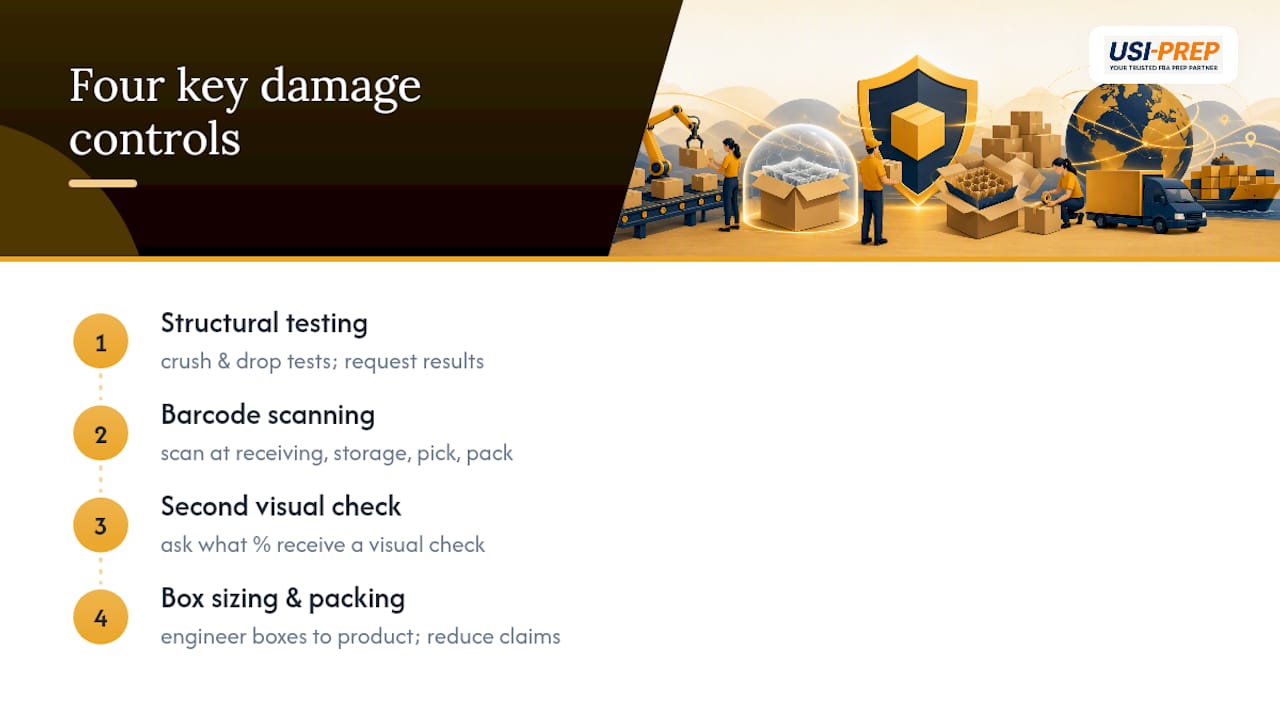
Damage in transit is usually a packaging engineering problem, not a shipping problem. The box, the void fill, and the way products are packed together determine whether an item survives a drop test far more than which carrier handles the last mile.
A quality provider runs structural testing on new box designs before full production, checking for crush resistance and drop performance under realistic warehouse and shipping conditions. Ask whether your vendor does this testing in-house or outsources it, and request the test results for your specific packaging, not generic industry data.
On the fulfillment side, quality control means barcode scanning at every touchpoint: receiving, storage, pick, and pack. Scan-based verification catches mis-picks before they ship, which is the single biggest driver of order accuracy. Ask what percentage of orders get a second visual check before sealing, especially for kitted or multi-item orders where mistakes compound.
Damage prevention also depends on packing density. Loose items rattling in an oversized box arrive damaged more often than tightly packed ones. A provider that engineers box sizing to the product, rather than defaulting to one standard size across your whole catalog, will show measurably lower damage claims over time. Ask for that damage claim rate as a real number, not a general assurance that “we’re careful.”
What This Guide Gets Right That Most Advice Misses
Most packaging content treats custom boxes as a design decision. That’s backwards. The design only matters if the box, the insert, and the fulfillment workflow around it actually ship on schedule and survive transit. Owners who chase the prettiest unboxing video before locking down lead times and SLA numbers end up with gorgeous packaging sitting in a warehouse they can’t move fast enough.
The conventional advice to “find the cheapest custom box supplier” also misses the real cost driver. Per-unit box price is a small fraction of your total cost per order once you count storage, labor, and the hidden cost of vendor handoffs causing delays. A slightly pricier integrated partner routinely beats a cheaper fragmented setup on total landed cost.
Prioritize this way: confirm the SLA numbers first, verify sample and pilot run terms second, negotiate price third. Brands that reverse this order usually end up locked into a contract before they know whether the vendor can actually deliver.
— Akbar
If You’re Ready: How USIPrep Can Help
USIPrep gives you both custom packaging and fulfillment through the same team, backed by a 98.9% on-time delivery rate and reported savings of up to 30% on fulfillment costs for existing clients.
Before you get on a call, have four things ready: your current SKU list, average monthly order volume, a packaging brief with any brand guidelines or dieline preferences, and a target ship date for your next production run. That’s enough for a real quote instead of a ballpark guess. Built by professionals experienced with common inventory and billing challenges, some fulfillment providers offer faster onboarding than generic 3PLs. If FBA prep is part of your plan, start with the FBA Prep Requirements Checklist so your first shipment goes in clean instead of getting flagged at inbound.
Sources
- End-to-End Custom Packaging Solutions | Zenpack
- Packaging Fulfillment | Repacking | Co Packaging
- Cubit | Custom Packaging Manufacturer | Boxes, Bags & Pouches | USA
- FedEx — overview (Wikipedia)