
An order cutoff time is the exact deadline an order must reach your 3PL’s system to be guaranteed same-day processing and carrier handoff. Confirm three things today: the cutoff time with its timezone, the same-day ship percentage written into your SLA, and whether weekends or holidays count toward that promise. Miss any of the three and an order placed at 3:59 PM might not ship until the next business day.
TL;DR:
- Confirm that the storefront cutoff time is set at least 30 minutes before the 3PL’s internal cutoff to allow for sync delays and address verification.
- Be aware that typical carrier pickup windows range from early morning for ground services to later times for express services, directly influencing the actual cutoff time.
- Ensure the SLA specifies a same-day ship percentage of at least 95 percent, with 99 percent or higher considered best-in-class, and verify how peak season affects these figures.
- Request detailed, recent raw shipment timestamps and demand weekly performance reports to verify that the 3PL consistently meets the cutoff and shipping commitments.
- Understand that extending a cutoff later usually incurs additional costs such as surcharges or dedicated pick lanes and that real-time capacity data can enable dynamic, more reliable cutoff scheduling.
Table of Contents
- How Order Cutoff Times Fit the Order-to-Carrier Chain
- Typical Cutoff Windows by Carrier and Service Level
- What Actually Limits How Late a Cutoff Can Be
- What to Put in Writing: The SLA and Contract Checklist
- Negotiating a Later Cutoff Without Breaking Your Margins
- Questions to Ask Before You Trust a Cutoff Commitment
- Three Ways to Make Your Cutoff Promise Actually Stick
- Get a Cutoff Commitment You Can Actually Rely On
- Sources
How Order Cutoff Times Fit the Order-to-Carrier Chain
A cutoff time isn’t one deadline. It’s a relay with four handoffs, and each one belongs to somebody different.
Your storefront sets the customer-facing cutoff. Your order management system (OMS) syncs that order to the 3PL’s warehouse management system (WMS), usually within minutes but sometimes with a lag. The 3PL’s internal cutoff determines whether pickers start on that order today. Then pick, pack, and staging have to finish before the carrier’s own pickup window closes. DCSA’s guidance on cutoff types makes a similar point about ocean freight: gate-in, documentation, and VGM cutoffs are distinct deadlines that need to sync across systems, not one blurry checkpoint.
That’s why your customer-facing cutoff should always sit earlier than the 3PL’s contractual cutoff, usually by 30 to 90 minutes. That buffer absorbs OMS sync delays, payment holds, and address verification issues before they eat into pick time.
A basic alignment sequence looks like this:
- Set the storefront cutoff at least 30 minutes ahead of the 3PL’s system cutoff.
- Confirm how fast your OMS pushes orders to the WMS (real time versus batch).
- Ask the 3PL what happens to an order that arrives one minute late.
- Match your marketing copy (“Order by 2 PM for same-day shipping”) to the actual, tested cutoff, not the aspirational one.
Typical Cutoff Windows by Carrier and Service Level
Cutoff times track carrier pickup schedules almost exactly, and pickup schedules vary more than most merchants assume. Ground service pickups often run earlier in the day, while express services (next-day air, priority overnight) tend to have later last-pickup windows because carriers route those parcels through faster sortation. SmartSMSSolutions notes that pickup windows differ by carrier and service type, and that gap directly shapes what cutoff a 3PL can realistically offer.
Regional couriers and local drop-off arrangements sometimes stretch cutoffs later, into the 5 or 6 PM range, but usually at the cost of narrower delivery coverage or a smaller carrier network.
- A 2:00 PM cutoff typically reflects a single daily pickup with standard ground service and average pick/pack complexity.
- A 4:00 PM cutoff usually means either a second daily pickup, an on-site carrier drop-off, or a smaller order volume that clears the floor faster.
- A cutoff past 5:00 PM is rare for standard parcel and almost always tied to a premium tier or a dedicated carrier arrangement.
Same-day ship SLA bands, per industry guidance: roughly 95% is considered an acceptable baseline for 3PL contracts, while 99%+ is treated as best-in-class performance. If your provider won’t commit to a number in that range, that’s a red flag worth pressing on before signing.
What Actually Limits How Late a Cutoff Can Be
Cutoffs aren’t arbitrary. They’re a byproduct of how much work a warehouse can physically finish between “order received” and “truck leaves the dock.” Racklify’s breakdown of cutoff-driving constraints identifies four gating factors, and understanding them lets you audit whether a 3PL’s stated cutoff is realistic or optimistic.
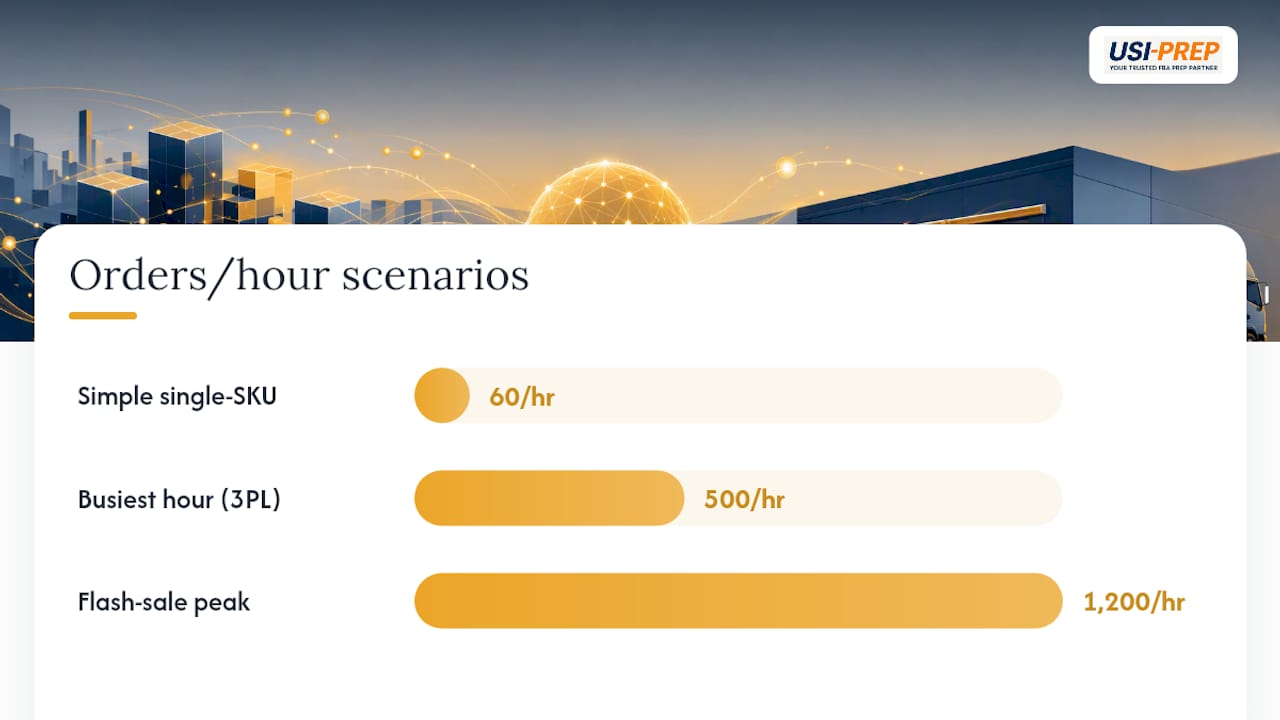
Throughput comes first. Picks per hour and orders per hour set a hard ceiling on how much volume can clear before the truck leaves. A warehouse that averages 60 orders per hour on simple single-SKU picks slows dramatically on multi-item or kitted orders, which changes the math entirely.
Sortation and staging matter just as much. Conveyor throughput and the number of dock doors available determine how fast packed orders move from pack station to trailer, and a facility with two doors hits a wall a ten-door facility never sees.
Staffing and shift handovers create their own ceiling. A cutoff scheduled right at a shift change often slips because the incoming crew needs ramp-up time.
Order complexity pushes cutoffs earlier across the board. Kitting, bundling, and cold-chain handling all take longer per unit, so a 3PL running heavy kitting volume needs an earlier cutoff than one shipping single-SKU apparel.
- Ask for orders-per-hour throughput by SKU complexity, not a blended average.
- Ask how many dock doors are dedicated to your account’s outbound volume.
- Ask what happens to your cutoff during a peak-season staffing crunch.
Pro Tip: Ask your 3PL for their busiest hour’s actual throughput number, not their average. A facility that handles 500 orders/hour on a slow Tuesday can fall apart at 1,200 orders/hour during a flash sale, and that’s exactly when your cutoff promise gets tested.
What to Put in Writing: The SLA and Contract Checklist
A verbal promise about cutoff hours is worthless the first time volume spikes. The contract needs specific, measurable language, and SmartSMSSolutions’ 3PL selection guide lays out the core elements worth demanding before you sign anything. A guide to how fulfillment SLAs work walks through the same metrics in more depth.
Your SOW or RFP should specify:
- The exact cutoff time, stated with its timezone (not “2 PM” but “2:00 PM Eastern”).
- Which days the cutoff applies to, including weekends and named holidays.
- The same-day ship percentage the 3PL commits to, and the measurement window used to calculate it.
- A precise definition of “shipped” (label printed versus carrier scan versus physical departure).
- Named exclusions (severe weather, carrier outages, force majeure events).
- How the cutoff and SLA percentage change during peak season.
Beyond the definitions, insist on reporting cadence and remedy terms:
- Weekly or biweekly SLA performance reports, broken out by cutoff compliance and ship percentage.
- A defined remedy (credit, fee reduction) if the 3PL misses its committed percentage for two consecutive reporting periods.
- The right to audit raw shipment timestamps, not just summary percentages.
International sellers should also separate warehouse cutoffs from customs and documentation deadlines. Importer Security Filing (ISF) is due 24 hours before ocean loading at origin, an entirely different clock from your domestic parcel cutoff, and confusing the two causes real delays at the port.
Negotiating a Later Cutoff Without Breaking Your Margins
Pushing a cutoff later almost always costs something. The question is whether that cost fits your margin and whether your customers value the extra hour enough to pay for it.
- Late-cutoff fees buy a fixed extension (say, 90 minutes) for a per-order surcharge, usually the cheapest lever for moderate volume.
- Prioritized pick/pack lanes dedicate staff or equipment to orders placed after the standard cutoff, which works well for high-margin SKUs but doesn’t scale cheaply across a full catalog.
- Carrier drop-off arrangements, where the 3PL trucks orders directly to a carrier hub instead of waiting for scheduled pickup, can add 30 to 60 minutes without a big cost jump.
- Multiple daily pickups split volume across two windows, which raises effective cutoff flexibility but requires enough order density to justify the second pickup.
Real-time telemetry and warehouse technology that shares live throughput data let a 3PL offer dynamic cutoffs that shift based on actual floor capacity that day, rather than a fixed number baked into the contract. Racklify’s operational analysis treats this kind of dynamic, staggered cutoff as one of the more durable fixes for merchants who outgrow a flat sitewide deadline.
Questions to Ask Before You Trust a Cutoff Commitment
Most 3PLs will quote a cutoff time confidently. Fewer can back it with data. Before you rely on one for storefront promises, ask for the exact time with timezone, the same-day ship percentage tied to it, actual carrier pickup windows at that facility, and how weekends, holidays, and peak season change the number. Ask separately about special-handling cutoffs for kitted, fragile, or cold-chain SKUs, since those almost always run earlier than the standard deadline.
Usiprep tracks cutoff compliance and same-day ship rate as standing operational metrics, reporting a 98.9% on-time delivery rate across client shipments, because a cutoff commitment that isn’t measured tends to quietly slip.
- Request the last 30 days of raw ship-timestamp data, not a summary number.
- Ask what percentage of orders placed in the final 15 minutes before cutoff actually shipped same day.
- Confirm reporting format and frequency before you sign, not after.
Pro Tip: Run a two to four week pilot on any new cutoff claim, using real order volume and tracking same-day ship rate, pick accuracy, and overtime minutes, before you change a single word on your storefront.
Three Ways to Make Your Cutoff Promise Actually Stick
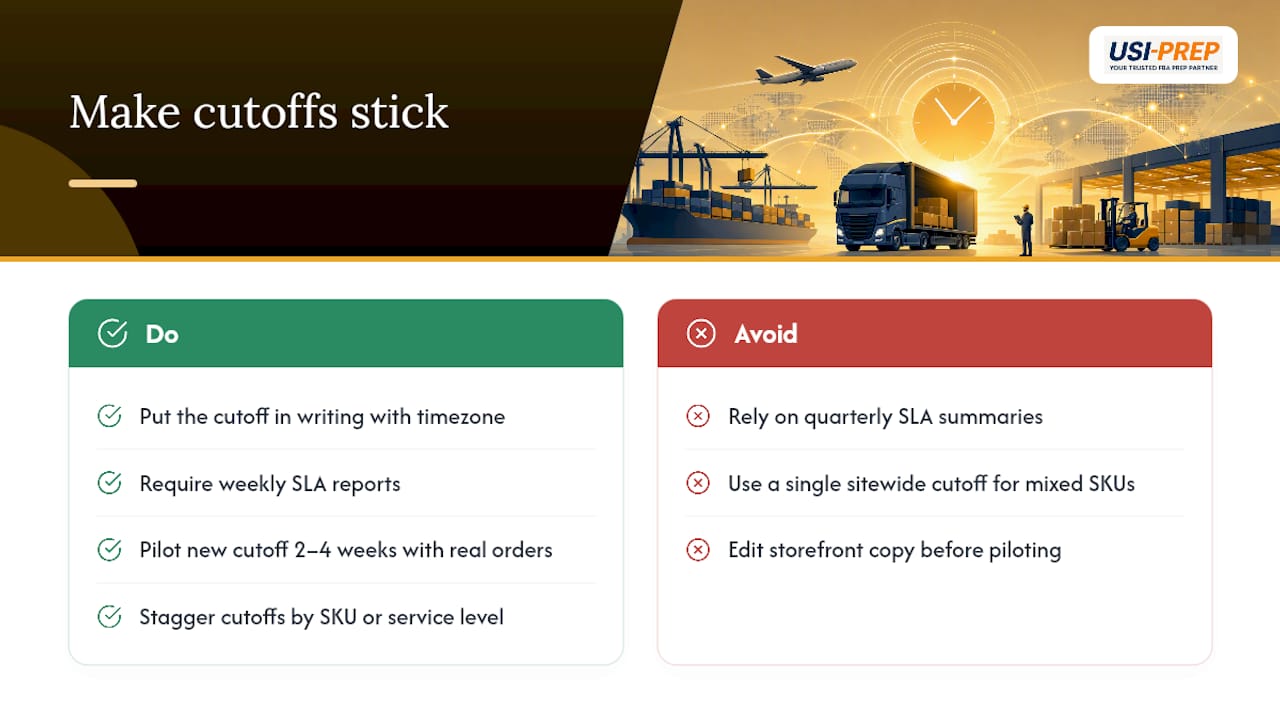
Get the cutoff in writing with a timezone attached, and demand weekly SLA reports, not a quarterly summary that hides bad weeks. Before you touch your storefront copy, pilot any later cutoff for two to four weeks against real order samples. If it doesn’t hold up under actual volume, you’ll know before your customers do.
Skip the single sitewide cutoff if your catalog mixes simple and complex SKUs. Staggered cutoffs by service level or SKU type usually beat a flat deadline that’s either too conservative for easy orders or too aggressive for kitted ones.
— Akbar
Get a Cutoff Commitment You Can Actually Rely On
Most merchants find out their 3PL’s cutoff promise was fiction the first time a flash sale hits. Usiprep was built by former Amazon sellers who ran into that exact problem, which is why cutoff times, same-day ship rate, and SLA reporting are tracked and shared, not buried in a quarterly summary. Clients working with Usiprep have seen fulfillment costs drop by roughly 30% alongside that 98.9% on-time delivery track record, with faster inventory check-ins built into the process rather than bolted on.

If you’re prepping inventory for Amazon FBA and need cutoff timing that matches your inbound schedule, start with the FBA prep requirements checklist to see exactly what needs to happen before your stock ever reaches the fulfillment floor. From there, request an intake call and walk through your actual order volume, SKU mix, and current cutoff pain points with the team directly.