
Don’t pick EDI or API exclusively. Classify each integration flow, then run a hybrid layer that translates between them. Use ANSI X12 documents like the 856 ASN and 810 invoice wherever a retailer or partner mandates standardized paperwork, and lean on APIs or webhooks for real-time events like inventory updates. A translation layer, often built on an iPaaS, lets Usiprep and similar operators run both without forcing partners to change formats.
TL;DR:
- Most 3PLs require both EDI and API integration methods, with EDI supporting mandated documents like purchase orders and ASNs, and APIs providing real-time updates.
- Implementing a hybrid integration with a translation layer reduces setup time, streamlines processes, and avoids forcing partners to adopt a single format.
- Expect several weeks for EDI partner certification and testing, compared to days for API onboarding if systems are well-documented and clean.
- Secure, resilient API setups use message queues, backpressure controls, and retry logic with idempotency keys to handle spikes and avoid duplicate orders.
- Critical questions for vendors include supported transaction sets, SLA timings, security controls, audit logs, and onboarding costs to ensure compatibility with operational needs.
Table of Contents
- EDI vs API for 3PL: A Quick Comparison
- What Is EDI and Which Transaction Sets Matter Most?
- How Does API Work in 3PL Integrations?
- Building a Hybrid EDI and API Architecture
- Questions to Ask a 3PL About Its Integration Options
- How Long Does EDI and API Integration Take With a 3PL?
- Security and Operational Best Practices for EDI and API
- What Small and Mid-Size Ecommerce Brands Should Prioritize
- Get Hands-On Help With Your 3PL Integration Setup
- Sources
EDI vs API for 3PL: A Quick Comparison
Neither format wins outright. Each fits a different job, and the smartest 3PL operations use both depending on what’s flowing and who’s on the other end.
EDI strengths:
- Mandated by most major retailers (Walmart, Target, Amazon vendor programs) for PO, ASN, and invoice exchange
- Battle tested over decades, with predictable structure and legal precedent in trading-partner agreements
- Strong governance and audit trails through acknowledgment documents
EDI weaknesses:
- Higher latency (batch based, often hours behind real time)
- Steep mapping effort per new partner, since every trading partner tweaks its own dialect
API strengths:
- Near-instant data exchange, ideal for inventory counts, order status, and shipment tracking
- Easier for developers to build against, test, and extend with modern tooling
API weaknesses:
- No universal standard, so every 3PL’s API looks different
- Rarely mandated contractually, which means adoption depends on both sides investing in integration
As a rule of thumb: purchase orders, ASNs, and invoices lean EDI. Inventory syncs, order status pings, and exception alerts lean API. Onboarding an EDI trading partner typically runs several weeks once mapping and certification testing are factored in, while a well documented API integration can go live in days if both systems expose clean endpoints.
What Is EDI and Which Transaction Sets Matter Most?
EDI (Electronic Data Interchange) moves structured business documents between systems using fixed standards. In North America, that mostly means ANSI X12; European and international trade often runs on EDIFACT instead. For 3PL work, a handful of transaction codes cover nearly everything:
- 850 — Purchase order
- 856 — Advance ship notice (ASN)
- 940 — Warehouse shipping order
- 945 — Warehouse shipping advice
- 943/944 — Stock transfer shipment and receipt
- 810 — Invoice
- 846 — Inventory inquiry/advice
These document types form the backbone of how retailers, warehouses, and 3PLs talk to each other about what shipped, what arrived, and what’s owed.
Transport matters as much as the document format. EDI moves over AS2 (the most common secure transport for direct partner connections), SFTP, value-added networks (VANs) that route traffic between multiple trading partners, or increasingly through cloud EDI platforms that handle translation as a service.
Every EDI exchange should generate an acknowledgment, typically a 997 for X12 or a CONTRL message for EDIFACT, confirming the document was received and structurally valid. Skipping this step is how shipments go missing without anyone noticing for days. Budget real time for partner-specific dialect quirks: even within the same 856 spec, two retailers can format the same field differently, and mapping that gap is where most implementation hours go.
How Does API Work in 3PL Integrations?
APIs move data through direct, on-demand calls between systems, usually formatted as JSON over REST, sometimes GraphQL for more complex querying. Webhooks flip that model: instead of asking “did anything change?” on a schedule, the 3PL’s system pushes a notification the instant it does, which is what makes APIs so useful for order status and exception alerts.
Authentication typically runs through OAuth2 tokens or, for higher security environments, mutual TLS (mTLS) between systems. Below that layer, a few engineering controls separate a stable integration from a fragile one:
- Rate limits that cap how many calls a client can make per minute
- Versioning so a partner’s API update doesn’t silently break your integration
- Idempotency keys that prevent duplicate orders when a retry fires twice
- Message queues that buffer traffic during demand spikes
Pro Tip: If your ecommerce platform sends a burst of orders during a flash sale, a queue between your storefront and the 3PL’s API absorbs that spike instead of letting it hammer the warehouse management system directly. This kind of buffering is what keeps API integrations resilient under load rather than falling over.
Where APIs really pay off is exception handling. A stuck shipment, a short pick, a damaged unit. Instead of waiting for a batch file, you get a webhook the moment it happens, which shortens the gap between a warehouse problem and a customer service response.

Building a Hybrid EDI and API Architecture
Most 3PL operations end up running an integration platform as a service (iPaaS) or a similar broker layer that mediates between partner EDI feeds and internal APIs. This layer handles mapping, orchestration, monitoring, and retries, so your internal systems talk one consistent language while external partners keep whatever format they already require.
The practical approach is to build a canonical data model internally, one consistent structure for orders, inventory, and shipments, and translate at the boundary. A partner sends an EDI 850, the broker translates it into your internal schema, and your system never has to know EDI existed. That same architecture pattern works in reverse when your system needs to speak EDI back out to a retailer.
| Flow | Common method | Typical transport |
|---|---|---|
| Fulfillment request | API or EDI 940 | REST/JSON or AS2 |
| Inventory update | API or EDI 846 | Webhook or VAN |
| Advance ship notice | EDI 856 | AS2/SFTP |
| Invoice | EDI 810 | AS2/VAN |
Some cloud EDI platforms now accept JSON internally and translate to X12 on the way out, which means your developers never have to write raw EDI mapping code at all.
Questions to Ask a 3PL About Its Integration Options
Before signing with any 3PL, get specific answers on how their systems actually talk to yours. A checklist beats a sales pitch here.
- Which transaction sets and API endpoints do you support out of the box? Get the exact list, not a vague “we do EDI.”
- Is there a sandbox and certification process before go-live? No sandbox is a red flag worth walking away from.
- What are your SLA timings for ASN and invoice delivery? Ask for hours, not “same day.”
- How do you monitor and alert on failed transactions? You want proactive alerts, not a support ticket you have to open first.
- What security controls protect data in transit? Confirm AS2 encryption or mTLS, not just “we’re secure.”
- What’s the onboarding timeline and fee structure? Get this in writing before committing.
- Do you keep audit logs for every transaction? If they can’t produce a log trail on request, that’s a problem later, not now.
Classify your own flows first: urgency, volume, and compliance requirements determine whether a given flow belongs on EDI or API before you even start the vendor conversation.
How Long Does EDI and API Integration Take With a 3PL?
Expect a phased rollout, not a flip of a switch.
- Discovery and canonical model. Identify who exchanges what, how often, and which flows are contractually mandated versus optional.
- Sandbox mapping and test payloads. Build and validate test transactions in a non-production environment before touching live orders.
- Partner certification. Retailers and 3PLs typically require formal certification testing for EDI documents before go-live.
- Staged cutover and monitoring. Move one flow at a time, watching acknowledgment rates and error logs closely during the first cycles.
A low-risk early win: add a read-only status API and webhooks before touching any core EDI document. It delivers visibility fast without renegotiating a single trading partner agreement. Keep a rollback plan and a monitoring dashboard ready before go-live day, not after something breaks.
Security and Operational Best Practices for EDI and API
Every integration needs controls that catch failures before a customer does. For EDI, that means AS2 message signatures and encryption, plus regular SFTP key rotation. For APIs, it means OAuth2 tokens or mTLS certificates that expire and rotate on a schedule, not ones set once and forgotten.
Observability matters just as much as security. Correlation IDs let you trace a single order across every system it touches, and durable exchange logs mean you can answer “did the ASN actually send?” without guessing. Map every 997 or CONTRL acknowledgment back to its business transaction so a silent failure doesn’t sit unnoticed for days.
- Use message queues to absorb bursty order volume during peak seasons
- Set rate-limit strategies and backpressure controls so a spike doesn’t take down your WMS
- Build retry logic with idempotency keys so a retried call never creates a duplicate order
Buffering isn’t optional at scale. Message queues protect WMS and ERP systems from bursts and give you durable retry semantics when a downstream system briefly goes offline.
What Small and Mid-Size Ecommerce Brands Should Prioritize
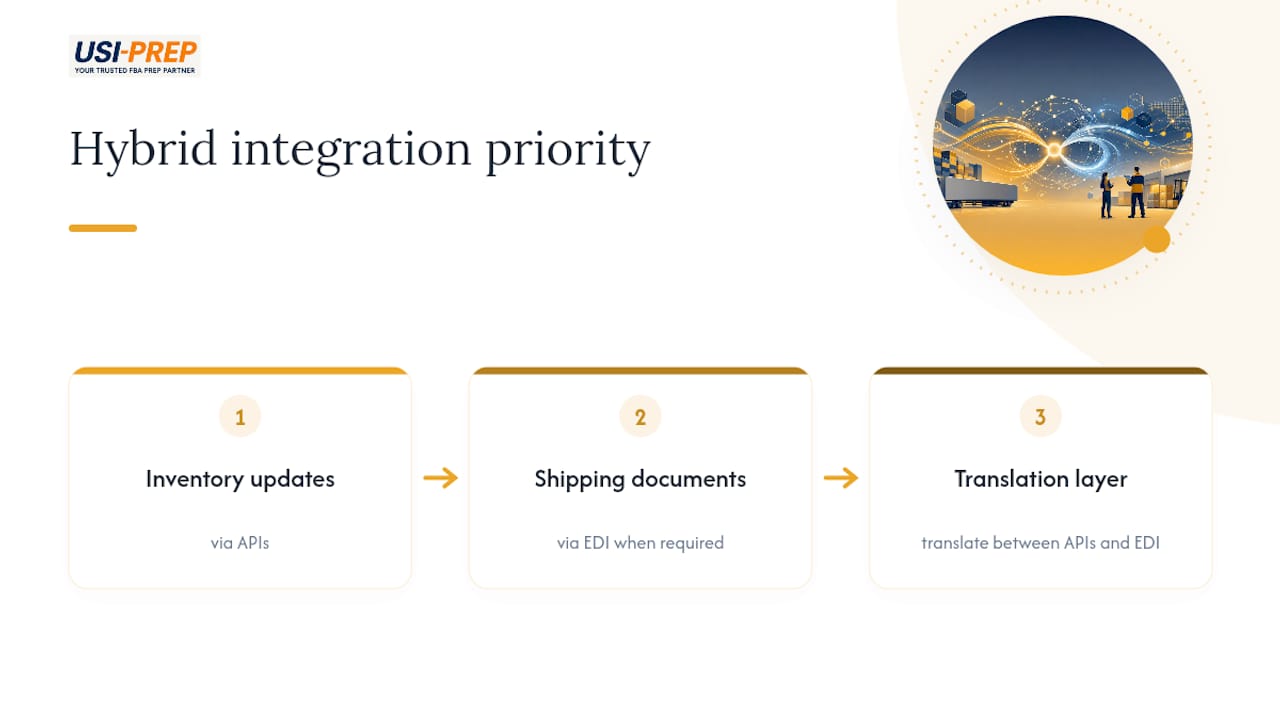
Founded by former Amazon sellers, Usiprep built its process around the frustration of slow inventory check-ins and opaque fulfillment communication. Operationally, hybrid integration means a seller’s inventory updates flow in through APIs while formal shipping documents still move through EDI where retailers require it, all translated at one layer so nothing gets lost between systems.
— Akbar
Get Hands-On Help With Your 3PL Integration Setup
There are fulfillment partners that have built translation layers between retailer-mandated EDI and the real-time visibility operations teams want, removing the need to guess through EDI mapping and API documentation alone.

If you’re gearing up for FBA prep or evaluating your current 3PL’s integration setup, start with a few concrete steps:
- Pull the FBA prep requirements checklist to see exactly what documentation and labeling your inventory needs before it ships
- Compare your current fulfillment costs against typical 3PL cost benchmarks to see where a managed integration could save money
- Book a consult with Usiprep to walk through your specific EDI and API requirements before your next inventory shipment goes out
Sources
- 3PL integration: How to automate fulfillment across ERP, ecommerce, WMS, and EDI – Celigo
- How to Integrate 3PL Systems with Client E‑Commerce Platforms: Complete Guide
- EDI vs API — IBM (overview)
- EDI vs APIs: Which is the right tool for B2B integration? — TIBCO