
A single-item direct-to-consumer order typically runs between mid-range costs around $2.75 in pick and pack fees. Each additional item usually adds a moderate additional fee. Your actual invoice depends on order mix, packaging complexity, and any special handling, but those two numbers are enough to start a real budget. Usiprep bills these charges as itemized line entries, not a bundled mystery fee.
TL;DR:
- The typical first-item pick and pack fee ranges from $1.50 to $3.50, with additional items costing around $0.30 to $0.75 each, depending on the provider.
- Large, bulky, or fragile items often trigger extra handling surcharges beyond the base pick and pack fee, increasing overall costs.
- Pricing structures vary widely, including flat per-order fees, per-line charges, tiered volume discounts, and combined all-in proposals, which can hide hidden fees.
- Volume thresholds, SKU complexity, package size, and special handling needs significantly influence the final pick and pack costs.
- Negotiating begins with carriers and storage, as those costs are more flexible, with packaging optimization and pre-kitting offering cost savings at scale.
Table of Contents
- What Pick and Pack Fees Cover
- Typical Pick and Pack Price Ranges and Worked Examples
- How 3PLs Structure Pick and Pack Billing
- What Makes Pick and Pack Quotes Vary
- How to Calculate Your Monthly Pick and Pack Spend
- Negotiating and Reducing Pick and Pack Fees
- The Reality Behind Transparent Pick and Pack Pricing
- Get an Itemized Pick and Pack Quote
- Sources
What Pick and Pack Fees Cover
Pick and pack fees pay for the physical labor of pulling your product off a shelf, boxing it, and getting it ready to ship. That sounds simple until you watch it happen at scale across thousands of SKUs a day.
The labor component covers a warehouse worker walking to a bin, scanning or verifying the item, selecting the correct quantity, and moving it to a packing station. That “pick” step is billed separately from the “pack” step, which covers boxing, void fill, sealing, and applying the shipping label and manifest. Some 3PLs fold both into one flat per-order fee. Others itemize them.
Packaging materials get billed one of two ways. A cost-plus model charges you for the actual box, tape, and filler used, plus a markup. A flat fee model bundles a standard poly bag or small box into the per-order price regardless of what you actually use, which works fine until your product needs an oversized box and you get hit with an accessorial charge.
Beyond the basics, most rate cards list add-ons separately:
- Kitting or bundling multiple SKUs into one sellable unit
- Custom or branded packaging insertion
- Returns processing and inspection
- Hazmat handling for batteries, aerosols, or flammable liquids
Reading a quote line by line, rather than trusting the headline number, is the single best habit for avoiding invoice surprises. A breakdown of fulfillment cost components can help you see where postage, labor, and packaging separate on paper.
Typical Pick and Pack Price Ranges and Worked Examples
Published rate guides for 2026 put the first-item fee at $1.50 to $3.50, with additional items landing between $0.30 and $1.00 depending on the provider, according to Warehousingcosts. A separate synthesis of current rate cards gives a slightly tighter band: $1.50 to $3.00 for the first item (working midpoint $2.75) and $0.30 to $0.75 for each additional item (working midpoint $0.50), per Eightx’s 2026 order-size analysis.
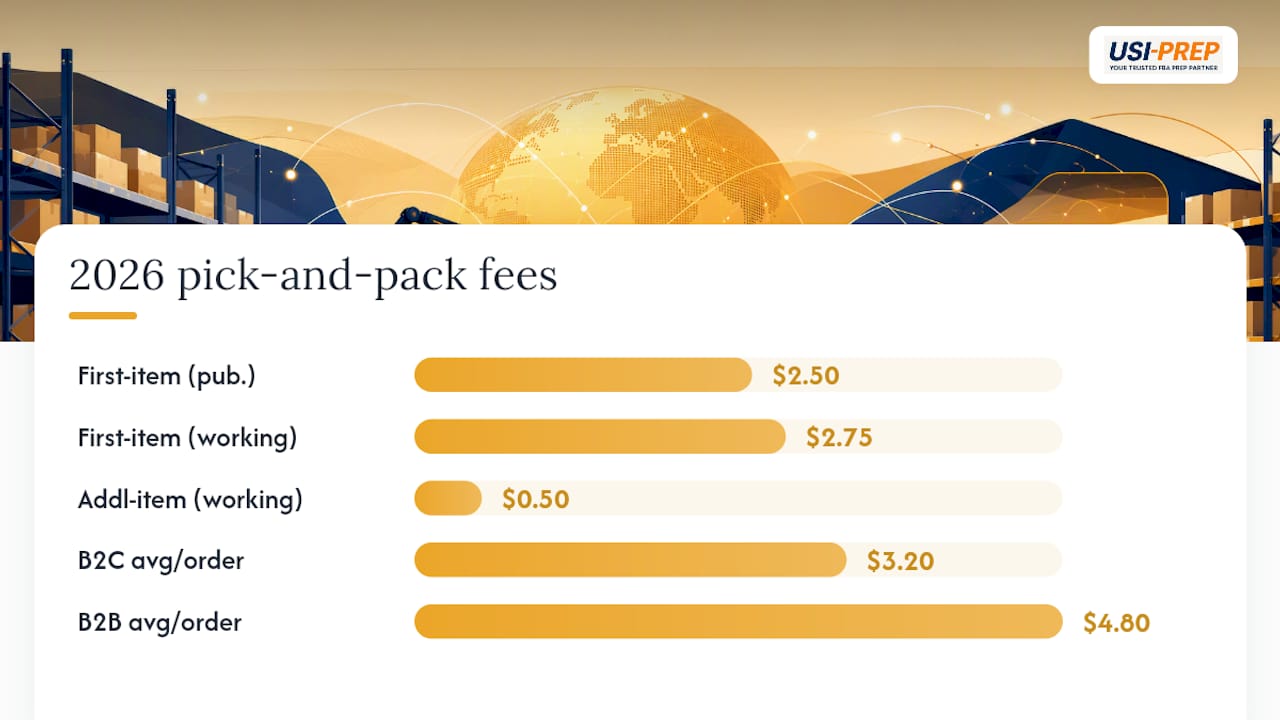
A survey of more than 600 warehouses found the 2025 industry average for B2C pick and pack sits at $3.20 per order plus $0.48 per additional item, while B2B orders average $4.80 because they tend to involve more complex packing and documentation, according to The Fulfillment Advisor’s rate guide.
Here’s what those ranges look like against real order profiles:
The oversized example runs higher because fragile or bulky items often trigger a per-order handling surcharge on top of the base pick fee, separate from any dimensional-weight shipping surcharge.
How 3PLs Structure Pick and Pack Billing
Rate cards aren’t standardized, so the same order can price out differently depending on which billing model a provider uses.
- Per-order flat fee: works well for single-item orders but penalizes you on multi-line baskets since you’re paying the same rate regardless of complexity.
- Base plus per-line or per-unit: a small base charge covers order setup, then each line item or unit adds its own fee. This scales more fairly with basket size.
- Tiered volume pricing: per-order costs drop as monthly volume crosses set thresholds, often 5,000, 25,000, and 100,000 orders.
- Hourly or contract labor: less common for eCommerce, more typical for B2B or highly custom kitting work.
- Blended all-in proposals: one number covers pick, pack, and materials, which simplifies forecasting but can hide savings if your orders skew heavily toward single items.
Watch for invoice details that don’t show up on the headline rate: minimum monthly fees, account maintenance charges, and storage costs used to offset an artificially low pick fee. A checklist of hidden fulfillment contract fees covers exactly where these show up.
What Makes Pick and Pack Quotes Vary
- Monthly volume. Crossing thresholds like 5,000 orders a month commonly unlocks discounts of 15% to 30% off standard per-order rates.
- SKU count and warehouse spread. More SKUs spread across more bins means longer walk time per pick, which raises labor cost even at the same unit count.
- Package size, weight, and fragility. Oversized, heavy, or breakable items trigger handling surcharges beyond the base fee.
- Custom packaging and kitting. Branded inserts, gift wrapping, or pre-built bundles add labor minutes that get billed separately.
- Returns processing and temperature control. Reverse logistics and cold-chain requirements carry their own premium, often quoted outside the standard pick and pack line.
How to Calculate Your Monthly Pick and Pack Spend
- Pull your order metrics. Get total monthly orders, average lines per order, and average units per order straight from your order management or eCommerce platform.
- Apply the formula: (orders × per-order fee) + (lines × per-line fee) + (units × per-unit fee) + (orders × materials cost) + apportioned monthly account fees.
- Run a sample. At 5,000 orders a month, 1.5 lines per order, and 3 units per order, using a $1.00 base, $0.50 per line, and $0.50 per unit: (5,000 × $1.00) + (7,500 × $0.50) + (15,000 × $0.50) = $5,000 + $3,750 + $7,500 = $16,250, before materials and account fees.
- Add materials and fixed charges. If materials run $0.35 per order, add $1,750. If there’s a flat $500 monthly account fee, add that too, bringing the estimate to roughly $18,500.
- Recheck quarterly. Order mix shifts with seasonality, so rerun the math whenever your average units per order moves more than 10%.
Negotiating and Reducing Pick and Pack Fees
The order in which you negotiate matters more than most sellers realize. Start with carrier surcharges since they’re often the most bloated line on the invoice, then push on storage, and only then negotiate the pick and pack rate itself. Providers have more room to move on the first two, and showing you’ve already trimmed those costs gives you leverage on the third.
- Pre-kit your most common bundles so multi-item orders bill as fewer lines.
- Ask for blended or volume-tier pricing once you’re consistently above 1,000 orders a month.
- Request SLA-backed credits for picking errors or late shipments, not just a verbal promise.
- Decide whether to supply your own packaging materials or let the 3PL bill cost-plus, depending on which is actually cheaper at your volume.
Packaging optimization and pre-kitting can save more than $0.25 to $0.50 per order at scale by cutting the labor minutes spent per pick, according to FreightFigures’ cost breakdown. A related guide to cutting shipping costs covers the carrier side of that stacked negotiation.
Pro Tip: Ask any 3PL for their full rate card, not just the pick and pack line. A quote that only shows pick fees is usually hiding the real cost somewhere else on the invoice.
The Reality Behind Transparent Pick and Pack Pricing
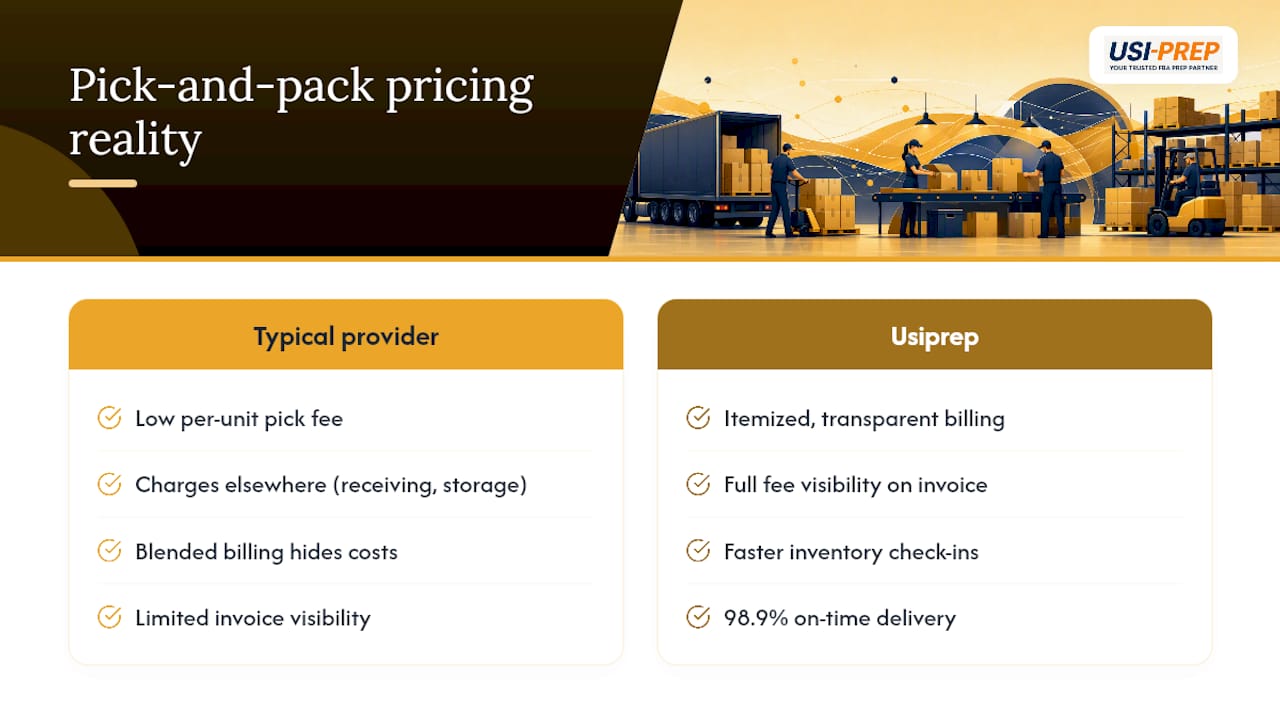
Most fee disputes I’ve seen in this industry come down to one thing: sellers negotiate the wrong line item. They fixate on shaving ten cents off the per-unit pick fee while ignoring a storage line that quietly doubled. A provider with a suspiciously low pick fee almost always makes it back somewhere else on the invoice, whether that’s receiving fees, storage minimums, or account charges buried in the fine print.
Usiprep was built by former Amazon sellers who got burned by exactly this pattern, which is why the pricing model runs on itemized, transparent billing instead of a blended number that hides where the money actually goes. That approach, combined with faster inventory check-ins and full visibility into every stage of the process, is part of why brands working with Usiprep report a 98.9% on-time delivery rate and, in many cases, a 30% reduction in total fulfillment costs. The lesson for any seller shopping quotes: read the whole rate card before you sign anything.
— Akbar
Get an Itemized Pick and Pack Quote
Pick, pack, and ship services can be offered as a transparent, line-by-line service, not a flat number designed to obscure where your money goes. That means you see the pick fee, the packaging cost, and any add-on separately, so you can spot exactly where a quote is padded before you commit to a contract. For sellers who also move inventory through Amazon, some providers handle FBA prep, inventory check-ins, and labeling under one roof, which cuts the coordination overhead of juggling separate vendors.
If you’re comparing your current 3PL invoice against what you should actually be paying, start with a breakdown of fulfillment cost components and request a custom quote based on your real order volume and SKU mix. It takes one conversation to find out whether your current rate card is fair or padded.
Sources
3PL Pricing & Rates Guide · Eightx 2026 Pick and Pack Cost Analysis · Shippo Shipping and Handling Fee Guide · WarehousingCosts.com Pricing Breakdown
- 3PL Pricing & Rates Guide
- Average ecommerce 3PL pick and pack cost by order size, 2026: $2.75 first item, $0.50 each additional | Eightx
- Warehousingcosts