
The true cost of fulfillment is defined as every expense tied to getting an order from your warehouse to your customer’s door, including costs most sellers never see on a single invoice. For small eCommerce businesses, this number typically runs $8–$15 per order domestically when you account for shipping, pick and pack labor, storage, returns, and hidden fees. That range matters because sellers who only track quoted 3PL rates or shipping postage are measuring the wrong number entirely. Accurate profit analysis starts with knowing your real fulfillment cost, not the advertised one.
How to calculate the true cost of fulfillment
The cost of order fulfillment breaks into four distinct layers: product costs, operational fulfillment costs, processing fees, and overhead allocations. Most sellers only track one or two of these. Missing even one layer produces a margin estimate that is off by a meaningful amount.
Product cost layer
Your product cost is not just the price you paid the supplier. True COGS equals the unit cost plus inbound freight, import duties, and packaging materials. Inbound freight and duties alone can push your actual product cost 10–20% above the supplier invoice price. Assign these costs at the SKU level, not as a blended average across your catalog, or your most profitable products will subsidize your worst ones.

Operational fulfillment cost layer
This layer covers what your 3PL or warehouse charges to physically handle each order. The core components are:
- Pick and pack labor: Charged per item or per order, typically $0.50–$2.00 per pick.
- Packaging materials: Boxes, poly mailers, void fill, and tape, either billed separately or bundled into pick fees.
- Storage fees: Monthly charges per pallet, bin, or cubic foot. These accumulate fast for slow-moving SKUs.
- Outbound shipping postage: The carrier rate for the actual shipment, which adds $5–$10 per domestic order on average.
Processing fee and returns layer
Payment processing fees are rarely what the advertised rate suggests. The effective rate, calculated as total processing fees divided by total revenue, runs higher than the headline percentage once you include gateway fees, chargeback costs, and currency conversion. Dashboard gross margins overstate true profit by 20–40% because they ignore these real processing costs and the cost of returns. Your return reserve should equal your return rate multiplied by your average return processing cost. Return processing typically costs $3–$8 per unit returned.
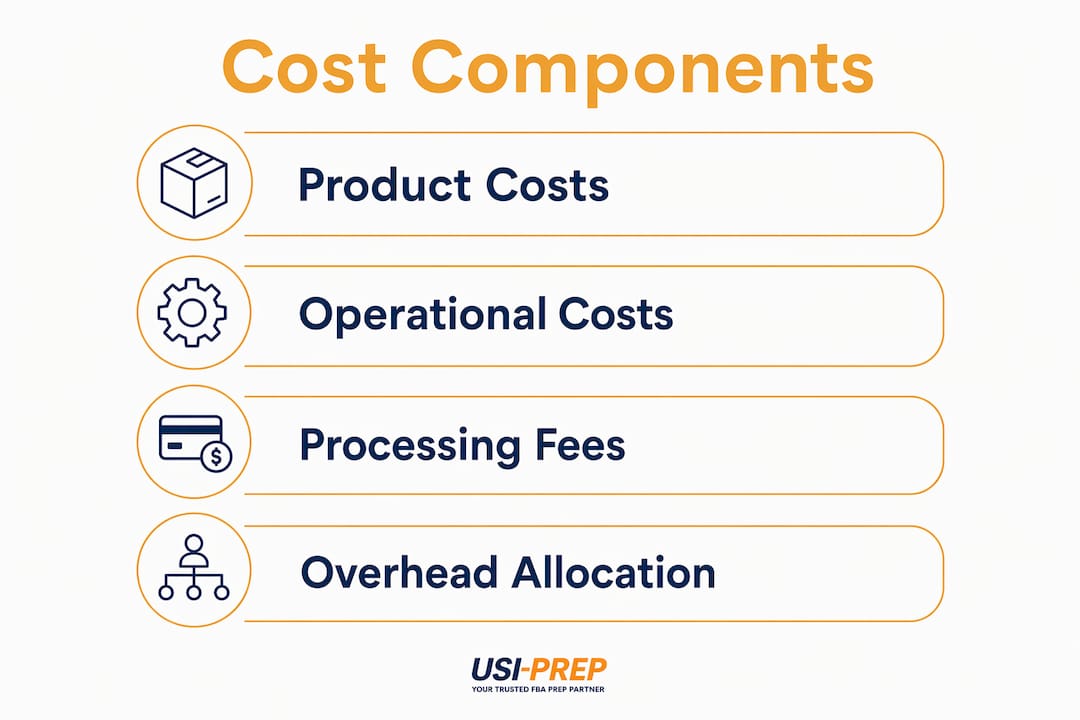
Overhead allocation layer
Overhead includes costs that are real but easy to forget: customer acquisition cost allocated per order, account management fees charged by your 3PL, software integration costs, and any special handling fees. These are not optional line items. They are part of what it costs to run each order through your business.
What formulas do you use to calculate each cost component?
Calculating each component accurately requires a formula and a data source. Here is how to work through the major ones:
-
Cost per order (fulfillment only): Total fulfillment cost divided by total orders fulfilled. Pull total fulfillment cost from your 3PL invoice, not from a dashboard estimate.
-
Inbound freight per unit: Total inbound freight cost for a shipment divided by the number of units in that shipment. Do this calculation per purchase order, not as an annual average.
-
Storage cost per order: Monthly storage fees divided by the number of orders shipped that month. This figure spikes when order volume drops but inventory stays constant.
-
Return reserve per order: Your return rate (returns divided by orders) multiplied by your average return processing cost per unit. If you return 8% of orders and processing costs $5 per return, your reserve is $0.40 per order.
-
Effective payment processing rate: Total payment fees for the period divided by total revenue for the period. Compare this to your advertised rate. The gap is usually larger than expected.
-
True cost per order (all-in): Add product COGS per unit, inbound freight per unit, duties per unit, packaging per unit, pick and pack per order, storage per order, outbound shipping per order, return reserve per order, processing fees per order, and overhead allocation per order.
Pull your data from supplier invoices, your 3PL portal, your payment processor’s reporting dashboard, and your accounting software. Cross-referencing these four sources catches discrepancies that any single source misses. For sellers managing inventory across multiple locations, tracking costs by fulfillment node adds another layer of accuracy.
Pro Tip: Track costs separately by sales channel and update your model every month. A product that is profitable on your direct-to-consumer site may lose money on a marketplace once you add platform fees and higher return rates.
Fulfillment costs also vary significantly by order volume, product size, multi-item packs, and seasonal surcharges. Peak season can raise fees 15–30%. Build that variability into your model rather than using a flat annual average.
What hidden fees inflate your fulfillment cost calculation?
Hidden fees are the most common reason a fulfillment cost analysis produces the wrong answer. 3PL headline prices hide indirect costs that can greatly affect fulfillment economics. Specifically, account management fees, carrier surcharges, peak season uplifts, and integration fees can add 25–40% to the cost you see on a rate card.
Common hidden fees to audit on every invoice:
- Residential delivery surcharges: Carriers charge extra for home delivery versus commercial addresses.
- Dimensional weight adjustments: If your package is light but large, you pay for the dimensional weight, not the actual weight.
- Peak season uplifts: Many 3PLs apply a surcharge from october through january that is not in the base rate.
- Account management fees: Monthly retainer fees for dedicated account support, sometimes buried in contract addenda.
- Integration and setup fees: Charged when connecting your store platform to the 3PL’s warehouse management system.
- Special handling fees: Applied for fragile items, kitting, or non-standard packaging requirements.
Advertised 3PL rates represent the floor, not the ceiling. A visible $10 fulfillment cost can reach $15 or higher once surcharges, account management, and peak season uplifts are included. Always request a complete fee schedule and audit actual invoices against it every quarter.
The impact on margins is significant. Many sellers mistakenly perceive profitable products that actually lose money once full cost accounting is applied. Reviewing hidden fees in fulfillment contracts before signing is one of the highest-value steps you can take before committing to a 3PL.
Pro Tip: Ask your 3PL for a sample invoice from a peak period, not just the rate card. Real invoices reveal surcharges that rate cards omit.
How do fulfillment cost insights improve pricing and profitability?
Knowing your true fulfillment cost changes how you price products, set marketing budgets, and evaluate vendor quotes. Full cost accounting requires tracking COGS, fees, payment processing, shipping, returns, marketing, and overhead together. Each of these inputs feeds a decision.
Applying cost data to pricing and marketing
Your maximum allowable customer acquisition cost equals your average order value minus your true all-in cost per order minus your target profit margin. If your all-in cost is $18 and your average order value is $35, you have $17 left. Subtract your target margin and you have your real marketing ceiling. Most sellers set this ceiling based on dashboard gross margin, which overstates the available budget.
Benchmarking vendor quotes
Use your current true cost model as a baseline when evaluating a new 3PL or renegotiating rates. Compare line by line, not just the headline pick-and-pack rate. The table below shows how to structure a vendor cost comparison:
| Cost component | Current cost per order | Quoted cost per order |
|---|---|---|
| Pick and pack | $1.80 | $1.50 |
| Outbound shipping | $7.20 | $6.90 |
| Storage | $0.60 | $0.55 |
| Account management fee | $0.40 | $0.80 |
| Peak season surcharge | $1.10 | $1.40 |
| Total | $11.10 | $11.15 |
A lower pick-and-pack rate means nothing if account management and peak surcharges more than offset the savings. This kind of line-by-line model prevents bad vendor decisions.
Ongoing monitoring
Update your cost model monthly. Carrier rates change, storage fees shift with inventory levels, and return rates move with product mix and marketing channels. Comprehensive fulfillment cost tracking requires data integration across supplier invoices, 3PL portals, payment processors, and accounting systems. Sellers who treat this as a quarterly task rather than a monthly one are always reacting to margin problems instead of preventing them. Understanding fulfillment’s direct role in profits makes the case for treating cost tracking as an operational priority, not a finance task.
Key Takeaways
Accurately calculating the true cost of fulfillment requires tracking product costs, operational fees, processing charges, and overhead allocations together, not in isolation.
| Point | Details |
|---|---|
| True cost range | Domestic fulfillment typically costs $8–$15 per order all-in, not just the shipping rate. |
| Hidden fees add up fast | Surcharges and account management fees can add 25–40% above quoted 3PL rates. |
| Use a per-order formula | Divide total fulfillment expenses by total orders to get a reliable cost baseline. |
| Update your model monthly | Carrier rates, storage fees, and return rates shift often enough to make annual averages unreliable. |
| Apply costs to decisions | Use true cost per order to set marketing budgets, pricing floors, and vendor benchmarks. |
Why most sellers are measuring the wrong number
I have worked with enough small eCommerce businesses to know that the dashboard margin is the most dangerous number in the business. It feels real because it updates in real time and it is easy to read. The problem is that it almost never includes the full picture. Payment processing effective rates, return reserves, and 3PL surcharges are almost always missing.
The sellers who grow sustainably are the ones who treat fulfillment cost calculation as a monthly financial discipline, not a one-time setup task. They pull invoices, cross-reference them against their model, and update their numbers before making any pricing or marketing decision. That habit catches fee increases before they destroy a quarter’s margin.
The other mistake I see constantly is evaluating a 3PL on the rate card alone. The rate card is a marketing document. The invoice is the truth. Request a sample invoice from a peak period before you sign anything. If a provider resists sharing that, treat it as a signal.
True cost analysis is not complicated. It requires discipline and the right data sources, but the math is straightforward. The sellers who do it consistently make better decisions on pricing, marketing spend, and vendor selection. The ones who skip it find out their margins were wrong at the worst possible time.
— Akbar
Usiprep’s resources for sellers who want accurate fulfillment numbers
Usiprep was built by former Amazon sellers who understood exactly how hidden fees and opaque invoices erode margins. The team brings that experience directly to FBA prep and order fulfillment, with transparent pricing and full visibility into every cost component.
Sellers working through their first true fulfillment cost analysis will find the FBA prep requirements checklist a practical starting point for understanding what prep costs actually include. For sellers evaluating whether a 3PL or self-fulfillment makes more financial sense, Usiprep’s guide on choosing between 3PL and self-fulfillment walks through the cost comparison in concrete terms. Usiprep’s 98.9% on-time delivery rate and 30% cost reduction results for clients reflect what accurate cost tracking and reliable execution look like in practice.
FAQ
What is the true cost of fulfillment per order?
The true cost of fulfillment per order ranges from $8–$15 domestically, covering pick and pack, outbound shipping, storage, returns, and hidden fees. The fulfillment-only portion runs $3.50–$8.00, with shipping adding $5–$10 on top.
How do I calculate fulfillment cost per order?
Divide your total fulfillment expenses for a period by the number of orders fulfilled in that same period. Pull total expenses from your 3PL invoice, payment processor, and accounting software combined, not from a single dashboard.
What hidden fees should I watch for in fulfillment contracts?
The most common hidden fees are residential delivery surcharges, dimensional weight adjustments, peak season uplifts, account management fees, and integration costs. These can add 25–40% above the quoted headline rate.
Why does my dashboard margin not reflect my true profit?
Dashboard gross margins typically exclude payment processing effective rates, return processing costs, and 3PL surcharges. This causes them to overstate true profit by 20–40%, which leads sellers to underprice products or overspend on marketing.
How often should I update my fulfillment cost model?
Update your cost model every month. Carrier rates, storage fees, and return rates shift frequently enough that quarterly or annual reviews leave you reacting to margin problems rather than catching them early.