
Before you get on a single vendor call, here are the 12 checkpoints that separate a genuinely transparent third-party logistics partner from one that just markets itself that way. Print this, paste it into your RFP scoring sheet, and use it to grade every provider you speak with. Score each item 0 (not provided), 1 (partially provided), or 2 (fully documented) to get a comparable total across vendors.
- Itemized pricing: Request a full fee schedule covering every charge type, plus a redacted sample invoice from a comparable client.
- SLA commitments in writing: Confirm on-time delivery percentage and order accuracy targets are contractual, not just stated.
- Network map and transit-time matrix: Ask for a regional transit-time breakdown by carrier and zone.
- WMS/tech integration proof: Request API documentation, sandbox access, and a sample payload before signing.
- Carrier rate transparency: Confirm whether rates are resold or negotiated, and ask for the margin disclosure method.
- Returns workflow documentation: Require a written disposition process, per-return cost breakdown, and inspection protocol.
- 90-day incident log: Ask for real outage or error narratives with detection times and resolution steps.
- Insurance certificates: Verify commercial general liability, cargo coverage, and broker surety bond status via FMCSA.
- Reference checks: Speak with at least two current clients in a similar category and volume range.
- Onboarding milestone plan: Get a written timeline from inventory intake to first live order, with acceptance criteria.
- Exit terms: Confirm data export format, inventory retrieval timeline, and final audit process before you sign.
- Monthly review cadence: Confirm a joint scorecard review is built into the contract, not left to your initiative.
Use this list on discovery calls by asking for each item directly. If a vendor hesitates on more than two, that pattern tells you something.
Key Takeaways
Choosing a transparent fulfillment provider comes down to demanding documented proof on pricing, SLAs, technology, and exit terms before you sign, not after.
| Point | Details |
|---|---|
| Demand itemized pricing upfront | Require a full fee schedule and a redacted sample invoice from a comparable client before evaluating any quote. |
| Make SLAs contractual | On-time delivery, order accuracy, and receiving turnaround must carry defined breach remedies, not just reported metrics. |
| Test tech with real data | Request API documentation, sandbox access, and a 90-day incident log to verify integration reliability before committing. |
| Negotiate exit terms before signing | Confirm data export format, inventory retrieval timeline, and final audit process while you still have leverage. |
| Usiprep as a benchmark | Usiprep’s 98.9% on-time delivery rate, itemized pricing, and FBA prep capability map directly to the checklist’s core checkpoints. |
Table of Contents
- What do you need from a fulfillment provider before you start comparing?
- How does warehouse location affect your shipping costs and delivery speed?
- Does the provider’s tech stack give you real visibility or just a dashboard?
- What fees should you demand in writing, and how do you verify a quote?
- How do carrier relationships and negotiated rates actually work?
- Can the provider handle your packaging, kitting, and special product requirements?
- What should a transparent returns process look like?
- Which KPIs should be contractual, and how often should you review them?
- What insurance, security, and compliance documentation should you require?
- What contract terms protect you during onboarding and at exit?
- What questions reveal a provider’s real operational character?
- How does Usiprep demonstrate transparency in practice?
- What I wish brands had asked before they signed
- Usiprep gives you the transparency this checklist demands
- Sources
What do you need from a fulfillment provider before you start comparing?
The most common mistake in fulfillment service evaluation is starting with vendor demos before you know what you actually need. Every answer a provider gives you is only useful if you have a baseline to compare it against.
Start with three numbers: your average daily order volume, your peak-season multiple (how many times higher does volume get?), and your SKU count. Then add your channel mix. A brand selling mostly direct-to-consumer on Shopify has different requirements than one splitting volume between multiple channels like DTC, Amazon FBA, and wholesale B2B. Those channels have different SLA expectations, labeling rules, and carrier requirements, and a provider who is excellent at one may be mediocre at another.
- Document your volume profile: Average orders per day, peak orders per day, number of active SKUs, and average units per order.
- Define your channel mix: B2C DTC, Amazon FBA, Walmart, eBay, TikTok Shop, or wholesale B2B, and the percentage split.
- Set your SLA floor: Minimum acceptable on-time delivery rate, order accuracy rate, and days-to-ship target.
- List your required integrations: Shopify, Amazon SP-API, WooCommerce, NetSuite, or any custom ERP.
- Specify reporting needs: Do you need daily inventory snapshots, real-time order tracking, or weekly exception reports?
Once you have these written down, every vendor conversation becomes a structured comparison rather than a sales pitch you are reacting to.
Pro Tip: Build a short onboarding milestone checklist before your first vendor call: inventory received and counted, SKU mapping confirmed, integration tested with sample orders, initial orders reconciled, and go-live acceptance signed off. Ask every vendor to confirm they can meet each milestone and give you a timeline.
How does warehouse location affect your shipping costs and delivery speed?
Warehouse proximity to your customers is one of the most direct levers on both shipping cost and transit time. A single fulfillment center in the Midwest can reach roughly 70% of the U.S. population within two days via ground shipping, but brands with heavy West Coast or Northeast customer concentrations often pay a zone premium that erodes margin on every order.
When evaluating a provider’s network, ask for a transit-time matrix by region, not just a stated “2-day delivery” claim. The matrix should show estimated transit days by carrier (UPS Ground, FedEx Home, USPS Priority) from each warehouse location to major metro areas. Then overlay it against your own customer zip code distribution. That exercise often reveals whether a single-node provider actually fits your customer base or whether you need a two-node strategy.
What to request from every provider:
- A sample transit-time matrix by carrier and shipping zone from each warehouse location.
- Carrier performance data or client-provided evidence that stated transit times are actually achieved.
- Their policy on carrier selection per order (do they optimize by zone, or does your team control it?).
- A clear explanation of how dimensional weight is calculated and applied.
When a multi-warehouse strategy makes sense:
- Your customer base is split roughly evenly between coasts.
- You are shipping heavy or bulky items where zone costs are significant.
- You have a hard two-day delivery SLA that a single Midwest node cannot meet for coastal customers.
- Your volume is high enough that split inventory carrying costs are offset by shipping savings.
Verify transit-time claims by asking for a recent shipping cost audit from a current client, or by running a sample batch of your own orders through their rate calculator before committing. Promises without data are just marketing.
Does the provider’s tech stack give you real visibility or just a dashboard?
A warehouse management system (WMS) that shows you a pretty dashboard is not the same as one that gives you auditable, exportable data you can act on. The difference shows up when something goes wrong: a real-time inventory discrepancy, a mispicked order, or an integration outage. Evaluating WMS capabilities before you sign is one of the highest-leverage steps in the entire selection process.
The technical capabilities that actually matter are:
- API access with documentation: Can you pull order status, inventory levels, and shipment data programmatically? Ask for the API docs and a sandbox environment before signing.
- Webhooks or event-based notifications: Real-time order acknowledgement, shipment confirmation, and exception alerts, not just batch file exports.
- Daily inventory sync: Automated reconciliation between their WMS and your storefront, with a clear process for resolving discrepancies.
- Pick/pack audit exports: Raw reports you can download, not just summary metrics.
- Returns disposition reports: Item-level detail on what was received, inspected, and restocked or scrapped.
- Inventory adjustment logs: Every adjustment to on-hand quantity, with timestamp and reason code.
On integration reliability, ask for a specific incident example: when their WMS integration last failed, how long it took to detect the issue, who notified the client, and how it was resolved. Providers that give you a specific timeline and a postmortem demonstrate operational maturity. Providers that say “we haven’t had outages” are either very new or not being straight with you.
Industry guidance from AHAeCommerce is direct on this point: standard RFP metrics measure inputs, not outputs. Stated accuracy rates and uptime percentages tell you nothing about how a provider behaves when something breaks. Test error-recovery behavior and integration failure response time explicitly.
What fees should you demand in writing, and how do you verify a quote?
Pricing transparency is where most fulfillment relationships go wrong. A low per-pick rate looks attractive until you see the invoice: peak-season surcharges, dimensional weight adjustments, account management fees, integration setup costs, and minimum monthly charges that were never mentioned in the sales call. The hidden fees in fulfillment contracts are almost always in the line items no one volunteered.
Every fee category to require in writing:
- Receiving (per pallet, per carton, or per unit)
- Per-SKU handling or storage setup
- Pick-and-pack per order (base rate plus per-item rate)
- Packaging materials (standard poly mailer, box, void fill)
- Kitting and assembly (per kit, per component)
- Storage (per pallet or cubic foot, monthly)
- Returns processing (per return, per item inspected)
- Account management or platform fee
- Integration or setup fee
- Monthly minimums
- Peak-season surcharges and dimensional weight policy
- Fuel surcharge pass-through method
The simplest pricing transparency test: ask for a redacted sample invoice from a client with a similar order profile. Any provider unwilling to share one is telling you something. Then build a sample monthly cost estimate using your own baseline numbers.
Sample monthly cost estimate (illustrative structure):
Run this exercise with every provider using your actual numbers. The variance between quotes often reveals which providers have buried fees they have not disclosed.
Pro Tip: Include a clause in your contract requiring advance written notice before any fee change takes effect. Also request historical surcharge data, specifically peak-season and dimensional weight adjustments, so you can model your true annual cost.
How do carrier relationships and negotiated rates actually work?
There is a meaningful difference between a 3PL that resells carrier labels at a markup and one that gives you access to genuinely negotiated rates. Both are common, and neither is automatically bad, but you need to know which model you are dealing with and how the margin is disclosed.
Questions to ask every provider on carrier relationships:
- Do you act as a carrier reseller, or do clients access negotiated carrier accounts directly?
- How is your margin on shipping disclosed? Is it a flat markup, a percentage, or built into the rate?
- What is your carrier mix, and what are the average negotiated discounts versus retail rates for UPS, FedEx, and USPS?
- How do you handle dimensional weight calculations, and are fuel surcharges passed through at cost?
- Can I bring my own carrier account if I have better rates?
To validate negotiated rate claims, ask for rate sheets or carrier agreement terms of service. A provider confident in their rates will share them. One who deflects with “we have great carrier relationships” without documentation is worth pressing harder.
- Request a sample shipping cost audit from a current client or a rate comparison against retail UPS/FedEx pricing for your typical package dimensions and weights.
- Ask whether they batch shipments by carrier to optimize cost, or whether you can define carrier selection rules per order or per zone.
- Confirm how carrier performance failures (lost packages, late deliveries) are handled: does the provider file claims on your behalf, or does that responsibility fall to you?
- Ask for their process when a carrier rate changes mid-contract. Do they absorb it, pass it through immediately, or provide advance notice?
Carrier cost is often the largest line item in your total fulfillment spend. Treating it as a fixed given rather than a negotiable variable is one of the more expensive assumptions a growing brand can make.
Can the provider handle your packaging, kitting, and special product requirements?
Not every 3PL is built for every product type. A provider that handles standard poly-mailer DTC orders efficiently may struggle with multi-component kits, fragile items requiring custom void fill, or Amazon FBA prep that demands precise labeling and carton configuration. Verifying capability before you sign saves you from discovering the gap after your first peak season.
Packaging questions to ask in writing:
- What packaging materials are included in the standard pick-and-pack rate, and what triggers an upcharge?
- Who owns the packaging SKUs if you use custom branded boxes or mailers?
- What is the process for introducing a new packaging configuration, and what is the lead time?
- How do you handle oversize or irregular-shaped items?
Kitting and assembly questions:
- What is the average kit assembly time per unit for a two-to-four component kit?
- What is your error rate on kit orders, and how are kit errors caught before shipment?
- Is there a minimum run size for kitting, and how is kitting priced (per kit, per component, or flat setup fee)?
- How do you handle kit component shortages when one SKU is out of stock?
Special handling covers a wider range than most brands anticipate. If you sell fragile items, ask for their damage rate and packaging protocol. If you sell products that require climate control, confirm the warehouse has it and that it is monitored. For Amazon FBA prep specifically, ask for their FBA prep requirements compliance rate and whether they have handled ASIN-level labeling, poly-bagging, and carton content requirements before.
A useful test: describe your most complex product (heaviest, most fragile, or most label-intensive) and ask the provider to walk you through exactly how they would handle it from receiving to shipment. Vague answers reveal inexperience more quickly than any checklist item.

What should a transparent returns process look like?
Returns are where fulfillment transparency gets tested most directly. A provider can run clean outbound operations and still lose you money on the inbound side if their returns process is slow, opaque, or inconsistently applied.
The core elements of a documented returns workflow:
- Inbound routing: How does a return get from the carrier to the inspection station, and what is the average time from delivery to inspection start?
- Disposition options: Resellable (restock), refurbish, scrap, or return to vendor. Who authorizes each disposition, and is it documented per item?
- Inspection protocol: What is inspected, how is it graded, and is photographic evidence captured for high-value items?
- Restock timeline: From inspection completion to available inventory, what is the average time?
- Per-return cost breakdown: Receiving fee, inspection fee, restock fee, and any disposition-specific charges.
Ask for chain-of-custody documentation on high-value returns. A provider that can show you a timestamped inspection record with photos for a $200 item is operating at a different level than one that says “we inspect everything” with no supporting process. Require this in writing as a contractual standard, not a courtesy.
For brands with return rates above 10%, the cost and speed of returns processing can materially affect cash flow. A return sitting uninspected for two weeks is inventory you cannot resell. Ask for the provider’s average returns processing time and their 90th-percentile time (the slowest 10% of returns), because the average alone hides the tail that hurts you most.
Which KPIs should be contractual, and how often should you review them?
The difference between a vendor relationship and a managed logistics partnership is whether performance metrics are contractual or just reported. Reported metrics with no consequence are marketing. Contractual KPIs with defined breach remedies are accountability.
KPIs to require in the contract, with benchmark levels:
- On-time-in-full (OTIF): Aim for approximately 98% or higher for DTC; confirm the definition (ship date vs. delivery date).
- Order accuracy: Industry-leading providers can reach 99.9%; set your floor at 99% and negotiate remedies below it.
- Receiving turnaround: Time from carrier delivery to inventory available for picking, typically 24–48 hours for standard cartons.
- Inventory accuracy: Cycle count results versus system records, measured monthly.
- Days-to-ship: Time from order receipt to carrier scan, typically same-day or next-day for orders received before cutoff.
SLA breach remedies should be specific: a financial credit formula, a remediation plan with a defined timeline, and an escalation path if the breach persists. “We will work to improve” is not a remedy. Ask for the exact credit calculation and the escalation window in writing.
On reporting cadence, a well-run provider should offer daily operational dashboards (order status, exceptions), weekly exception reports (inventory discrepancies, late shipments), and a monthly joint scorecard review. That monthly review is where you track the same metrics you used in selection, which prevents the contract from becoming the only accountability mechanism. AHAeCommerce’s selection framework makes this point directly: governance built into the relationship from day one outperforms governance you try to add after problems appear.
Ask for 90 days of incident logs before signing. A provider with nothing to show either has no documentation culture or is hiding something.
What insurance, security, and compliance documentation should you require?
This section is often skipped in the rush to evaluate pricing and technology. It should not be.
Insurance and surety minimums to verify:
- Commercial general liability coverage (ask for the certificate of insurance, not just a stated limit).
- Cargo insurance covering goods in their possession, with per-occurrence and annual limits.
- If the provider arranges motor-carrier shipments as a broker, verify their FMCSA broker authority and confirm their surety bond. Property brokers are generally required to maintain a $75,000 surety bond (BMC-84) or a trust agreement (BMC-85) on file with the FMCSA. Check FMCSA SAFER and the L&I search tool directly, not just the vendor’s word.
Warehouse security and personnel:
- Ask for their access control policy for the warehouse floor.
- For high-value SKUs, confirm whether staff handling those products undergo background checks.
- Request their visitor and vendor access log policy.
Data security:
- How is your order and customer data stored, and who has access?
- How are API keys managed and rotated?
- Do they have a documented data breach notification process?
- If they process EU customer data, ask about their data handling practices under applicable frameworks.
This is general information, not legal or insurance advice. Verify current FMCSA requirements and insurance minimums with a licensed broker or attorney before finalizing any contract.
What contract terms protect you during onboarding and at exit?
The contract is where transparency either gets formalized or disappears. Providers who are genuinely confident in their operations will accept reasonable terms. Ones who push back hard on SLA remedies, data ownership, or exit timelines are showing you something about how they operate.
Onboarding milestones to put in writing:
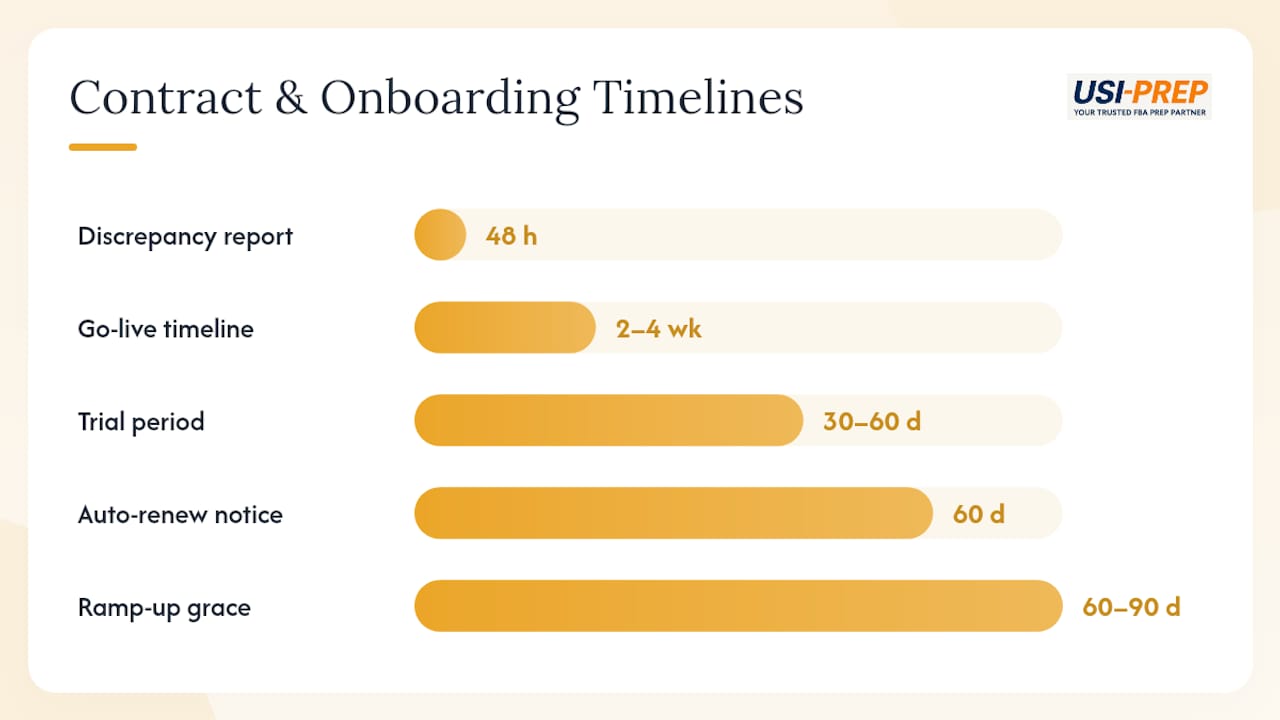
- Inventory intake complete and counted, with discrepancy report issued within 48 hours.
- SKU mapping confirmed in WMS and verified against your catalog.
- Integration tested with 10 sample orders, results reviewed and signed off.
- First 100 live orders fulfilled, reconciled, and any exceptions documented.
- Go-live acceptance criteria met and formally acknowledged by both parties.
Contract terms to negotiate:
- A 30–60 day trial period with defined exit rights if SLAs are not met.
- Monthly minimums stated clearly, with a ramp-up grace period for the first 60–90 days.
- Auto-renewal clauses: require 60 days’ written notice to cancel rather than the standard 30.
- Fee escalation caps: no more than a defined percentage increase per year without renegotiation.
- Data ownership on exit: your order history, inventory records, and customer data are yours, in an exportable format, within a defined timeframe.
Exit requirements to confirm before you sign:
- Inventory retrieval timeline (how many days from termination notice to your inventory being packed and ready for pickup or transfer).
- Final audit process and who pays for it.
- Data export format (CSV, API pull, or flat file) and the timeline for delivery.
For small brands, the ramp-up period is often underestimated. A realistic timeline from contract signing to first live order is typically 2–4 weeks for a straightforward integration, longer if you have complex kitting or FBA prep requirements. Push back on any vendor who promises a one-week go-live without having seen your SKU catalog and integration requirements. For a detailed step-by-step setup guide, outsourced order fulfillment setup walks through the full process.
What questions reveal a provider’s real operational character?
The discovery call script below is organized by topic. Use it verbatim or adapt it for your RFP appendix. The goal is not to catch vendors in a lie but to see how they respond to specificity.
Technology:
- Can you share your API documentation and give us sandbox access before we sign?
- Walk me through the last integration outage you had: when was it detected, who notified the client, and how was it resolved?
- What raw reports can we export, and at what frequency?
Pricing:
4. Can you provide a redacted sample invoice from a client with a similar order volume and SKU mix?
5. What surcharges were applied in the past 12 months, and what triggered them?
6. How are fee changes communicated, and what notice period do you provide?
Operations:
7. What is your current order accuracy rate, and how is it measured?
8. What is your receiving turnaround time for standard cartons, and what is your 90th-percentile time?
9. How do you handle a pick error discovered after the order ships?
Returns:
10. Walk me through your returns disposition process from carrier delivery to restock.
11. What documentation do you provide for high-value returns?
Onboarding:
12. What does your onboarding milestone plan look like, and what are the go-live acceptance criteria?
Red flags that should stop further negotiation:
- Refusal to share a sample invoice or surcharge history.
- No incident logs or “we don’t really have outages” as an answer.
- Vague SLA breach remedies (“we’ll make it right”) with no financial credit formula.
- Unwillingness to provide sandbox API access before signing.
- Pressure to sign quickly with limited time to review contract terms.
Score each answer 0, 1, or 2 using your checklist. A provider who scores below 16 out of 24 on the discovery call is unlikely to improve after you sign. The contract does not change operational culture; it only documents it. Providers who score well on specificity and documentation are worth a site visit or a short pilot before full commitment.
How does Usiprep demonstrate transparency in practice?
Usiprep was founded by former Amazon sellers, which means the team has been on the buyer’s side of exactly the problems this checklist is designed to catch. That background shapes how the service is built, not just how it is marketed.
Here is how Usiprep maps to the checklist checkpoints:
- Pricing transparency: Usiprep provides itemized, per-unit pricing with no hidden minimums buried in the fine print. Clients can request a cost breakdown built from their actual order profile before committing.
- On-time delivery: Usiprep reports a high on-time delivery rate that is above the industry norm and aligns with the kind of contractual SLA benchmark this checklist recommends requiring in writing.
- Cost reduction: Brands working with Usiprep have reported notable fulfillment cost reductions, driven by faster inventory check-ins, lower per-unit rates, and carrier access that smaller brands cannot negotiate independently.
- FBA prep capability: Usiprep handles Amazon FBA prep including ASIN-level labeling, poly-bagging, carton content configuration, and compliance with current FBA requirements, covering the special-handling checklist items that trip up generalist providers.
- Visibility: Clients get complete visibility into inventory status and order history, with reporting that matches the daily/weekly/monthly cadence this checklist recommends requiring contractually.
| Checklist checkpoint | Usiprep proof point |
|---|---|
| Itemized pricing | Per-unit, per-order cost breakdown available before signing |
| On-time delivery SLA | 98.9% on-time delivery rate |
| Cost transparency | 30% fulfillment cost reduction reported by clients |
| FBA prep capability | Full Amazon FBA prep: labeling, poly-bagging, carton config |
| Inventory visibility | Real-time inventory and order history reporting |
The Forbes Communications Council recommends aligning your 3PL’s capabilities with your brand strategy and customer experience requirements, not just selecting on price. Usiprep’s founding context and operational model are built around exactly that alignment for eCommerce brands that need both speed and accountability.
What I wish brands had asked before they signed
The most common selection mistake I see is optimizing for the lowest pick cost and treating everything else as secondary. It feels rational because pick cost is the most visible line item in a quote. The problem is that pick cost tells you almost nothing about how a provider behaves when volume spikes, when an integration breaks, or when a batch of returns arrives uninspected for two weeks.
Three things I wish brands had asked earlier:
“What does your error recovery process look like, step by step?” Not “what is your accuracy rate” but what happens after an error. The answer reveals whether the provider has a documented recovery process or just a customer service rep who apologizes. AHAeCommerce’s framework puts it plainly: test error-recovery behavior, not just stated accuracy.
“Can I see 90 days of incident logs?” Most brands never ask this. The ones who do get a clear picture of operational maturity in about 10 minutes. A provider with clean, timestamped logs and postmortems is a different operation than one with nothing to show.
“What happens to my data if I leave?” Data portability is negotiated before you sign, not after. After, you have no leverage. Confirm the export format, the timeline, and who owns the customer records before the contract is finalized.
On governance: adopt a monthly joint review from day one. Track OTIF, order accuracy, receiving turnaround, and inventory accuracy every month using the same definitions you used in selection. This is not a nice-to-have. It is the mechanism that keeps the relationship accountable when the sales team is no longer involved.
Usiprep gives you the transparency this checklist demands
Most brands spend weeks comparing fulfillment quotes and end up choosing the lowest per-pick rate, only to discover the real cost six months later in surcharges, slow receiving, and opaque invoices. Usiprep is built to be the alternative to that experience.
Founded by former Amazon sellers who lived through exactly those frustrations, Usiprep offers itemized pricing you can verify before you commit, a 98.9% on-time delivery rate backed by contractual SLAs, and complete inventory visibility from the moment your goods arrive. For brands selling on Amazon, Usiprep’s FBA prep capability covers the full compliance checklist: ASIN labeling, poly-bagging, and carton configuration. For DTC brands, the pick-and-pack and returns workflows are built for the cadence and accuracy this checklist requires.
The next step is straightforward: request a sample cost breakdown built from your actual order profile, ask about a short pilot, or review Usiprep’s transparent pricing directly. If you sell on Amazon and want to verify FBA prep compliance specifically, the FBA prep requirements checklist is a practical starting point. Visit Usiprep to get started.
Sources
- The 3PL Selection Framework: What the RFP Process Always Misses | AHAeCommerce
- Selecting the right third-party logistics partner | Forbes
- Third-party logistics — Wikipedia