
Viral product fulfillment is the set of inventory, warehouse, carrier, and customer-workflow actions that let a brand absorb a sudden, social-media-driven order surge without collapsing service levels. When a TikTok video or Shopify live drop sends orders spiking overnight, you have roughly 48 hours before customer expectations harden into reviews and chargebacks. The brands that come out ahead are the ones who treat that window as a binary: either you’re ready before it happens, or you’re scrambling afterward.
If your product just went viral, do these five things first:
- Pause or cap paid ads immediately if your current inventory cannot cover the incoming volume.
- Call your pre-vetted 3PL and activate any surge clause in your contract.
- Pull a live inventory count across every sales channel and identify which SKUs are at risk.
- Push a customer messaging template (estimated ship date, honest delay notice) to your email and order-confirmation flows.
- Set a hard inventory cap in Shopify or your OMS to prevent oversells before your WMS syncs.
Pro Tip: Set your Shopify inventory buffer slightly below your actual on-hand count before a planned launch or influencer campaign. That gap absorbs the lag between a sale and your WMS confirming the pick, which is where most oversells happen in the first 24 hours.
Table of Contents
- Why viral demand is a different kind of fulfillment problem
- Common failure modes that turn a viral win into a loss
- What the demand timeline actually looks like, hour by hour
- How your systems need to connect: Shopify, OMS, WMS, and beyond
- What a 3PL actually does for you during a viral spike
- Pre-spike checklist: most failures are preventable
- Post-spike operations: what happens after the wave
- Metrics and SLAs to watch in real time during a viral event
- How Usiprep handles viral fulfillment in practice
- Key Takeaways
- The part most brands get wrong about viral fulfillment
- Usiprep is built for brands that cannot afford to miss a spike
- Further reading and useful sources
Why viral demand is a different kind of fulfillment problem
Standard fulfillment planning assumes a demand curve you can see coming. Viral demand does not give you that. The core differences are velocity, variance, channel concentration, and near-zero lead time to peak.
A typical seasonal spike might double your order volume over two weeks. Viral surge capacity describes demand that can jump 10x to 50x in a single event, sometimes within hours of a video gaining traction. That is not a planning problem you solve with safety stock alone.
The 48-hour window is the whole game. Social commerce algorithms amplify content hardest in the first 24–48 hours. Orders that come in during that window carry the highest customer expectations because buyers saw the product at peak excitement. Miss their ship date, and you lose them permanently.
The operational consequences stack fast. Inventory depletes before your WMS can flag it. Carriers hit daily pickup limits. Packing stations bottleneck when volume triples and your team is still running a standard pick rate. Customer support tickets pile up faster than any small team can answer. A TikTok-driven launch can generate cascading failures across product pages, order flows, and backend systems simultaneously. The failure is rarely one thing. It is five things breaking at the same moment.
Product packaging matters here too. Items that go viral on TikTok often do so because of a visible, shareable user experience. That means your packaging and labeling need to survive high-volume packing by temporary staff who have never seen your product before. Pre-validating that experience is part of understanding product fulfillment at the viral scale.

Common failure modes that turn a viral win into a loss
Most viral fulfillment disasters trace back to a short list of predictable failures. Knowing them in advance is half the fix.
- Stockouts and oversells: Inventory sync lags between your sales channel and WMS allow orders to clear on items already sold out. The customer gets a confirmation email for a product you cannot ship.
- Receiving bottlenecks: If you need to rush emergency stock to a 3PL, slow check-in processes mean that inventory sits in a receiving queue while orders pile up unfulfilled.
- Slow order routing: Without pre-configured routing rules, orders queue for manual review instead of flowing automatically to the nearest fulfillment node.
- Packing and kit errors: Temporary staff unfamiliar with your product assemble kits incorrectly or apply wrong labels, triggering a returns surge that compounds the original problem.
- Carrier pickup limits: Your carrier has a daily pickup cap. When you exceed it, orders sit packed but unshipped, and your on-time delivery rate collapses.
- Returns surge: A wave of “where is my order” contacts turns into return requests when customers lose patience. Without a triage workflow, returns processing backs up and refunds are delayed.
Watch for this early signal: a rising gap between checkout completions and confirmed inventory commits in your OMS. That gap tells you oversells are already happening before your WMS has caught up.
What the demand timeline actually looks like, hour by hour
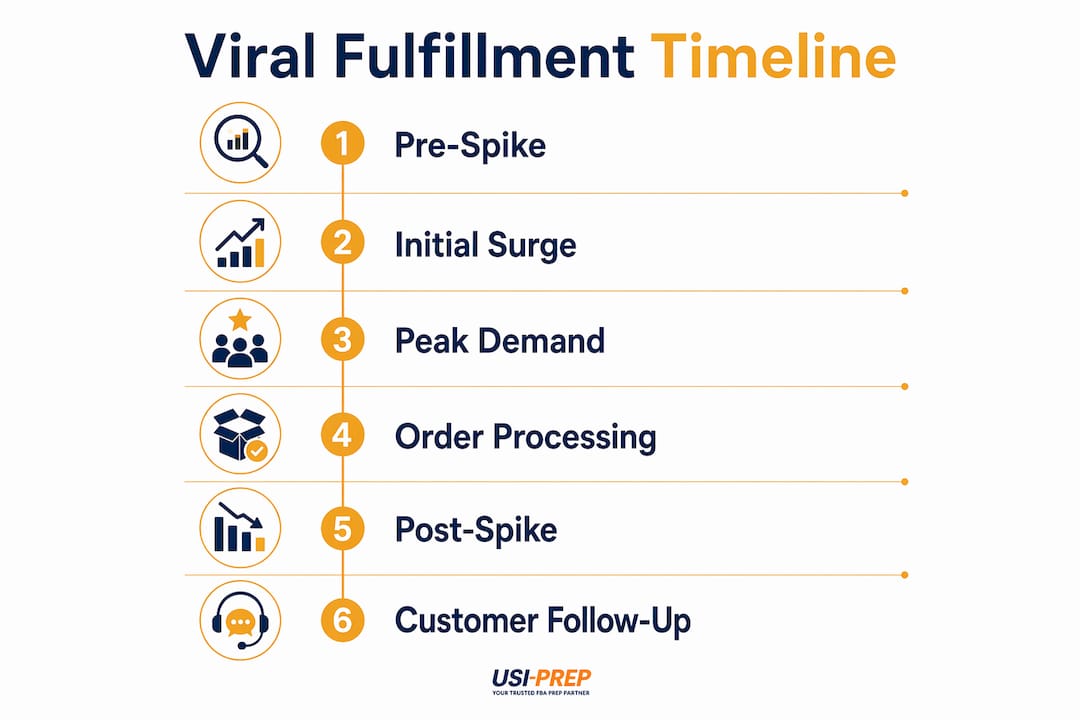
Virality does not arrive as a steady ramp. It hits in a spike, flattens, then sometimes resurges when an influencer reposts or the algorithm recycles the content. Here is the operational sequence you should plan around.
- Minutes 0–60: A video gains traction. Traffic to your product page spikes. If you have no inventory cap set, oversells begin immediately. Your first move is to verify live inventory and set a hard cap.
- Hours 1–6: Order volume accelerates. Your OMS starts queuing faster than your warehouse can pick. Activate your 3PL surge contact. Push customer messaging. Check that your Shopify-to-WMS sync is running on its shortest interval.
- Hours 6–24: Peak order velocity. Carrier pickups need to be confirmed for same-day or next-day cutoffs. Packing throughput is your constraint now. Temporary staff onboarding, if needed, happens here.
- Hours 24–48: The initial spike begins to taper, but secondary spikes are common. Influencer reposts, media coverage, and algorithm recycling can send a second wave. Keep inventory caps active and monitor order lead times in real time.
- Days 3–7: Demand normalizes but does not disappear. Replenishment orders need to be in transit. Customer support volume peaks as shipping windows pass. This is when retention work begins.
Live shopping fulfillment follows a compressed version of this same curve, with even tighter cutoffs. The brands that handle it well have mapped this timeline before the spike, not during it.
How your systems need to connect: Shopify, OMS, WMS, and beyond
The integration chain that breaks most often during a spike runs like this: sales channel → OMS/order router → WMS → carrier/TMS → customer notification. Every handoff in that chain is a failure point under high volume.
Specific integration points to validate before a spike:
- Inventory sync cadence: How often does your Shopify inventory count update from your WMS? A 15-minute sync is too slow during a viral event. Push it to real-time or near-real-time via webhook.
- Order routing rules: Are your routing rules configured to auto-assign orders to the correct fulfillment location without manual intervention? Test this with a simulated order burst.
- SKU mapping: Every SKU in Shopify must map exactly to the WMS item code. A mismatch causes orders to queue for manual resolution, which kills throughput.
- API throttling limits: Shopify and most OMS platforms have API rate limits. At high order volume, your integration can hit those limits and drop orders. Confirm your middleware handles retry logic.
- Split order handling: If an order contains items across multiple fulfillment nodes, does your OMS split it cleanly, or does it hold the entire order waiting for one location?
- Label and barcode formatting: Carrier label formats must match exactly. A formatting error at 500 orders per hour means 500 unshippable packages.
Retailers that surface dedicated fulfillment flows for viral SKUs do so precisely because standard routing rules cannot handle the volume concentration on a single item. Replicating that logic in your OMS, even as a simple priority flag on a viral SKU, is worth the setup time. Good order management practices make this kind of pre-configuration straightforward.

What a 3PL actually does for you during a viral spike
The primary value of a 3PL during a viral event is not storage. It is capacity you cannot build yourself in 48 hours: surge staffing, pre-staged inventory, carrier relationships, and a WMS that does not break under load.
Services to expect and negotiate before you need them:
- Surge staffing: A good 3PL has a temp labor pool it can activate within hours. Confirm this is in your contract, not just a verbal promise.
- Receiving prioritization: Emergency inbound shipments need to jump the receiving queue. Ask specifically how long check-in takes for a rush pallet during peak periods.
- Pre-kitting: If your product ships as a kit, pre-kitting before the spike means packing staff are pulling one item, not assembling four. This alone can double throughput.
- Same-day pick/pack cutoffs: Know the exact cutoff time for same-day processing. For social commerce fulfillment, a 2 PM cutoff may not be fast enough.
- Split routing: A 3PL with multiple nodes can route orders to the closest location, cutting transit time and reducing carrier concentration risk.
SLA metrics to require in writing:
- Pick-to-ship window: 24 hours or less for standard orders during a surge.
- Inventory check-in time: same day or next business day for rush inbound.
- Order accuracy rate: 98% or better.
Pro Tip: Negotiate a pre-activated surge clause into your 3PL contract before you need it. This clause should define exactly what “surge” means (e.g., 3x normal daily order volume), what the 3PL commits to providing, and the notice period required. A verbal agreement to “do our best” is not a surge clause.
Deciding whether to use a 3PL or self-fulfill is a strategic question worth answering before virality forces the decision for you.
Pre-spike checklist: most failures are preventable
The vast majority of viral fulfillment failures are preventable with preparation that takes days, not months. Here is the sequence.
- Pre-vet and contract a 3PL with a signed surge clause. Confirm their receiving speed, staffing model, and carrier relationships.
- Build a buffer SKU inventory position at your 3PL: at minimum 2–3x your average weekly velocity for your highest-risk items.
- Validate packaging and kit instructions with a timed packing test using someone unfamiliar with your product. If they cannot pack it correctly in under two minutes, simplify it.
- Pre-authorize overtime and temp labor with your warehouse or 3PL. This is a paperwork step that takes an hour but saves you four hours of scrambling during a spike.
- Test your WMS/OMS failover with a simulated order burst. Confirm API retry logic, routing rules, and inventory sync intervals.
- Prepare customer messaging templates for three scenarios: on-time fulfillment, 24-hour delay, and 48-hour-plus delay. Load them into your email platform and order management system now.
- Set inventory caps in your sales channels at 85–90% of actual on-hand to absorb sync lag.
Viral surge capacity research consistently points to modular workflows and pre-vetted partners as the differentiators between brands that scale through a spike and brands that collapse under one.
Pro Tip: Create a one-page visual packing guide with photos for each SKU and post it at every packing station before a surge. Small brands that went viral have used printed pack photos and short training videos to rapidly onboard temporary helpers and cut kit errors significantly. A laminated sheet costs nothing and prevents expensive mispacks at scale.
Post-spike operations: what happens after the wave
Post-spike operations determine whether a viral moment becomes a growth inflection or a one-time event with a long customer-service tail.
- Inventory reconciliation: Run a full count within 24 hours of the spike tapering. Discrepancies between your OMS and WMS need to be resolved before you reopen full inventory to new orders.
- Replenishment orders: Place restock orders immediately. Restocking FBA inventory efficiently after a spike requires knowing your lead times cold. If your supplier needs three weeks, your reorder needs to go in on day one.
- Returns triage: Categorize returns by reason code. Packing errors and wrong items need immediate resolution. “Changed mind” returns can follow standard processing.
- Customer outreach: Proactively contact any customer whose order shipped late. A discount or free shipping on the next order, sent before they complain, retains far more customers than a reactive apology. A solid customer retention communication strategy makes this outreach systematic rather than ad hoc.
- Retention sequencing: First-time buyers from a viral event have low brand loyalty by default. A two-email sequence at day 7 and day 21 post-purchase, focused on product education and a soft cross-sell, converts a meaningful share of them into repeat buyers.
The customers who bought during the spike are your highest-intent new audience. Treat them accordingly.
Metrics and SLAs to watch in real time during a viral event
Six metrics tell you whether your fulfillment operation is holding or breaking during a spike. Monitor all of them on a live dashboard, not a daily report.
| Metric | What “Good” Looks Like During a Spike | Trigger Threshold | Data Source |
|---|---|---|---|
| Orders per hour | Tracks against your capacity ceiling | High max throughput load | OMS / order dashboard |
| Order lead time | Under 24 hours pick-to-ship | More than 24 hours triggers escalation | WMS / 3PL reporting |
| Order accuracy rate | 98% or better | Below 98% triggers packing audit | WMS / returns data |
| On-time delivery (OTD) | 98.9% | Below 90% triggers carrier review | Carrier tracking feed |
| Stockout rate | Zero on hero SKUs | Any stockout on primary SKU | Inventory management system |
| Carrier pickup success | Same day or next business day pickup rate | Any missed pickup triggers backup carrier | Carrier manifest / WMS |
- Orders per hour tells you when you are approaching your throughput ceiling, which is when to call in additional staff.
- Order lead time is your earliest warning that the packing line is backing up.
- Stockout rate on your primary SKU is a binary: zero is the only acceptable number during the spike window.
Fulfillment efficiency has a direct financial impact, and these six metrics are where that impact shows up first.
How Usiprep handles viral fulfillment in practice
Usiprep was founded by former Amazon sellers, which means the team has been on the brand side of a demand spike before building the infrastructure to handle one. That background shapes how they approach surge engagements: pre-vetted playbooks, fast receiving, and transparent itemized reporting at every step.
What a surge engagement with Usiprep looks like in practice:
- Rapid receiving and check-in: Usiprep prioritizes emergency inbound shipments with same-day or next-business-day check-in, so inventory is available to fulfill orders rather than sitting in a receiving queue.
- Pre-kitting and staging: For brands with multi-component products, Usiprep pre-kits units before the spike so packing staff pull one ready-to-ship item instead of assembling components under pressure.
- Multi-channel integration: Usiprep integrates with Shopify, TikTok Shop, Amazon, and other major platforms, so order routing and inventory sync run automatically without manual intervention during a surge.
- Transparent reporting: Every operation is itemized. Brands can see receiving status, pick rates, and carrier manifests in real time, not in a next-day summary.
- FBA prep expertise: For brands routing viral volume to Amazon FBA, Usiprep handles FBA inventory check-in and prep requirements so shipments are not rejected at the Amazon receiving dock.
Performance benchmark: Usiprep reports a 98.9% on-time delivery rate and a 30% reduction in fulfillment costs for many clients — two metrics that matter most when a viral spike is stress-testing your operation.
To initiate a surge engagement, brands typically share their SKU list, current inventory position, and expected order volume. Usiprep can confirm capacity and activate a surge plan within one business day for brands already in their system, and within a short onboarding window for new clients.
Key Takeaways
Viral product fulfillment succeeds or fails in the first 48 hours: brands with pre-staged inventory, tested integrations, and a contracted 3PL surge clause consistently outperform those who prepare after the spike begins.
| Point | Details |
|---|---|
| The 48-hour window is critical | Initial fulfillment speed and customer communication in the first 48 hours determine whether buyers stay or churn. |
| Demand can spike dramatically overnight | Viral surge capacity requires modular workflows and pre-vetted partners, not just safety stock. |
| Six KPIs decide the outcome | Monitor orders per hour, order lead time, order accuracy, OTD, stockout rate, and carrier pickup success in real time. |
| Pre-spike prep prevents most failures | A pre-spike checklist covering inventory buffers, OMS/WMS testing, and customer messaging templates prevents the majority of spike failures. |
| Usiprep offers surge-ready 3PL support | With a 98.9% on-time delivery rate and same-day receiving, Usiprep is built for brands that need a partner before the next spike hits. |
The part most brands get wrong about viral fulfillment
The conventional wisdom says viral fulfillment is a logistics problem. Get more inventory, hire more pickers, add a carrier. That framing is wrong, and it is why so many brands with genuinely great products end up with a 2.8-star rating after their biggest week.
Viral fulfillment is a systems problem with a very short deadline. The brands that survive a spike are not the ones with the most inventory. They are the ones whose OMS routes orders without human intervention, whose 3PL can staff up in four hours, and whose customer messaging goes out automatically before a single complaint arrives. The inventory is almost secondary. You can sell out gracefully if your systems tell customers the truth immediately and your 3PL can receive emergency stock fast.
What rarely works: calling your 3PL the morning after a video goes viral and asking them to “do whatever they can.” Without a pre-negotiated surge clause and a pre-tested integration, that call produces goodwill but not capacity. The 3PL’s other clients have the same claim on their floor space and labor.
What actually works: treating every product launch and every influencer campaign as a potential viral event, even when you think it probably will not be. The cost of a pre-spike checklist is a few hours. The cost of being unprepared is your brand’s first impression on ten thousand new customers.
Run the customer communication audit on your current messaging templates now, before you need them. The brands that convert viral moments into lasting growth have already done it.
Usiprep is built for brands that cannot afford to miss a spike
When a product goes viral, the difference between a brand that grows and one that burns goodwill comes down to one thing: a fulfillment partner who was ready before the orders arrived. Usiprep gives ecommerce brands exactly that. Founded by former Amazon sellers, Usiprep offers faster inventory check-ins, transparent itemized reporting, and a 98.9% on-time delivery rate that holds even under surge conditions.
What Usiprep handles for surge-ready brands:
- Same-day or next-business-day inventory receiving for emergency inbound shipments
- Pre-kitting and staging for multi-component products before a spike
- Shopify, TikTok Shop, and Amazon integrations with real-time inventory sync
- FBA prep and shipment compliance so viral volume moves to Amazon without rejection delays
- Itemized cost reporting so you know exactly what you are paying per unit, per order
If you have a product with viral potential or an influencer campaign launching soon, the time to set up your surge plan is now. Review the FBA prep requirements checklist to confirm your inventory is ready to move fast, then contact Usiprep directly to discuss a surge engagement before your next spike hits.
Further reading and useful sources
- Viral Surge Capacity: Scale Supply Chain Fast — Defines surge capacity and covers modular workflows and pre-vetted partner strategies. Supports sections on why viral demand is different and the pre-spike checklist.
- How a Y Combinator food-delivery app used TikTok to soar in the App Store — Real-world example of TikTok-driven demand causing cascading system failures. Supports the timeline and systems sections.
- How to Capitalize on Going Viral, Grow a Sustainable Small Business — Practical small-brand tactics including printed packing guides and training videos for temporary staff. Supports the pre-spike checklist and post-spike operations sections.
- What Is Ecommerce Fulfillment: A 2026 Guide | Usiprep — Foundational overview of ecommerce fulfillment and Usiprep’s service model. Good starting point for readers new to outsourced fulfillment.
- How Live Shopping Fulfillment Works for eCommerce Brands | Usiprep — Covers social commerce and live-drop fulfillment patterns, SLAs, and cutoff times. Directly supports the TikTok and social commerce sections.
- How to Choose Between 3PL and Self Fulfillment | Usiprep — Decision framework for brands evaluating whether to outsource. Relevant for the 3PL services section and the Usiprep case study.
- Ecommerce Order Management Best Practices in 2026 | Usiprep — OMS workflows and routing best practices. Supports the systems and integrations section.
- How Fulfillment Errors Happen and How to Stop Them | Usiprep — Diagnostic guide on common fulfillment errors and prevention. Supports the failure modes section.