
The single most important move you can make is to require a structured ASN and a confirmed dock-to-stock SLA before your 3PL touches a pallet. Pair that with a written six-stage receiving SOP and enforceable variance thresholds, and blind receiving stops being a recurring problem. Start now: send your 3PL a dock appointment request 48 to 72 hours before any inbound arrival and ask them to quote you a dock-to-stock number in hours, not days. An experienced logistics professional has built receiving workflows around exactly this discipline, and it’s the difference between inventory you can trust and inventory you have to guess about.
TL;DR:
- Requiring a structured ASN, a confirmed dock-to-stock SLA, and a six-stage SOP prevents blind receiving by enforcing planned timelines and variance thresholds.
- A lean, five-category receiving checklist ensures compliance without overloading dock staff, focusing on pre-arrival, at-dock, carton verification, variance handling, and putaway confirmation.
- Demanding detailed ASN fields, a dock appointment window, and quick cross-checks before unloading reduces errors and establishes accountability with suppliers.
- Ensuring real-time WMS updates via API or EDI and confirming same-day putaway prevents inventory invisibility that can cause overselling during high volume periods.
- Establishing clear variance thresholds, documented outcomes, and receiving SLAs in hours safeguards available-to-sell accuracy and minimizes manual overrides or reactive fixes.
Table of Contents
- What Should a Receiving Checklist 3PL Cover?
- The Six-Stage Receiving SOP Explained
- Pre-Arrival Coordination: What to Demand From Suppliers
- Dock and Documentary Checks That Take Five Minutes
- Carton and SKU Verification: How Deep to Sample
- Variance Rules: Thresholds, Outcomes, and SLA Commitments
- Putaway and WMS Updates: Closing the ATS Gap
- Closing Reconciliation: What Finance and Planning Need
- Onboarding Checklist: Making the SOP Stick With New Suppliers
- Why SOP Discipline Beats Ad Hoc Fixes
- Get a Faster, More Transparent Receiving Process With USIPrep
- Sources
- FAQ
What Should a Receiving Checklist 3PL Cover?
A working receiving checklist 3PL teams can actually follow needs five categories, not fifty line items. Overbuilt checklists get ignored on the dock; lean ones get used every time.
- Pre-arrival: structured ASN with SKU, lot, and carton counts submitted 48 to 72 hours ahead, plus a booked dock slot.
- At-dock checks: BOL matched against the ASN and PO, trailer seal number logged, driver ID confirmed before unloading starts.
- Carton verification: every carton weighed and scanned, with stratified sampling (one carton per style/color/lot) opened for physical count.
- Variance handling: a named owner and escalation path the moment counts don’t match, with clear accept, recount, hold, or claim outcomes.
- Putaway confirmation: units posted to the WMS the same day, tagged for the correct sales channel before they’re marked available to sell.
Statistic to know: event-driven integrations that push WMS updates immediately, rather than batching them overnight, eliminate the blind spot that causes oversells during peak shipping windows.
Pro Tip: Ask your 3PL to show you their dock-to-stock time in writing, not describe it verbally. If they can’t produce a number, that’s your answer about how tightly they run receiving.
The Six-Stage Receiving SOP Explained
A checklist tells your 3PL what to check. An SOP tells them what each stage has to produce before the next one starts. That distinction is what keeps Available-to-Sell inventory honest across every channel you sell on.
- Pre-arrival ASN and booking. The supplier submits SKU-level detail and a dock appointment 48 to 72 hours out. No ASN, no dock slot, no unload.
- Container or vehicle arrival checks. Documents first, before a single box moves. The BOL, ASN, and PO get cross-checked, and the seal number gets logged against what the carrier’s paperwork says.
- Carton-level verification and sampling. Every carton gets weighed and scanned; a stratified sample gets opened for physical count.
- Variance outcomes. Counts either match, or they trigger a recount, a claim against the carrier or supplier, or a quarantine hold. No silent overrides.
- Putaway confirmation. Physical location gets logged, and the WMS gets updated the same day, tagged for whichever channel that inventory is meant to serve.
- Closing reconciliation. A three-way match between the PO, the ASN, and what was actually received, closed out with reason codes for every discrepancy.
Skip stage six and you lose the paper trail that explains why your numbers drifted three weeks later. Skip stage one and everything downstream becomes reactive instead of planned.
Pre-Arrival Coordination: What to Demand From Suppliers
Receiving quality is decided before the truck ever shows up. If your supplier’s ASN is vague, your 3PL is receiving blind no matter how good their dock team is.
Require these ASN fields on every inbound shipment:
- SKU and style identifiers matching your master catalog exactly.
- Lot or serial numbers for anything with expiration dates or warranty tracking.
- Carton count and unit count per carton, not just a total unit figure.
- Expected arrival window tied to a confirmed dock appointment, not an estimate.
Suppliers who miss dock windows repeatedly should face a documented noncompliance rule, whether that’s a chargeback or a mandatory rebooking fee. New suppliers should ship a small pilot load first so your 3PL can flag ASN formatting issues before a full-size shipment arrives with the same mistakes multiplied by ten.
Dock and Documentary Checks That Take Five Minutes
Before anyone touches a pallet, someone should spend five minutes on paper. Cross-check the BOL, the ASN, and the PO against each other. If any two disagree on quantity or SKU, the shipment gets flagged before unloading, not after.
Confirm the trailer seal number matches the carrier’s paperwork and photograph it intact. Verify driver identity against the scheduled carrier. Stage the load in a designated receiving zone rather than dispersing cartons across the floor, and photograph pallets on arrival using warehouse security cameras to secure the area and support claims. That photo record becomes the evidence you need if you ever file an OS&D claim.
Carton and SKU Verification: How Deep to Sample
Weighing and scanning every carton is the baseline, not the extra step. It catches missing or swapped cartons before anyone opens a box.
Stratified sampling goes further: pull one carton per style, color, and lot rather than grabbing random boxes off the pallet. Random sampling can miss systematic packing errors that hit an entire production run, while stratified sampling catches them because it deliberately covers every variation in the shipment.
- Weigh and scan 100% of cartons on arrival.
- Physically open and count one carton per style/color/lot combination.
- Expand sampling by style, not by grabbing more random cartons, when a discrepancy shows up.
- Trigger a full recount only when variance crosses your predefined threshold.
Pro Tip: If a stratified sample turns up a shortage in one color of a style, don’t assume it’s isolated. Expand the sample across every carton of that specific color first. Errors in apparel receiving usually cluster by SKU variant, not randomly across the pallet.
Variance Rules: Thresholds, Outcomes, and SLA Commitments
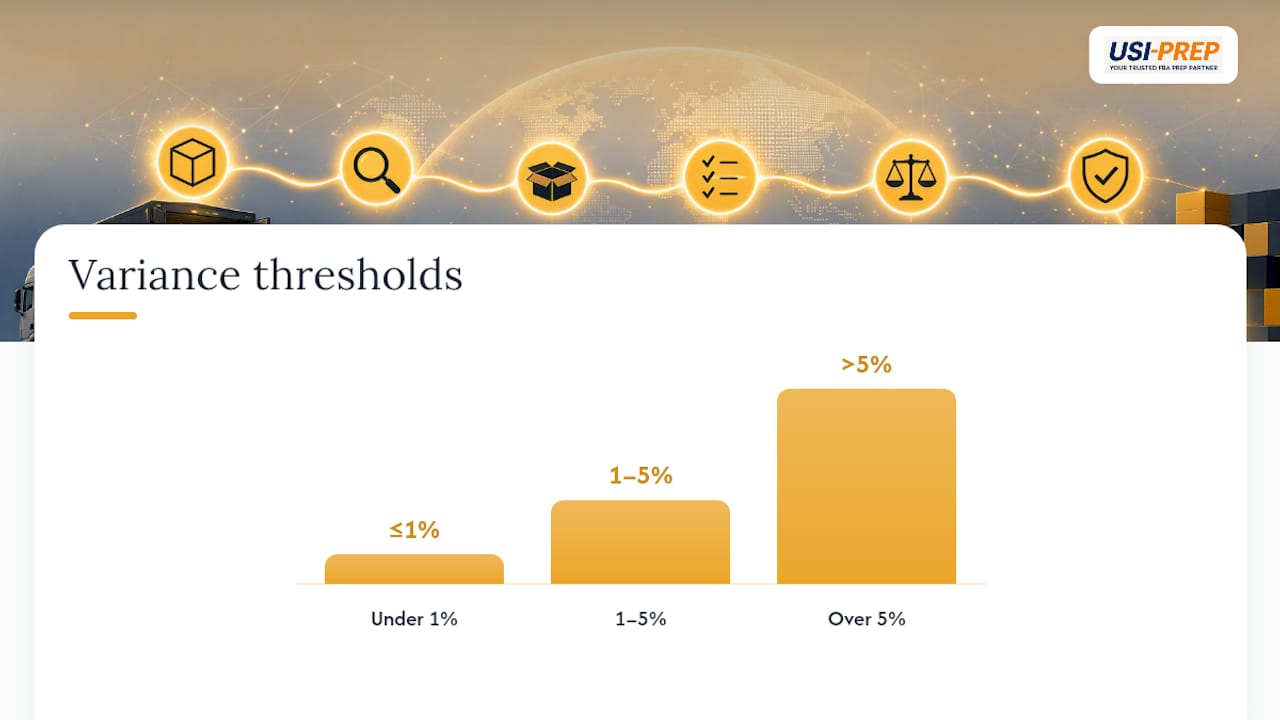
Every mismatch needs one of four outcomes: accept the variance, recount, file a claim, or quarantine the shipment. What you should never accept is a silent manual override that just adjusts your system count to match what showed up.
Practical thresholds that work for most ecommerce and Amazon-bound inventory:
- Under 1% variance: accept and log it, no further action needed.
- 1% to 5% variance: recount the affected SKUs before posting anything.
- Over 5% variance: quarantine the shipment and open a claim with the carrier or supplier.
Statistic to know: dock-to-stock time, meaning the hours between a truck backing into the dock and inventory going live in your WMS, is the metric that matters most here. Ask any 3PL you’re evaluating to name that number in hours and put it in the contract, alongside a resolution window for OS&D disputes, typically 24 to 48 hours for straightforward cases.
Putaway and WMS Updates: Closing the ATS Gap
Putaway confirmation is where inventory either becomes sellable or sits invisible in a warehouse for a day too long. Same-day WMS posting is the standard to insist on; overnight batch updates create exactly the kind of blind spot that causes oversells during high-volume periods.
Ask your 3PL which integration method they run: API, EDI, or manual batch upload. API and EDI integrations push data in near real time, while batch uploads can lag by hours or a full overnight cycle. That gap is exactly when a marketplace listing can oversell.
- Confirm putaway location and update the WMS the same business day, ideally within hours of physical receipt.
- Ask which events trigger real-time pushes versus batch jobs, and test both before your first live shipment.
- Require channel-aware tagging at putaway, so units get sorted correctly for wholesale, marketplace, or direct-to-consumer pools instead of one undifferentiated bucket.
Merchants running multiple platforms should also confirm how the 3PL’s system talks to Shopify or other storefronts, since SKU mapping errors at this stage tend to surface as phantom stockouts weeks later.
Closing Reconciliation: What Finance and Planning Need
Reconciliation is the paperwork stage that nobody enjoys and everybody needs. A three-way match between the PO, the ASN, and what was physically received closes out every shipment with a clear status, and every discrepancy gets a reason code, whether that’s carrier damage, supplier shortage, or a packing error.
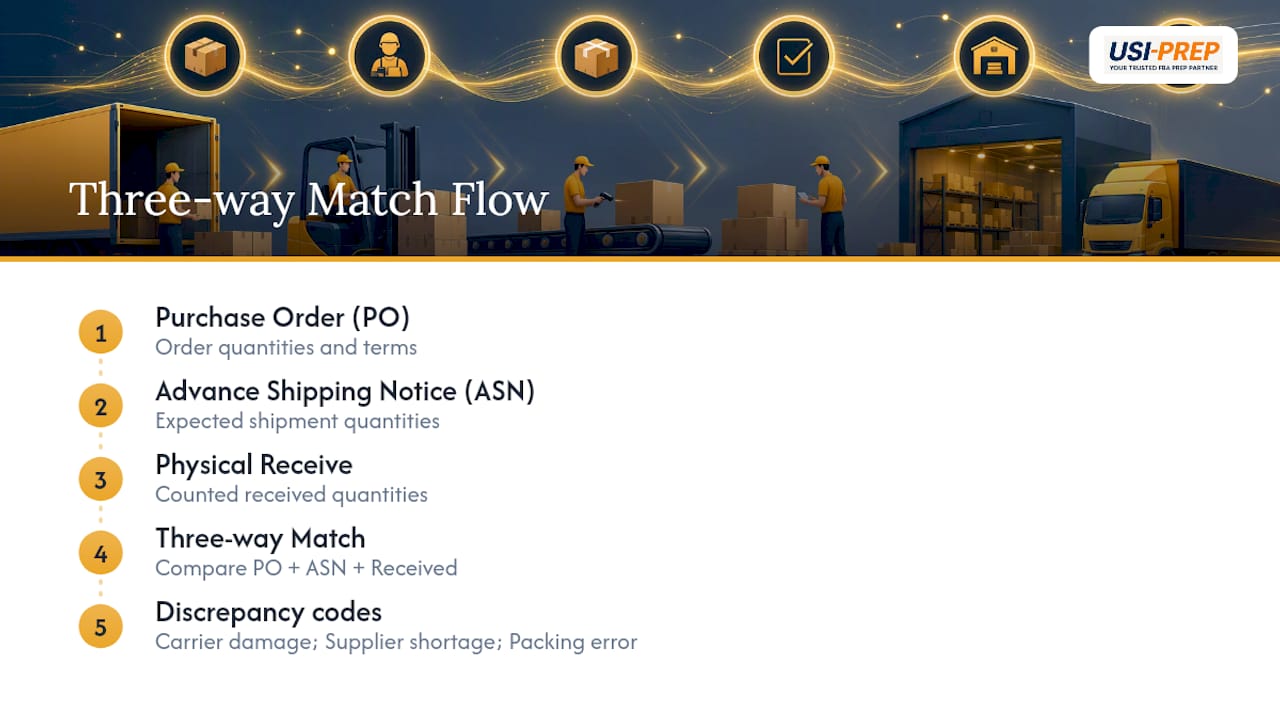
Operations should see a daily variance report; finance needs a weekly rollup that ties received quantities to landed cost. Get this wrong consistently and your next purchase order sizing is built on bad data, which compounds the error instead of correcting it. Reconciliation reports also feed directly into order management practices that keep available-to-sell numbers accurate across every sales channel.
Onboarding Checklist: Making the SOP Stick With New Suppliers
A checklist only works if it survives contact with a new supplier or a new 3PL relationship. Build these milestones into onboarding before your first chargeable shipment moves.
- Run a pilot shipment through the full six-stage SOP and review every variance before scaling volume.
- Require a live integration map showing exactly how ASN data, inventory counts, and tracking events move between systems, and test those events before go-live.
- Publish a supplier manual covering label formats, palletization standards, and required ASN fields, with chargebacks specified for noncompliance.
- Get sign-off from both sides only after a pilot receipt clears with zero unresolved variances.
Suppliers who can’t hit these basics on a pilot load rarely improve once volume goes up.
Why SOP Discipline Beats Ad Hoc Fixes
Ad hoc receiving fixes work until volume doubles, then they fail all at once. Same-day posting isn’t a nice operational habit, it’s what keeps your available-to-sell numbers from drifting into oversells during your busiest weeks. Automated hold rules matter for the same reason: a person manually overriding a variance under deadline pressure is how bad counts quietly become permanent.
The company was built by former Amazon sellers who lived through exactly this failure mode, and that shapes how the SOP gets enforced rather than just documented. A checklist without a named SLA behind it is a suggestion, not a control.
— Akbar
Get a Faster, More Transparent Receiving Process With USIPrep
If you’re tired of chasing a 3PL for basic visibility into what happened to your inventory after it hit their dock, USIPrep runs receiving differently. USIPrep reports a 98.9% on-time delivery rate and has helped brands cut fulfillment costs by 30% by tightening exactly the kind of receiving discipline this article covers, faster check-ins, clear dock-to-stock timing, and visibility into every inbound event instead of a black box.
When you get on a call with a 3PL provider, ask three things directly: their dock-to-stock SLA in hours, how a pilot shipment would run before you commit real volume, and what their integration map looks like for your specific platform. Those three answers tell you more than any sales pitch. Start by reviewing the FBA prep requirements checklist for 2026 to see expectations for inbound shipments before they reach a dock.
Sources
- Six-stage 3PL receiving SOP for apparel brands that keeps ATS honest
- How to choose a 3PL: checklist (2026)
FAQ
What Is a Receiving Checklist 3PL Providers Should Follow?
It’s a written list of pre-arrival, dock, carton verification, and putaway requirements a 3PL follows on every inbound shipment, typically backed by a six-stage SOP and a named dock-to-stock SLA.
What Is an ASN and Why Does 3PL Receiving Need One?
An ASN, or Advance Shipping Notice, tells the receiving warehouse what’s arriving, when, and in what quantities before the truck shows up, which is what lets ASN receiving 3pl workflows run without blind guessing at the dock.
What Is a Reasonable Dock-to-Stock SLA?
Dock-to-stock time should be measured in hours, not days, and providers like USIPrep structure their process to keep that window tight rather than letting inventory sit unposted overnight.
Does Receiving Photo Documentation Actually Matter?
Yes. Photographing seals, pallets, and any damage at the dock creates the evidence needed to support an OS&D claim, and skipping it usually means losing that dispute by default.