
Kitting means combining multiple SKUs into a single sellable unit before it reaches Amazon. In 2026, the smart move is doing that assembly upstream with a 3PL, not inside a fulfillment center. Amazon has been pulling back on in-house kitting and prep, so sellers who build kits before inbound get consistent presentation, fewer compliance rejections, and lower rework costs.
TL;DR:
- Upstream kitting with a trusted 3PL reduces compliance rejections, rework costs, and improves product presentation compared to relying on Amazon’s declining in-house services.
- Properly setting up a kit requires clear SKUs prioritization, detailed bills of materials, pilot testing, and careful inventory metrics tracking to avoid supply chain issues.
- Amazon treats kits as separate units with their own ASINs and FNSKU labels, making precise labeling and packaging compliance essential to prevent rejection and inventory discrepancies.
- Kitting can increase profit margins and order value but adds costs in assembly, labeling, and storage, which may outweigh benefits for low-volume or thin-margin products.
- Starting upstream kitting involves choosing high-velocity SKUs, working with experienced fulfillment partners, and running small pilots to verify QC and turnaround times before scaling.
Table of Contents
- What Does FBA Kitting Actually Mean?
- Why Upstream Kitting Usually Beats Amazon-Side Prep
- How Do You Set Up an FBA Kitting Operation?
- What Amazon Compliance Rules Apply to Kits?
- What Does Kitting Cost, and When Does It Pay Off?
- How a Prep Partner Turns Kitting Into a Repeatable Process
- Does Kitting Actually Fit Your Growth Stage?
- Ready to Move Your Kitting Upstream?
- Sources
- FAQ
What Does FBA Kitting Actually Mean?
Kitting and bundling get used interchangeably, but they’re not identical, and mixing them up causes catalog problems. A kit is a set of separate, individually sellable items packaged together and sold under one new ASIN, like a skincare set with a cleanser, serum, and moisturizer boxed as one unit. A bundle is similar but often refers to items sold together temporarily or promotionally, sometimes without a dedicated barcode. A multipack is multiples of the identical SKU, and a case pack is a wholesale-quantity carton, usually not a consumer-facing kit at all.
The distinction matters because of how Amazon’s catalog and FNSKU systems work:
- Every kit needs its own ASIN, separate from the ASINs of its individual components.
- The kit gets its own FNSKU label, which means Amazon treats it as one unique product, not three products shipped together.
- Component items already listed and sold individually will now compete for Buy Box against your own kit if not managed carefully.
- Pricing a kit below the sum of its parts is usually what drives conversion, since customers expect a bundling discount.
Get the ASIN structure wrong and you’ll end up with stranded inventory, duplicate listings, or a kit that Amazon’s system can’t reconcile against the components inside it.
Why Upstream Kitting Usually Beats Amazon-Side Prep
Amazon has been scaling back its in-FC kitting and prep services, and that shift is pushing more of the assembly burden onto sellers and their 3PL partners. Relying on Amazon to kit products at the fulfillment center level has always been inconsistent. Now it’s becoming less available, and the sellers who adapt fastest are the ones building kitting into their prep workflow before goods ever leave the warehouse.
The case for doing it upstream comes down to three things:
- Quality control happens before the kit is sealed, not after a customer complaint.
- Throughput scales because a dedicated packing line doesn’t compete with FC labor priorities.
- Cost predictability replaces the surprise fees and delays that come with downstream fixes.
A contract-packaging partner with a facility positioned near major fulfillment hubs can also cut ground freight time to multiple FCs, which matters most for seasonal or high-volume programs where timing determines whether inventory arrives before a demand spike or after it. Mid- and high-volume brands feel this shift hardest, since their kits touch more units and more FCs, and downstream inconsistency multiplies with scale.
How Do You Set Up an FBA Kitting Operation?
Building a kitting workflow isn’t complicated, but skipping steps is exactly how sellers end up with rejected shipments or a warehouse full of half-assembled units. Here’s the order that actually works.
- Prioritize which SKUs to kit first. Start with high-velocity items that carry healthy margins and aren’t sitting as aged inventory. A slow mover isn’t worth kitting complexity, no matter how good the bundle idea sounds on paper.
- Write a full bill of materials and packaging spec. Document every component, quantity, label placement, and whether the kit needs polybagging, a suffocation warning, or bubble wrap protection.
- Run a pilot batch before scaling. Get sample approval in writing, define QC acceptance criteria (defect rate, label accuracy, seal integrity), and set a throughput target your partner has to hit.
- Track the inventory metrics that shift once kitting enters the picture. Days of cover, lead time, and reorder points all change when three SKUs become one, since a shortage in any single component now stalls the whole kit; understanding these changes is critical according to the Inventory Turns Formula for Operations Leaders.
- Interview your 3PL before committing volume. Ask about turnaround SLA, how they handle component shortages or damaged units, and whether their team has real FNSKU labeling experience.
Pro Tip: Run your pilot with the SKU that has the tightest margin for error, not your easiest one. If a partner can hit QC targets on your hardest kit, everything else will be simpler by comparison.
Ranking SKUs by days-of-cover before committing to a kitting pilot keeps you from locking capital into a bundle that won’t move fast enough to justify the assembly cost.
What Amazon Compliance Rules Apply to Kits?
Amazon treats a kit as one sellable unit, which sounds simple until you realize it changes how labeling and packaging rules apply. The kit’s outer packaging needs the FNSKU visible and scannable, and depending on your prep category, you may also need to cover or obscure the manufacturer’s original barcode on each component so scanners don’t pick up the wrong item.
A few rules trip up sellers constantly:
- Any component with loose parts smaller than certain dimensions may require poly bagging with a suffocation warning printed on the bag.
- Fragile items inside a kit sometimes need bubble wrap even if the standalone product never required it.
- Amazon’s prep and packaging guidelines apply to the kit as a whole unit, meaning a single mislabeled component can flag the entire carton for rejection at receiving.
- Carton contents must match the manifest exactly. If a kit’s assembled unit count doesn’t match what’s declared, expect a hold or extra fee.
The fastest fix for most rejections is simple: standardize your label placement and barcode coverage before the first unit ever gets boxed, not after Amazon flags the first shipment.
What Does Kitting Cost, and When Does It Pay Off?
Kitting adds real line items to your cost structure, and pretending otherwise leads to margin surprises. Budget for assembly labor, FNSKU labeling, polybag or box materials, receiving fees, and storage, since a kit sometimes occupies more cubic space per unit than its components would separately.
The upside is real too. Bundling multiple items typically lifts average order value and reduces the per-order fulfillment fee you’d otherwise pay shipping three separate SKUs. The risk: if a kit’s velocity is lower than its individual components, you can end up paying more in storage than you save in fees. For very high-volume programs, sending components in bulk through AWD before final kitting can be more cost-efficient than warehousing fully assembled kits close to peak season.
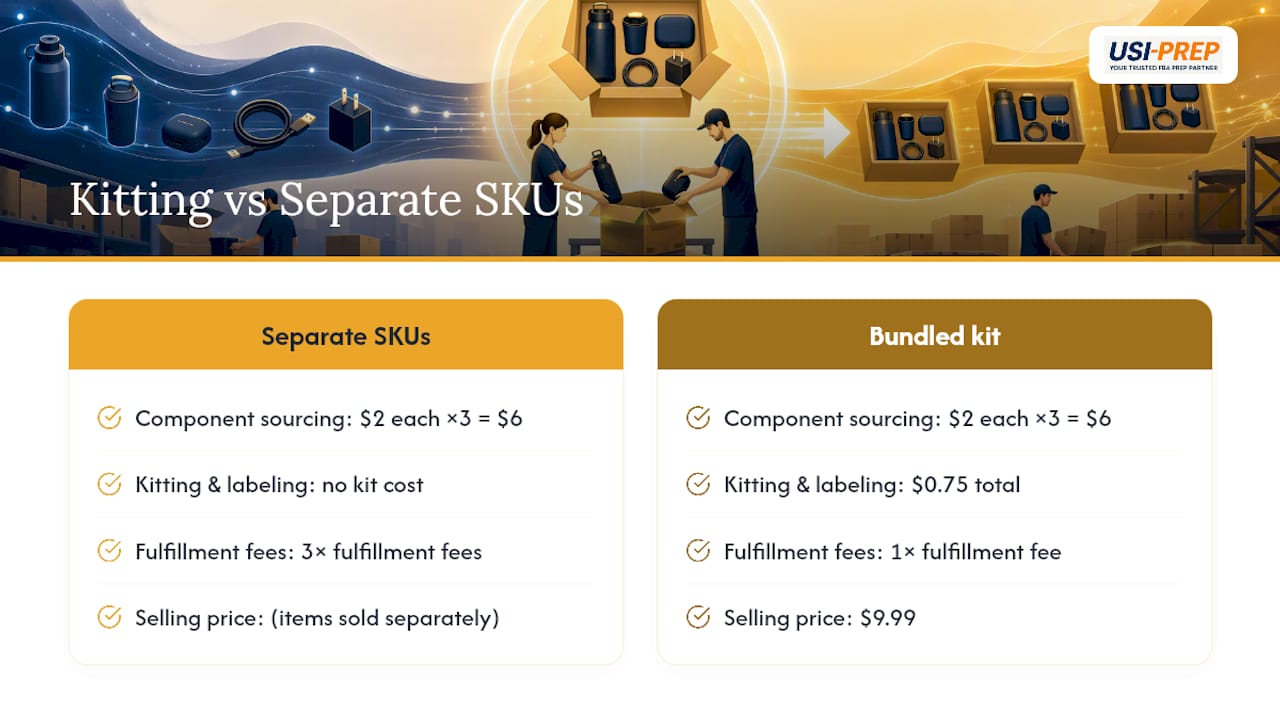
A quick example: say three components cost $2 each to source and $0.75 total to kit and label. Sold separately, each earns a $1 margin after Amazon fees. Bundled at $9.99, after a single referral fee and one fulfillment fee instead of three, the kit often nets $1 to $2 more per sale, assuming it sells at close to the same velocity as the individual items.
How a Prep Partner Turns Kitting Into a Repeatable Process
A workable kitting operation runs on a simple sequence: build the bill of materials, assemble and QC each kit, apply compliant labeling, then move it into inbound. The company was built by former Amazon sellers who got tired of unreliable prep vendors, and that background shapes how kitting projects are structured, with transparent per-unit pricing and faster inventory check-in times than sellers typically get elsewhere.
Founders who’ve run their own FBA operations know exactly where kitting projects usually break down: unclear specs, slow check-in, and no visibility once inventory leaves the truck. Building the process around those failure points, rather than around generic warehouse workflows, is what separates a reliable kitting partner from a bottleneck.
That operational focus shows up in reported metrics: a high on-time delivery rate and fulfillment cost reductions for many client brands.
Does Kitting Actually Fit Your Growth Stage?
Kitting earns its keep when it lifts average order value, protects brand presentation, or clears slow-moving inventory by pairing it with a strong seller. It backfires on thin-margin products or anything with unreliable demand, where the added assembly cost outpaces any lift in price. Before signing with any 3PL, get their QC error rate and turnaround SLA in writing. Vague promises are where most kitting programs quietly fail.
— Akbar
Ready to Move Your Kitting Upstream?
Handling kitting inside a fulfillment center means living with whatever Amazon’s staffing and prep capacity allow that week. This company flips that arrangement: kits get assembled, labeled, and QC checked at a dedicated facility before they ever touch an FC dock, with transparent per-unit pricing instead of surprise prep fees.
If you’re planning your first kitting pilot, start with the FBA Prep Requirements Checklist 2026 to confirm your labeling and packaging specs are inbound-ready before you commit volume. Sellers looking to tighten turnaround times on existing prep workflows should also read how to speed up your FBA prep process. When you’re ready to test kitting with real inventory, request a quote from a qualified 3PL and run a small paid pilot batch before scaling to your full catalog.
Sources
For compliance rules straight from the source, review Amazon’s own packaging and prep guidelines and the FBA Inventory tool for tracking excess and stranded stock. SellerVault’s inventory management guide covers DOC and reorder-point math in more depth than fits here.
- FBA prep, packaging, and labeling: A beginners guide – Sell on Amazon
- The Complete FBA Inventory Management Guide | SellerVault
- Amazon Kitting Alternatives | Amazon FBA Kitting Replacement
FAQ
Is FBA Still Profitable in 2026?
Yes, for sellers who control their prep costs and inventory turns. Margins have gotten tighter as Amazon shifts more prep responsibility to sellers, which is exactly why upstream kitting and disciplined days-of-cover tracking matter more now than a few years ago.
What Does FBA Kitting Mean in Logistics?
FBA kitting is the process of assembling multiple individual SKUs into one new sellable unit, given its own ASIN and FNSKU, before it’s sent into Amazon’s fulfillment network.
Can I Make $1,000 a Month Selling on Amazon?
It depends entirely on margin, volume, and how well you manage fulfillment costs. Bundling complementary products into kits is one legitimate way sellers lift average order value and reach that kind of monthly revenue faster than selling components separately.
How Does Kitting Work in Retail More Broadly?
Retail kitting follows the same logic as Amazon kitting: components get assembled into one packaged unit before it reaches the shelf or the fulfillment center, which reduces the retailer’s or platform’s own labor and consolidates SKUs at the point of sale.
What Should I Ask a 3PL Before Starting a Kitting Program?
Ask about their turnaround SLA, how they handle component shortages or damaged units, and whether their team has hands-on FNSKU labeling experience, since gaps in any of those three areas are what typically cause shipment rejections.