
USIPrep is the strongest overall pick for small to medium Amazon sellers who need reliable FBA prep in 2026, especially with Amazon’s own prep and labeling service shutting down. If you run high volume with tight margins, pair that with a low-cost batch prep specialist for simple polybagging and labeling runs. If your catalog leans heavily into multipacks or fragile goods, look at a kitting and fragile-goods specialist that builds custom assembly lines for bundles.
That’s the short version. Amazon confirmed it will end its own FBA prep and item labeling services in the U.S. effective January 1, 2026, which means every seller who leaned on Amazon-provided prep now needs a third-party plan before that date hits. Waiting until December to figure this out is how sellers end up with rejected inbound shipments in January.
Here’s the shortlist worth evaluating first:
- USIPrep (publisher pick): Founded by former Amazon sellers, reports a 98.9% on-time delivery rate and clients commonly cite a 30% drop in fulfillment costs after switching.
- Best for low-volume or new sellers: A batch prep specialist charging simple per-unit rates with low or no monthly minimums, ideal if you’re shipping a few hundred units a month.
- Best for kitting and complex prep: A fragile-goods and bundling specialist with dedicated assembly lines for multipacks, subscription boxes, and items needing extra protective packaging.
Scroll to the comparison table below to see how these three archetypes stack up on pricing, turnaround, and minimums before you commit to a pilot shipment.
Key Takeaways
Choosing an Amazon prep center in 2026 comes down to matching your SKU complexity to a provider that handles compliance, turnaround, and pricing transparency without forcing you into multiple vendor contracts.
| Point | Details |
|---|---|
| 2026 deadline is real | Amazon ends its own FBA prep and labeling service on January 1, 2026, making third-party prep a necessity, not an option. |
| Pilot before you scale | Test a small shipment with your most complex SKU before committing to full volume with any provider. |
| Know your cost per unit | Standard prep runs $1.00 to $2.00 per unit on average; get a sample invoice before signing. |
| Match services to SKUs | Don’t pay for kitting or climate control you don’t need, but never skip FNSKU labeling. |
| USIPrep fits sellers needing one partner | Reports a 98.9% on-time delivery rate and roughly 30% average fulfillment cost savings for switching clients. |
Table of Contents
- What Are the Best Amazon Prep Centers to Compare in 2026?
- How Do You Choose the Right Prep Center for Your Business?
- What Services Do Amazon Prep Centers Actually Provide?
- What Do Prep Centers Charge and How Do You Estimate Your Cost?
- How Does Amazon’s 2026 Prep Shutdown Change Your Operations?
- How Do You Onboard With a Prep Center Step by Step?
- Why Does USIPrep Stand Out Among Prep Centers?
- Get Your FBA Prep Sorted Before the 2026 Deadline Hits
- Frequently Asked Questions
- Sources
What Are the Best Amazon Prep Centers to Compare in 2026?
Picking the right Amazon prep center comes down to matching your SKU mix and volume to a provider’s actual strengths, not just their advertised rate card. A seller shipping 200 units of one SKU a month has completely different needs than someone running 5,000 units across 40 SKUs with seasonal kitting requirements. Below is a side-by-side look at four provider archetypes: the publisher pick, a low-cost batch specialist, a high-volume fulfillment partner, and a kitting and fragile-goods specialist. Names have been generalized into categories rather than naming specific competing brands, since the goal here is helping you evaluate types of providers, not chase logos.
| Feature | USIPrep (Publisher Pick) | Low-Cost Batch Specialist | High-Volume Fulfillment Partner | Kitting & Fragile-Goods Specialist |
|---|---|---|---|---|
| Best for | Sellers wanting speed, transparency, and lower total cost | New or low-volume sellers with simple SKUs | Sellers scaling past several thousand units a month | Multipack, bundle, or fragile-item sellers |
| Services offered | Receiving, FNSKU labeling, polybagging, kitting, inspection, returns, global shipping | Receiving, labeling, polybagging (limited kitting) | Full-service prep plus warehousing and multichannel fulfillment | Custom kitting, bundling, protective packaging, QC inspection |
| Pricing model & example ranges | Per-unit and per-order, transparent itemized invoices; sellers report roughly 30% lower fulfillment costs after switching | Flat per-unit fee, often near the low end of the $1.00 to $2.00 per unit industry range | Tiered volume pricing with storage fees layered in | Per-unit prep plus a kitting assembly fee per bundle |
| Turnaround / SLA | Fast check-in with published on-time metrics | Standard 24 to 72 hour turnaround | Can slow during peak season without dedicated account management | varies depending on kit complexity |
| Minimums & capacity | Flexible for small and mid-size sellers, scales with growth | Low or no monthly minimum | High minimums, built for six and seven-figure sellers | Moderate minimums tied to kit order size |
| Integrations | Seller Central, Shipments API, major ecommerce platforms | Basic Seller Central integration | Full API and multichannel platform support | Seller Central plus custom SKU mapping for bundles |
| Warehouse footprint & locations | U.S.-based facilities with room to add regional nodes | Often single-location, limited regional coverage | Multiple large regional warehouses | Fewer locations, but deeper kitting expertise per facility |
| Customer support / SLA | Direct communication, full visibility into shipment status | Email-based support, slower response on complex issues | Dedicated account manager but slower for smaller accounts | Specialized support for kitting spec questions |
A few things jump out once you line these up. The low-cost batch specialist wins on price for dead-simple SKUs, but its lack of kitting capability means you’ll need a second vendor the moment your catalog gets more complex. The high-volume partner makes sense once you’re moving serious freight, but their support model often deprioritizes smaller accounts during Q4 rushes, which is exactly when you can least afford a delay.
USIPrep’s advantage isn’t a single feature. It’s that the same account handles receiving, labeling, kitting, and returns without forcing you to stitch together two or three vendors for different SKU types. That matters more in 2026 than it did a year ago, because sellers who previously outsourced prep to Amazon itself now need one reliable partner covering the full range of prep tasks Amazon used to handle in-house.
- USIPrep pros: Transparent itemized invoices, fast check-in, single point of contact for prep and fulfillment. Cons: Newer brand recognition compared to legacy 3PLs with decades in the space.
- Low-cost batch specialist pros: Cheapest entry point for simple SKUs. Cons: Limited kitting, slower support, minimal integration depth.
- High-volume fulfillment partner pros: Built for scale, multiple warehouse locations. Cons: High minimums shut out smaller sellers, support often deprioritizes smaller accounts.
- Kitting specialist pros: Genuine expertise in bundle assembly and fragile packaging. Cons: Narrower service range, generally not the cheapest option for basic labeling-only jobs.
If your business genuinely needs both simple labeling and occasional kitting, that’s usually where the FBA prep services overview is worth reading before you sign with a single-service specialist and end up needing a second contract three months later.
How Do You Choose the Right Prep Center for Your Business?
The wrong prep center rarely fails on day one. It fails in month three, when your volume grows or your SKU mix shifts and the provider’s limitations start showing. Build your evaluation around these criteria before you sign anything:
- Pricing structure: Per-unit, per-order, or hybrid? Get a sample invoice, not just a rate sheet.
- Turnaround commitments: Ask for their actual average, not just their advertised best case.
- Minimums: Monthly volume minimums can lock out small sellers or force overpaying for capacity you don’t use.
- Kitting and inspection capability: Confirm they can handle your specific bundle complexity, not just “kitting” as a checkbox.
- Integrations: Seller Central and Shipments API compatibility, plus support for your sales channel if you sell on more than Amazon.
- Warehouse location: Proximity to your supplier or port can cut freight costs and, in some cases, affect your sales tax exposure if you’re sourcing through online arbitrage.
- Insurance and liability terms: Know what happens if inventory is damaged or lost in their facility.
- Returns handling: Ask whether returns processing is included or billed separately.
Before you commit, ask these questions directly:
- What’s your average turnaround time by SKU size, not just your best case?
- Can I see a sample itemized invoice from an existing client?
- What are your insurance limits for lost or damaged inventory?
- Will you accept a small pilot shipment before I commit to volume?
- How do you handle chargebacks or reimbursement disputes with Amazon?
- What’s your process when a shipment gets flagged at check-in?
Watch for vague answers to any of those. A provider that won’t share a sample invoice, gives a fuzzy SLA (“usually pretty fast”), or refuses a small pilot shipment is telling you something. Reputable prep centers expect new sellers to test the relationship before scaling volume. If a provider pushes back hard on a trial run, that’s a signal to keep looking, not a quirk to overlook.
Pro Tip: Run your pilot shipment with your most complex SKU, not your easiest one. If a provider handles your trickiest packaging or labeling case cleanly, the simple SKUs will take care of themselves.
Negotiation matters more than most sellers assume. Ask about volume tiers before you hit them, not after, and get chargeback handling terms in writing. Many prep centers will offer a short trial period at standard rates before locking you into a longer contract. Take it.
What Services Do Amazon Prep Centers Actually Provide?
Not every SKU needs every service, and paying for prep you don’t need is one of the fastest ways to erode your margin. Here’s what’s actually on the menu and when each one earns its cost.
Receiving and inspection covers the intake of your inventory from suppliers, checking for damage, counting units, and verifying against your packing list. Online-arbitrage sellers should treat inspection as close to mandatory, since supplier variance is common with secondhand or retail-sourced inventory.
FNSKU labeling applies Amazon’s barcode to each unit so it’s trackable inside the fulfillment network. This one isn’t optional. Amazon’s Seller Central labeling guidance spells out the exact requirements, and getting it wrong risks reimbursement denial if a unit gets lost or damaged in transit.
Polybagging and bubble-wrapping protect items during handling and shipping. Textiles, loose parts, and anything with a suffocation warning requirement typically need polybagging. Fragile or glass items need bubble wrap or foam inserts. Usiprep’s guide on polybagging requirements breaks down which categories Amazon flags most often.

Kitting and bundling combine multiple SKUs into one sellable unit, common for gift sets or multipacks. Rework covers relabeling or repackaging when a product arrives with the wrong barcode or damaged retail packaging.
Expiration-date management matters for consumables and supplements, where FIFO rotation and expiration tracking prevent aged stock from getting flagged. Temperature-controlled storage protects items sensitive to heat, like cosmetics or certain electronics, during the 24 to 72 hour turnaround window most prep centers advertise.
Returns processing and shipping to Amazon round out the list. Ask specifically whether returns are inspected and restocked or simply logged.
What Do Prep Centers Charge and How Do You Estimate Your Cost?
Most prep centers charge per unit for standard prep, with additional line items for special handling. Industry averages run $1.00 to $2.00 per unit for standard labeling and polybagging, though actual rates shift based on item size, weight, and your monthly volume.
| Fee type | What it covers | Typical range |
|---|---|---|
| Receiving | Intake, count, inspection per unit | Often bundled into per-unit prep fee |
| Standard prep (labeling, polybagging) | FNSKU application, bagging | $1.00 to $2.00 per unit |
| Kitting/bundling | Assembling multi-item bundles | Per-unit prep fee plus assembly surcharge |
| Special handling | Fragile packaging, oversized items | Added surcharge on top of base rate |
| Storage | Holding inventory before shipment | Varies by cubic footage and duration |
| Returns processing | Receiving, inspecting, restocking | Often billed per returned unit |
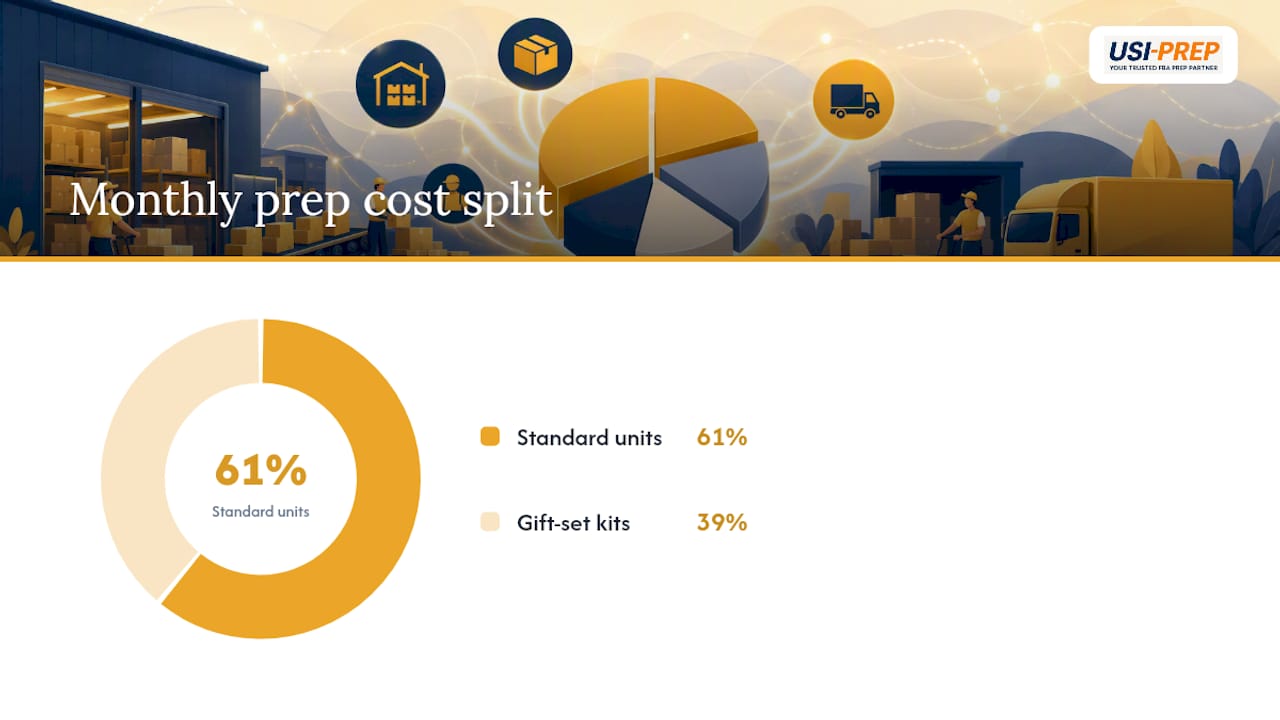
Here’s a worked example. Say you ship 1,000 units a month: 700 units need standard labeling and polybagging at $1.50 per unit, and 300 units are gift-set kits requiring an additional $0.75 assembly fee on top of the same base prep rate. That’s $1,050 for the standard units plus $675 for the kits, landing around $1,725 a month before storage or returns fees. Run that math against your actual SKU mix before signing with any provider.
A few tactics cut that number down. Batching similar SKUs together reduces per-unit handling time, and most prep centers pass some of that savings along. Negotiating volume tiers once you cross a few thousand units a month is standard practice, not an unusual ask. Choosing a prep center near your supplier’s freight route or the port your imports clear can meaningfully cut inbound shipping costs. And if you’re eligible, using Ships-in-Product-Packaging eliminates the need for polybagging entirely on qualifying items, which can shave real money off your monthly prep bill.
One more angle worth knowing: sellers doing online arbitrage sometimes choose prep centers in sales-tax-free states like Delaware, Alaska, Montana, New Hampshire, or Oregon, since inventory can be billed to the prep center’s address rather than the seller’s home state. That’s a real cost lever, not just a location convenience.
How Does Amazon’s 2026 Prep Shutdown Change Your Operations?
Amazon confirmed it’s ending its own FBA prep and item labeling services in the U.S. effective January 1, 2026. After that date, sellers who previously paid Amazon to handle prep must either do it themselves or hand it off to a third-party provider before creating any shipment.
Amazon has told sellers to prep and label products before creating shipments once its own prep and labeling services stop, pointing them toward doing it in-house or working with a third-party prep provider.
This isn’t a minor policy tweak. Sellers who never built their own prep workflow because Amazon handled it are now facing a hard deadline, and the sellers who wait until Q4 2026 to figure out a plan will be competing with everyone else for prep center capacity right when it’s tightest. Here’s the transition checklist worth working through now:
- Audit every SKU currently relying on Amazon-provided prep or labeling.
- Sort those SKUs into “needs third-party prep” versus “can be prepped at the supplier level” before shipping.
- Update your packing workflows and documentation to match your chosen prep partner’s specs.
- Schedule a pilot shipment with a third-party prep center well before your usual Q4 inventory push.
- Confirm your prep partner’s labeling process matches Amazon’s official requirements to avoid reimbursement issues on damaged or lost units.
The sellers who move on this now, rather than in December, will be the ones with functioning inventory pipelines in January. Everyone else will be stuck negotiating capacity with prep centers already at full booking.
How Do You Onboard With a Prep Center Step by Step?
Getting a prep center relationship running smoothly usually takes two to three weeks from first contact to your first full shipment, assuming you move efficiently through each step.
- Set up your account and share your product catalog, including SKU dimensions and weights.
- Provide detailed packing guidelines for each SKU category, including fragile or multipack items.
- Send a small sample shipment, ideally including your most complex SKU, not just your easiest one.
- Review and approve sample labels and packaging before authorizing full production.
- Schedule your first inbound shipment with clear expectations on turnaround.
- Confirm your Seller Central or Shipments API integration is passing data correctly.
- Get the finalized SLA in writing, including turnaround guarantees and support response times.
For your pilot shipment, include a handful of actual product samples across your different SKU types, sample FNSKU labels ready for review, and a spec sheet noting any special packaging requirements like polybagging or bubble wrap. Reference Amazon’s check-in guidance so your prep partner understands exactly what triggers a rejected or delayed check-in on Amazon’s end.
- Account setup: typically 1 to 2 business days.
- Sample shipment receiving and review: 3 to 5 business days.
- Label and packaging approval: 1 to 2 business days.
- First full inbound shipment: scheduled once approval is complete, usually within a week.
Why Does USIPrep Stand Out Among Prep Centers?
USIPrep was founded by former Amazon sellers, which shows up in how the operation is built. Every fee is itemized, so you see exactly what you’re paying for on each invoice rather than guessing at bundled charges.
The numbers back it up. USIPrep reports a 98.9% on-time delivery rate, and clients commonly report roughly a 30% reduction in fulfillment costs after switching from a previous provider or from in-house prep.
Founders who’ve run Amazon storefronts themselves tend to build prep operations around the failures they personally experienced, like slow check-ins, opaque invoicing, and support that goes silent during peak season.
Sign up and you get direct communication with your account team, not a ticket queue. Full visibility into shipment status means you’re not calling to ask where your inventory is. A few patterns show up repeatedly among small and mid-size sellers who switch providers: faster check-in times reduce the risk of missed Prime Day or Q4 windows, and the cost savings from consolidated invoicing free up budget that used to go toward paying two separate vendors for prep and fulfillment.
- Founded by former Amazon sellers who understand seller-side pain points firsthand.
- 98.9% on-time delivery rate reported across client shipments.
- Clients commonly see close to a 30% reduction in total fulfillment costs.
- Transparent, itemized billing with no bundled mystery fees.
Choosing a prep center in 2026
If I were picking a prep partner in 2026, compliance would be priority one. Amazon’s shutdown of its own prep service means the margin for labeling errors just got smaller, and a provider who doesn’t stay current on Amazon’s requirements will cost you reimbursement money down the line.
Priority two is the pilot shipment, and I’d push it further than most sellers do. Don’t just test your easiest SKU. Run two or three different product types through a small trial batch at once, including whatever item has the trickiest packaging in your catalog. That’s the fastest way to surface a labeling or handling gap before it shows up in a 500-unit shipment.
Priority three is integration. If your prep partner’s system doesn’t talk cleanly to Seller Central or the Shipments API, you’re manually reconciling data every week, and that friction compounds as you scale.
Get Your FBA Prep Sorted Before the 2026 Deadline Hits
Amazon ending its own prep and labeling service means every seller who leaned on that safety net now needs a real plan, and USIPrep was built by people who’ve felt that exact scramble from the seller’s side of the desk.
If you’re still mapping out which SKUs need third-party prep before January, start with the FBA prep requirements checklist for 2026. It walks through exactly what to audit before you commit to a provider, and it’s a faster starting point than trying to piece the rules together from scattered Seller Central pages. Run your pilot shipment now, not in November.
Frequently Asked Questions
What is an Amazon prep center?
An Amazon prep center is a third-party facility that receives, inspects, labels, and packages inventory before it ships to Amazon’s fulfillment network, handling tasks like FNSKU labeling, polybagging, and kitting on a seller’s behalf.
How much do Amazon prep services typically cost?
Standard prep runs $1.00 to $2.00 per unit on average, with additional charges for kitting, special handling, or storage depending on the provider and your volume.
Why is Amazon ending its own prep service in 2026?
Amazon announced it will stop offering FBA prep and item labeling services in the U.S. starting January 1, 2026, directing sellers to prep items themselves or use a third-party provider instead.
How do I choose the right prep center for my business?
Match your SKU complexity and volume to a provider’s actual capabilities: check pricing transparency, turnaround time, kitting capacity, integration with Seller Central, and whether they’ll accept a small pilot shipment before you commit to full volume.
What happens if my prep center mislabels an item?
Mislabeled or improperly prepped items risk rejection at Amazon’s fulfillment centers or denied reimbursement if lost or damaged, which is why confirming your provider follows Amazon’s official labeling requirements matters before your first full shipment.
Sources
- Amazon to end FBA prep, labeling services in US | Supply Chain Dive
- Amazon Seller Central help: prep and labeling guidance