
Dimensional weight (DIM weight) is a carrier pricing method that converts package volume into a billable weight. The rule is simple: you pay whichever is higher, your package’s actual scale weight or its DIM weight. The formula is (Length × Width × Height) ÷ DIM divisor. A 12×12×12-inch box that weighs 2 lb has a DIM weight calculated by dividing its volume by the carrier’s DIM divisor, which results in a number that can be significantly higher than the actual weight under a standard account divisor. You pay for 13 lb, not 2. That gap is where shipping budgets quietly disappear.
Key Takeaways
Carriers bill the greater of actual weight or DIM weight, so a 10 lb package in an oversized box can easily bill at 25 lb or more, and fixing that gap is the fastest way to recover margin on bulky SKUs.
| Point | Details |
|---|---|
| DIM formula | Divide L × W × H (in inches) by your carrier’s divisor; round up to the nearest whole pound. |
| Carrier divisors | FedEx and UPS account rates use 139 in³/lb; USPS applies DIM only above 1,728 in³ for eligible services. |
| Biggest DIM risk | Bulky, low-density SKUs like pillows and bedding almost always bill on DIM weight, not actual weight. |
| Fastest fix | Right-size boxes and switch soft goods to poly mailers; trimming a few inches per dimension cuts DIM weight materially. |
| Audit your invoices | Recalculate DIM weight per invoice line and dispute within carrier windows (FedEx: 60 days; UPS: 180 days). |
| Usiprep | Offers certified dimensioning, right-sizing, and negotiated carrier terms for ecommerce brands with DIM-heavy catalogs. |
Table of Contents
- How to calculate dimensional weight, step by step
- What the major U.S. carriers actually charge: FedEx, UPS, and USPS
- Which packages get hit hardest by DIM weight charges
- Practical ways to reduce your DIM weight charges
- How to audit your invoices and dispute DIM billing errors
- How DIM weight erodes product margins and what to do about it
- One thing worth doing this week
- Usiprep helps you stop paying for air in your packages
- Sources
How to calculate dimensional weight, step by step
Dimensional weight is the greater of actual weight or DIM weight, and getting the calculation right requires measuring carefully before you ever print a label.
-
Choose your unit system. U.S. carriers use inches and pounds. Measure in inches; weigh in pounds.
-
Measure the outside of the box. Include all packing material, bubble wrap, and padding. Measure at the longest, widest, and tallest points, even if the box bulges slightly.
-
Round each dimension up to the nearest whole inch. Most carriers, including FedEx and UPS, round fractional inches up per dimension before the calculation. A 10.2-inch side becomes 11 inches.
-
Multiply L × W × H to get cubic inches.
-
Divide by the carrier’s DIM divisor. The result is your DIM weight in pounds.
-
Round the DIM weight up to the next whole pound. Carriers apply this final rounding too, so 12.1 lb bills as 13 lb.
-
Compare DIM weight to actual scale weight. Whichever is higher is your billable weight.
Worked Example 1 — Account rate (divisor 139):
A box measuring 14 × 12 × 10 inches, actual weight 8 lb.
- Volume: 14 × 12 × 10 = 1,680 in³
- DIM weight: 1,680 ÷ 139 = 12.09 → rounds up to 13 lb
- Billable weight: max(8, 13) = 13 lb
Worked Example 2 — Retail rate (divisor 166):
An 18 × 18 × 18-inch box, actual weight 10 lb.
- Volume: 18 × 18 × 18 = 5,832 in³
- DIM weight: 5,832 ÷ 166 = 35.1 → rounds up to 36 lb
- Billable weight: max(10, 36) = 36 lb
That second example is not unusual for a pillow or a folded blanket. The carrier charges for 36 lb of space even though the package weighs 10 lb on a scale.
Measurement checklist before you ship:
- Measure the sealed, packed box, not the product alone
- Use a rigid tape measure, not a soft fabric one
- Measure at the widest point if the box is irregular
- Record all three dimensions and the scale weight before creating the label
What the major U.S. carriers actually charge: FedEx, UPS, and USPS
The DIM divisors below reflect standard published policies. Your negotiated account terms may differ, so always verify on your carrier portal.
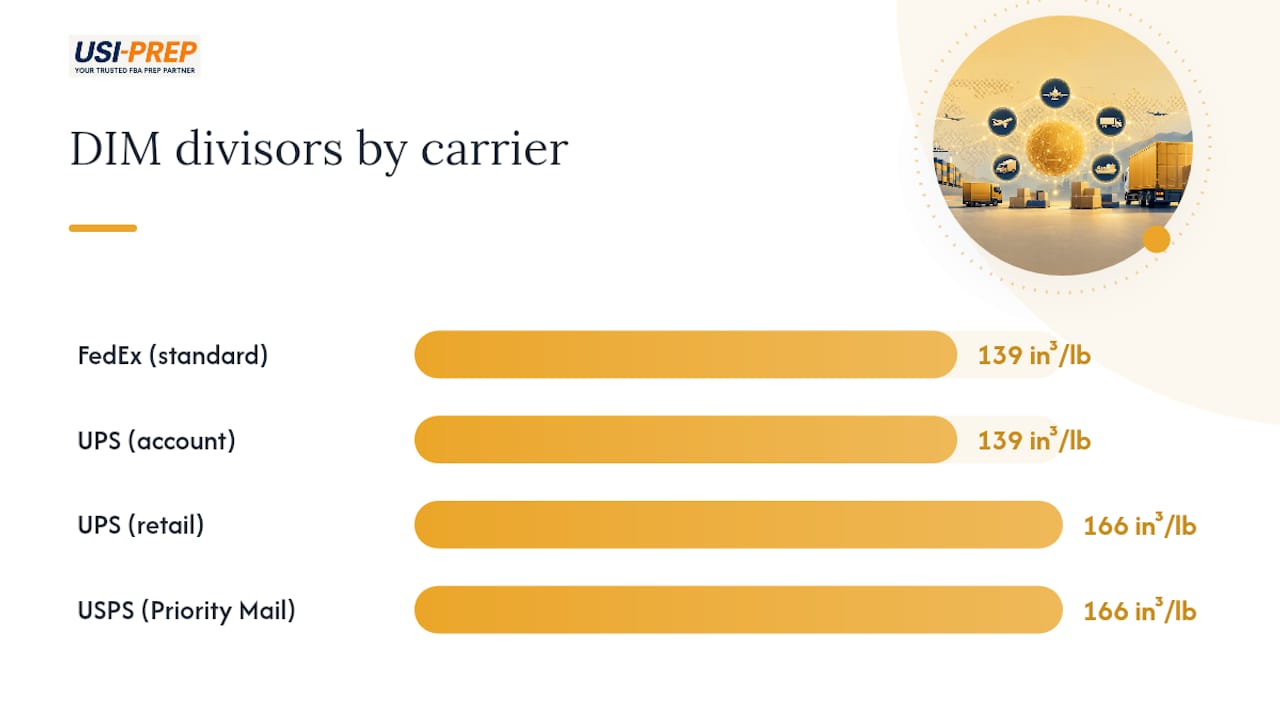
| Carrier | Standard DIM divisor | Applies to | Threshold / notes |
|---|---|---|---|
| FedEx | 139 in³/lb | Account/contract domestic ground and express | All packages; retail counter rates use 139 as well for most services |
| UPS | 139 in³/lb | UPS Daily Rate (account) domestic | Retail counter uses 166 in³/lb for some services |
| USPS | 166 in³/lb | Priority Mail, Priority Mail Express | Only applies when package exceeds 1,728 in³ (1 cubic foot) for certain domestic services; First-Class Package is exempt |
FedEx caveats:
- DIM weight applies to all FedEx Express and FedEx Ground packages regardless of size.
- International shipments may use a different divisor (often 139 or metric equivalent); check FedEx’s rate guide for the specific lane.
- Rounding: each dimension rounds up to the nearest whole inch before the calculation runs.
UPS caveats:
- UPS Daily Rate accounts use 139. Retail counter shipments can be billed at 166, which raises DIM weight by about 19% for the same box.
- UPS also applies a “large package surcharge” for packages exceeding certain girth thresholds, which stacks on top of DIM billing.
- Always confirm your account’s divisor in the UPS billing portal or your rate agreement.
USPS caveats:
- The 1,728 in³ threshold is the key number. A box under 1 cubic foot ships on actual weight only for most domestic Priority Mail services.
- USPS does not apply DIM weight to First-Class Package Service or Parcel Select Ground in most cases.
- For international USPS services, DIM rules differ by destination; check the USPS International Mail Manual.
Which packages get hit hardest by DIM weight charges
The core principle is density. A dense, heavy item fills its box efficiently; a light, bulky item wastes space, and carriers price that wasted space back into your bill.
DIM-heavy product categories (actual weight almost always loses to DIM weight):
- Pillows, comforters, and bedding
- Lampshades and light fixtures
- Foam padding, yoga mats, and exercise equipment with hollow cores
- Large stuffed animals and plush toys
- Bulk display boxes, gift boxes, and retail packaging
- Art prints and poster tubes (long and light)
- Inflatable products and pool floats
Rarely DIM-billed (actual weight usually wins):
- Books, textbooks, and printed catalogs
- Dumbbells, kettlebells, and weight plates
- Small appliances with metal components
- Canned goods and bottled liquids
- Hardware, fasteners, and tools
As Shopify’s DIM weight guide notes, lightweight but bulky SKUs like pillows and bedding are among the most commonly DIM-billed categories, and many growing brands underestimate the landed shipping cost impact until they run the numbers.
Quick “Is this DIM-heavy?” diagnostic:
- Pick up the package. Does it feel lighter than its size suggests? DIM risk is high.
- Estimate density: weight (lb) ÷ volume (ft³). Under 10 lb/ft³ almost always bills on DIM weight.
- Is there significant void space inside? Every inch of air adds to your DIM weight.
- Is the box more than twice the size it needs to be for the product? Right-sizing will save money immediately.
Practical ways to reduce your DIM weight charges
Small changes to packaging have a multiplicative effect on volume. Shaving a few inches off each dimension of a typical box can drop volume and reduce DIM weight significantly under a standard divisor. That difference compounds across hundreds of shipments.
-
Right-size your boxes. Match box dimensions as closely as possible to the product. Keep a small set of 3–5 standard box sizes that cover your SKU range rather than defaulting to one large box for everything.
-
Switch soft goods to poly mailers. A pillow in a poly mailer ships at a fraction of the DIM weight of the same pillow in a rigid box. Poly mailers conform to the product, eliminating void space.
-
Compress and vacuum-pack textiles. Vacuum compression bags can reduce the volume of bedding and apparel by more than half. The DIM weight drops proportionally.
-
Use form-fitting inserts instead of loose fill. Peanuts and air pillows add inches to your box dimensions. Molded pulp inserts or custom foam cut to product size hold the product securely without inflating volume.
-
Avoid double-boxing when possible. Each outer box adds 2–4 inches per dimension. If the product is sturdy enough, ship in its retail packaging with a label applied directly.
-
Measure before you create the label. Carriers sometimes remeasure at the hub. If your recorded dimensions are wrong and the carrier’s measurement is higher, you get billed on theirs. Accurate pre-ship measurement protects you in a dispute.
-
Standardize and source right-height boxes. Many shippers use boxes that are 2–3 inches taller than needed. On-demand box systems or suppliers offering half-size increments let you cut height without switching suppliers entirely.
-
Negotiate a higher DIM divisor. High-volume shippers can negotiate better carrier terms that include a higher divisor (e.g., 166 or even 194 for very large accounts). A higher divisor means lower DIM weight for the same box. This is typically available at mid-to-enterprise volume, but it’s worth asking once your monthly spend is meaningful.
-
Work with a 3PL that aggregates volume. A fulfillment partner shipping thousands of packages per day has leverage to negotiate divisors and rates that a small shipper cannot reach alone.
How to audit your invoices and dispute DIM billing errors
Carriers make measurement mistakes. A hub scanner can misread a dimension, a rounding error can add a pound, or the wrong divisor can be applied to your account. According to Packizon’s freight invoice auditing guide, automated audits commonly identify adjustments across a measurable share of shipments in many operations.
Common DIM billing errors to watch for:
- Wrong divisor applied (retail rate charged on a commercial account)
- Carrier hub measurement differs from your recorded dimensions
- Rounding applied twice (per-dimension AND to the final result)
- Transcription errors at pickup or label creation
- DIM applied to a USPS package under the 1,728 in³ threshold
Basic audit workflow:
The TCR Dimensional Weight Audit Guide recommends recalculating DIM weight for each invoice line as the primary corrective step. Here is a practical version for small shippers:
- Export your carrier invoice detail (available in the FedEx Billing Online, UPS Billing Center, or USPS Click-N-Ship portals).
- Match each tracking number to your own shipment records (dimensions, actual weight, box type).
- Recalculate DIM weight using your recorded dimensions and the correct divisor for your account.
- Flag any line where your calculated billable weight differs from what was charged by more than 1 lb.
- For flagged shipments, collect: a photo of the packed box with a tape measure visible, your scale weight receipt or photo, and the original label.
- File a billing dispute through the carrier’s online portal. FedEx allows disputes within 60 days of the invoice date; UPS within 180 days; USPS timelines vary by service.
Tracking your recovery by error type, as Ecommerce Times advises, lets you calculate the ROI of investing in certified dimensioning equipment or an outsourced audit program. If DIM-related adjustments represent a large share of your recoverable errors, the math on automation or a 3PL partnership often closes quickly.
How DIM weight erodes product margins and what to do about it
Consider a simple SKU: a decorative throw pillow selling for $35, with a product cost of $12 and a target shipping cost of $8. The actual weight is 3 lb. The box is 18×16×12 inches.
- Volume: 18 × 16 × 12 = 3,456 in³
- DIM weight is calculated by dividing the volume by the DIM divisor, resulting in a calculated billable weight that is higher than actual weight.
- Shipping cost at a typical ground rate for 25 lb: roughly $18–$22 instead of $8
That single DIM miscalculation turns a $15 gross margin into a $3–$7 margin or a loss, depending on the carrier zone. Multiply that across hundreds of orders and the impact is not a rounding error; it’s a structural problem.
The Shopify DIM weight guide makes the same point: brands selling lightweight bulky goods routinely misprice shipping and discover the gap only when they reconcile carrier invoices against forecasted costs.
When to optimize packaging vs. when to outsource:
| Situation | Recommended action |
|---|---|
| Low-volume shipments | Manual right-sizing and poly mailer switch |
| Medium-volume shipments | Standardize box set, measure every SKU, run monthly invoice audit |
| High-volume shipments | Certified dimensioning, automated audit, evaluate 3PL |
| Repeated DIM overcharges | Dispute + consider a 3PL with negotiated divisors |
A 3PL that ships at scale brings fulfillment cost reduction through negotiated carrier rates, certified dimensioning at intake, and right-sizing expertise that most small shippers cannot replicate in-house. For DIM-heavy catalogs, the savings on carrier charges alone often offset the 3PL fee.

One thing worth doing this week
Most shippers know DIM weight exists. Far fewer have actually run the numbers on their own top 10 SKUs. Pull your last 10 shipments, measure the boxes, recalculate DIM weight using the correct divisor for your account, and compare to what you were charged. Do it in a spreadsheet. It takes 20–30 minutes.
What you will almost certainly find: at least two or three shipments where DIM weight was higher than actual weight and you either did not know it or did not account for it in your pricing. That is the number that should drive your next packaging decision, not a general sense that “shipping is expensive.”
The one action I recommend: measure your highest-volume SKU today. Not the heaviest one. The biggest box you ship regularly. Run the DIM calculation.
Usiprep helps you stop paying for air in your packages
Repeated DIM overcharges are a signal, not just a cost. They mean your packaging, your carrier terms, or your audit process needs attention. Usiprep was built by former Amazon sellers who have run these exact numbers, and the result is a fulfillment service that addresses DIM-driven margin bleed directly: certified dimensioning at intake, right-sizing recommendations per SKU, and carrier relationships that give small and mid-size brands access to account-level divisors they cannot negotiate alone.

If your catalog includes soft goods, bulky items, or any SKU where the box is significantly larger than the product, Usiprep’s pick/pack/ship and FBA prep services are worth a direct look. Usiprep to see what the numbers look like for your catalog.
Sources
- What Is Dimensional Weight? How Carriers Calculate DIM Weight — FreightFigures
- Dimensional Weight Audit Guide — TCR
- Freight Invoice Auditing: Catch DIM Weight Overcharges | Packizon
- How to build a domestic freight audit program that recovers real money — Ecommerce Times