
The highest-impact bulk shipping discount opportunities for ecommerce brands are: direct carrier negotiation with UPS, FedEx, and USPS (base rate cuts, DIM divisor increases, and accessorial waivers); USPS cubic pricing for dense, small parcels; fuel-surcharge caps; residential delivery surcharge waivers; 3PL or group-buy aggregation for brands without direct volume leverage; regional carrier substitution (OnTrac, LSO, LaserShip) for short-zone shipments; distributed inventory to reduce average zone; and packaging right-sizing to lower billed weight. Each lever works independently, but the real savings come from stacking two or three together. Start right now by pulling your last 90 days of shipment invoices, noting your average actual weight, average DIM weight, zone distribution, and residential percentage. That 30-minute data pull, recommended by FedEx’s own small-business guidance, is what turns a vague “we should negotiate” conversation into a specific ask that carriers take seriously.
- Direct carrier negotiation: The most direct route to large savings when you can document volume and patterns.
- DIM divisor increase: Lowers billed weight on lightweight-but-bulky packages; negotiable in most UPS and FedEx contracts.
- Accessorial fee waivers/caps: Residential surcharges, address correction fees, and delivery area surcharges add up fast.
- Fuel-surcharge caps: Locks your exposure when fuel indexes spike.
- 3PL/group-buy aggregation: Near-enterprise rate tiers for brands that lack direct volume.
- Regional carriers: OnTrac, LSO, and LaserShip often beat national carriers on short-zone ground shipments.
- Distributed inventory: Fewer zones shipped = lower per-package cost.
- Packaging optimization: Right-sizing boxes and switching to poly mailers where possible cuts billed weight immediately.
- Platform/automation: Tools like ShipStation, EasyPost, and Shippo surface rate comparisons and flag invoice errors automatically.
Pro Tip: Set a calendar reminder for 30 minutes this week. Export your last 90 days of carrier invoices, sort by accessorial charge type, and add up the residential delivery surcharge line. For most consumer-facing brands, that single line is the fastest negotiation target.
Key Takeaways
Stacking three or four discount levers simultaneously — DIM divisor, accessorial caps, USPS cubic routing, and regional carrier substitution — produces materially larger per-package savings than negotiating a single lever in isolation.
| Point | Details |
|---|---|
| Start with a 90-day data pull | Export carrier invoices and calculate average actual weight, DIM weight, zone mix, and residential percentage before any negotiation. |
| DIM divisor is the fastest win | Requesting a higher DIM divisor (from 139 toward 166 or higher) lowers billed weight on bulky packages with no operational change required. |
| Accessorials are negotiable | Residential surcharges, fuel caps, and delivery area fees are contract terms, not fixed costs — model them before your first carrier call. |
| 3PL aggregation fills the volume gap | Brands below direct-negotiation thresholds can access near-enterprise rates through a 3PL or shipping platform that pools volume. |
| Usiprep provides the infrastructure | Usiprep’s multi-carrier fulfillment, DIM-aware packaging, and aggregated buying power help brands reduce fulfillment costs by up to 30%. |
Table of Contents
- What are bulk shipping discounts and how much can you save?
- How to negotiate directly with UPS, FedEx, and USPS
- How 3PLs, group-buy programs, and multi-carrier platforms unlock bulk discounts
- How packaging, dimensional weight, and USPS cubic pricing cut your bill
- How to reduce zones and build a smarter carrier mix
- What shipment data do you need before asking for a discount?
- A worked savings model: DIM divisor + accessorial cap + USPS cubic hybrid
- What most merchants get wrong about shipping cost reduction
- Usiprep gives you the fulfillment infrastructure to act on these discounts
- Sources
What are bulk shipping discounts and how much can you save?
“Bulk” or “negotiated” shipping discounts are the rates carriers offer when you commit to predictable, documented volume, as opposed to the retail or standard commercial rates any shipper gets by default. Carriers offer them because a committed shipper reduces their cost of customer acquisition, smooths their operational planning, and fills network capacity more efficiently. The discount is the carrier’s way of paying for that predictability.
The main discount types available to US ecommerce shippers:
- Base rate discounts: A percentage reduction off the carrier’s published rates, applied across a service tier (ground, express, etc.).
- DIM divisor increases: The dimensional weight divisor controls how billed weight is calculated for lightweight-but-bulky packages. A higher divisor means lower billed weight. UPS and FedEx both negotiate this.
- USPS cubic pricing: Available through USPS Commercial Plus and certain aggregator programs, cubic pricing bills by the package’s volume rather than weight, which benefits dense, small parcels. USPS volume discount tiers cover Priority Mail, Parcel Select, and First-Class Package services.
- Accessorial fee waivers/caps: Residential delivery surcharges, delivery area surcharges, address correction fees, and fuel surcharges can all be capped or waived in a negotiated agreement.
- Fuel-surcharge caps: Limits your exposure to index-driven fuel cost swings.
- Volume incentive programs: Rebate-style programs where hitting a quarterly volume target triggers a credit or rate reduction.
Savings context: Bulk rate postage programs can produce substantial per-package savings when qualification thresholds are met, though the exact range varies by carrier, service type, volume tier, and how many levers you negotiate simultaneously. Brands that stack base rate discounts with accessorial caps and a DIM divisor change typically see larger combined reductions than those who negotiate a single lever.
The threshold that triggers meaningful carrier flexibility varies. Smaller brands often find that 3PL aggregation or a group-buy program helps them reach a competitive tier faster than waiting to hit direct-negotiation minimums on their own.
How to negotiate directly with UPS, FedEx, and USPS
Direct negotiation is the most direct route to large savings when you can credibly document volume and patterns. Carriers assign dedicated reps to accounts above certain volume levels, and those reps have real authority to move on the levers below. The key is arriving with data, not just a request.
What to ask for, specifically
Carrier pricing is negotiable across several dimensions that most shippers never explicitly request:
- Base rate discount off published ground and express rates (ask for a percentage, not a dollar amount).
- DIM divisor increase from the standard 139 (UPS/FedEx domestic) to a higher number, which lowers billed weight on bulky packages.
- Residential delivery surcharge waiver or cap — this is often the highest-dollar line item for consumer brands.
- Fuel-surcharge cap tied to a specific index level.
- Free scheduled pickups (vs. per-pickup fees).
- Invoice audit credits for billing errors found within a defined window.
- Accessorial waivers on delivery area surcharges, address correction fees, and extended delivery area charges.
For USPS, the negotiation path is different. Direct negotiation is available only to very high-volume mailers. Most ecommerce brands access USPS discounts through a shipping platform or 3PL that holds a negotiated Commercial Plus or CASS-certified rate agreement.
Volume thresholds that matter
Carrier reps start taking calls seriously at roughly 100–250 packages per day for UPS and FedEx ground accounts, though smaller accounts can still negotiate if they show consistent growth and a clean 12-month history. Below that range, aggregation through a 3PL or platform is usually the faster path to better rates. For startups, early negotiation and data-led requests unlock better terms sooner than waiting until costs become painful.
Negotiation timeline and preparation
A direct carrier negotiation typically takes 4–8 weeks from first contact to a signed rate agreement. Here is how to structure it:
- Pull 12 months of invoice data (90-day minimum if you are newer).
- Calculate your average actual weight, average DIM weight, zone distribution, and residential percentage.
- Build a one-page summary: total parcel count, monthly volume trend, service mix, and top accessorial charges by dollar amount.
- Send that summary to your carrier rep before the first call.
- Open the call with your current effective rate per package and the specific asks from the checklist above.
- Request a sample rate model from the carrier using your data before signing anything.
Pro Tip: Ask the carrier rep to run a “what-if” model on your last 90 days using the proposed divisor and caps. If they won’t provide that model in writing, build it yourself using the rate tables and your invoice data before agreeing to terms.
How 3PLs, group-buy programs, and multi-carrier platforms unlock bulk discounts
Aggregation can deliver near-enterprise rates for brands that lack direct volume. A 3PL ships thousands of packages per day across all its clients combined, which puts it well above the thresholds where UPS, FedEx, and USPS offer their deepest terms. When you ship through a 3PL, you are buying into that aggregated volume.

Three models, different trade-offs
3PL aggregation is the most common path. The 3PL holds a master carrier agreement and passes a portion of its discounts to clients. The trade-off is that you give up direct carrier visibility and rely on the 3PL’s markup transparency. Always ask for a sample-rate comparison using your real SKU data before signing.
Buying cooperatives pool volume across multiple independent merchants to hit carrier thresholds together. Less common in ecommerce than in B2B freight, but some industry associations and platforms offer them.
Shipping platform volume tiers (ShipStation, EasyPost, Shippo, and similar tools) aggregate volume across their entire user base and offer pre-negotiated rates that are often better than what a small brand could get alone. These are easy to access and require no minimum commitment, which makes them a good starting point for brands under 100 packages per day.
What to ask a 3PL before committing
- Provide a sample-rate comparison using your last 90 days of actual shipment data (weights, zones, service mix).
- Show the markup structure: is the rate a pass-through with a flat fee, or a percentage markup on carrier cost?
- Disclose contractual minimums and exit terms.
- Confirm which carriers are in the network and whether you can use your own carrier account for specific lanes.
- Show on-time delivery performance by carrier and service level.
For a deeper look at ecommerce fulfillment workflows and when a 3PL makes sense, that context helps frame the rate conversation.
Pro Tip: Request the effective rate per package after all fees (fulfillment, handling, and carrier cost combined), not just the carrier rate in isolation. A 3PL with a slightly higher carrier rate but lower handling fees can still be cheaper net.
How packaging, dimensional weight, and USPS cubic pricing cut your bill
Right-sizing packaging and using cubic pricing where eligible often deliver the fastest per-package savings, because the fix requires no carrier negotiation and takes effect on the next shipment.
How DIM weight works and why the divisor matters
Carriers bill the greater of actual weight or dimensional weight. DIM weight is calculated as: (length × width × height) ÷ DIM divisor. The standard domestic divisor for UPS and FedEx is 139. A higher negotiated divisor (say, 166 or 194) lowers the calculated DIM weight, which reduces billed weight on lightweight-but-bulky packages.
Sample math: A 12" × 10" × 8" box has a volume of 960 cubic inches.
- At divisor 139: DIM weight = 960 ÷ 139 = 6.9 lbs (rounds to 7 lbs)
- At divisor 166: DIM weight = 960 ÷ 166 = 5.8 lbs (rounds to 6 lbs)
- At divisor 194: DIM weight = 960 ÷ 194 = 4.9 lbs (rounds to 5 lbs)
If the actual weight of the contents is 4 lbs, the divisor 194 contract means you bill at actual weight. At divisor 139, you bill at 7 lbs. At 10,000 packages per month, that difference compounds into a material cost gap.
USPS cubic pricing bills by the package’s volume (in cubic feet, in five tiers up to 0.5 cubic feet) rather than weight. For dense, small packages under about 20 lbs, cubic pricing through USPS volume discount programs can be significantly cheaper than weight-based rates. Access it through a shipping platform or 3PL with a Commercial Plus agreement.
Packaging optimization checklist
- Audit your top 20 SKUs by parcel count and measure actual box dimensions vs. product dimensions.
- Identify boxes where the product fills less than 60% of the box volume — those are DIM weight candidates.
- Test poly mailer substitution for soft goods, apparel, and flat items (poly mailers have no DIM weight issue).
- Switch to padded mailers for small, lightweight items that don’t need a rigid box.
- Test smaller box sizes for multi-unit orders before assuming a larger box is necessary.
Pro Tip: Splitting a two-unit order into two smaller packages sometimes costs less than one large box, because each smaller package may fall under the cubic pricing threshold or bill at actual weight. Model it before assuming consolidation always wins.
How to reduce zones and build a smarter carrier mix
Reducing your average shipping zone and routing short-zone shipments to regional carriers materially lowers per-package costs. Zone charges are one of the most consistent drivers of high shipping spend, and they are addressable without any carrier negotiation.

Three approaches, different complexity levels
Distributed inventory means placing stock in two or more fulfillment locations closer to your customer base. A brand shipping from a single warehouse in Ohio might average Zone 5–6 to West Coast customers. Adding a West Coast node drops those shipments to Zone 2–3. The trade-off is higher inventory carrying costs and more complex replenishment. Fast fulfillment from distributed nodes also reduces storage penalties and late-delivery costs.
Zone skipping consolidates shipments into a truckload or LTL move to a regional hub closer to the delivery area, then injects them into the carrier network at a lower zone. It works best for high-volume lanes with predictable demand. The complexity is in the consolidation logistics and timing.
Regional carriers are the lowest-complexity option. OnTrac covers the Western US, LaserShip (now part of OnTrac) covers the Eastern US, and LSO covers the South-Central region. They typically offer competitive rates on Zones 2–4 within their coverage areas and often beat UPS and FedEx ground on those lanes.
When regional carriers win
- Short-zone residential deliveries within their coverage footprint.
- Brands with high residential percentages in specific metro areas.
- Shipments where the national carrier’s residential surcharge makes the effective rate uncompetitive.
- Situations where the regional carrier’s transit time matches or beats the national carrier for that zone.
How to pilot a carrier-mix change
- Identify your top 3 destination zip code clusters by parcel count.
- Check whether a regional carrier covers those zips.
- Pull the last 90 days of shipments to those zips and model the rate difference.
- Route 10% of volume to the regional carrier for 30 days.
- Track on-time delivery rate, damage rate, and effective cost per package.
- If on-time delivery stays above your threshold (typically 95%+) and cost is lower, expand the allocation.
What shipment data do you need before asking for a discount?
Carriers and 3PLs expect a 12-month shipment dataset — 90 days at minimum — with specific fields before they will model a rate proposal. Showing up without this data signals that you are not a serious negotiating partner. Showing up with it signals the opposite.
Data export checklist
- Total parcel count (last 90, 180, and 365 days)
- Monthly volume trend (are you growing, flat, or seasonal?)
- Average actual weight per package
- Average DIM weight per package
- Zone distribution (% of packages by zone, Zones 1–8)
- Residential vs. commercial split (%)
- Accessorial charges by type and dollar amount (residential, fuel, delivery area, address correction)
- Service mix (ground vs. express vs. postal, by %)
- Returns volume and return-to-origin rate
- Top 10 SKUs by parcel count with dimensions and weights
Model inputs to calculate before your first meeting
- Current average cost per package (total carrier spend ÷ total packages)
- Projected 12-month volume commitment (conservative, base, and stretch scenarios)
- Desired contract term (12 vs. 24 months)
- Walkaway threshold: the minimum savings that justify switching or committing
Contract documentation: what to capture
When a carrier or 3PL offers negotiated terms, get the following in writing before signing:
- Rate tables by service, zone, and weight break
- Surcharge caps (fuel, residential, delivery area) with the index or formula used
- Contract term and renewal conditions
- Minimum volume commitments and the penalty or rate-reset clause if you miss them
- Audit and dispute resolution process (how to flag billing errors and the credit timeline)
For platform-level integration, connecting your fulfillment software to your store is how negotiated rates flow through to checkout so customers see accurate shipping charges. WooCommerce users can follow platform-specific bulk discount configuration steps to set up cart rules that reflect negotiated rates at checkout.
A recurring audit cadence keeps negotiated terms competitive: a monthly 30-minute operational review, a quarterly carrier scorecard, and an annual full audit to catch DIM divisor changes or new surcharge formulas before they erode your savings.
A worked savings model: DIM divisor + accessorial cap + USPS cubic hybrid
Here is a concrete model showing how three levers stack. The inputs are illustrative but use realistic ranges for a mid-size US ecommerce brand shipping 5,000 packages per month.
How each lever contributes
- DIM divisor change (139 → 166): Reduces billed weight by 1 lb per package on average. At $0.68/lb, that is roughly $0.68 saved per package before the base rate discount.
- Base rate discount (10%): Applied to the lower billed weight, this compounds the DIM savings rather than adding to them independently.
- Residential surcharge cap ($5.40 → $3.50): For a brand with 70% residential delivery, this saves $1.90 per residential package, or $1.33 per package across the full volume.
- Fuel-surcharge cap (22% → 15%): Reduces fuel exposure on the base rate. At current index levels, this saves roughly $0.30–0.50 per package depending on the base rate.
- USPS cubic hybrid (20% of volume): Rerouting small, dense packages to USPS cubic pricing typically saves $1.50–3.00 per package on those shipments versus ground rates.
Pro Tip: The residential surcharge waiver is the lever most brands underestimate. Pull your last invoice and add up every residential delivery surcharge line. That total, annualized, is your negotiation anchor. Carriers know it is painful — use it.
What most merchants get wrong about shipping cost reduction
The conventional wisdom says: wait until shipping costs are “too high,” then call your carrier rep. That advice costs brands real money every month they wait.
The highest-return first moves, in order of expected ROI and effort:
First: pull a 90-day invoice audit this week. You cannot negotiate what you have not measured. Most brands discover that residential surcharges and fuel surcharges together represent 25–35% of their total carrier spend. Knowing that number before any conversation gives you a specific, dollar-denominated ask. FedEx’s own small-business resources endorse this as the starting point.
Second: request a DIM divisor change before anything else. It is the single negotiation lever that costs the carrier the least to give and saves you the most per package on lightweight-but-bulky shipments. Most reps will move on this before touching base rates.
The data from that pilot either confirms the switch or tells you exactly why it doesn’t work for your profile.
The mistake I see most often is treating accessorial fees as fixed costs. They are not. Residential surcharges, delivery area surcharges, and address correction fees are all negotiable in a carrier contract, and they are often the fastest path to a meaningful per-package reduction. Brands that model only base rates and ignore accessorials routinely leave more savings on the table than they capture.
The other common miss: not building a recurring review cadence. Carrier surcharge formulas change, DIM divisors reset at contract renewal, and fuel indexes shift. A monthly 30-minute review and a quarterly carrier scorecard, as recommended by multi-carrier shipping best practices, keep your negotiated terms from quietly eroding.
Usiprep gives you the fulfillment infrastructure to act on these discounts
Knowing the levers is one thing. Having the operational infrastructure to use them is another. Usiprep was built by former Amazon sellers who understand exactly where fulfillment costs leak, and the platform is designed to give ecommerce brands the data, carrier access, and packaging discipline that make bulk discount negotiations work.
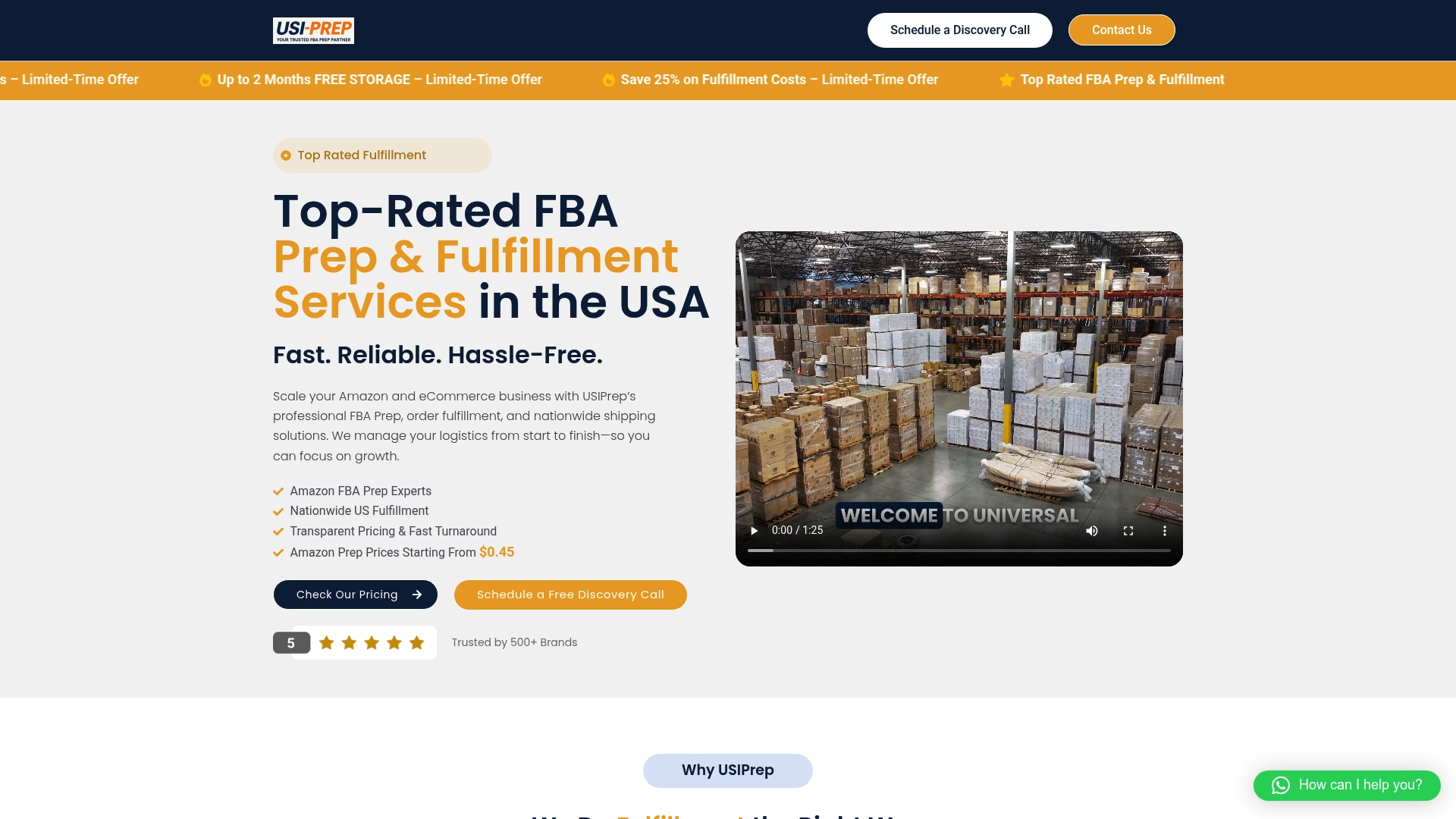
Usiprep clients get multi-carrier fulfillment with transparent, itemized pricing, DIM-aware packaging workflows, and the aggregated buying power of a 3PL that ships at scale. You get clean shipment data exports ready for carrier negotiations, a carrier mix that already routes shipments to the most cost-effective option, and a team that has run these negotiations before.
If you are ready to stop guessing at your carrier costs and start with a real rate comparison, review Usiprep’s fulfillment pricing or explore the fulfillment cost reduction strategies that Usiprep applies for brands at every volume level.
Sources
- Maximizing Savings with Bulk Rate Postage: A Comprehensive Guide for eCommerce Businesses | FreightAmigo
- 7 Carrier Cost Advantages That Come With Shipping at Volume | DearBloggers
- How to build a multi-carrier shipping stack that actually cuts costs in 2026 | eCommerce Times
- How to Set Up Shipping Discounts for Bulk Purchases in WooCommerce | Octolize