
Ask for an itemized rate card, a sample invoice, and the all-in per-order cost modeled for your exact volume profile. Those three requests expose most hidden charges before you sign anything.
Here is why each one matters. An itemized rate card forces the provider to name every fee category, not just the headline pick rate. A sample invoice shows you whether those categories actually appear as line items when billing runs, or whether they get bundled into vague charges you cannot audit. The all-in per-order model converts their fee schedule into a number you can compare directly against your current cost or another provider’s quote. Without that model, a $1.50 pick rate from one provider and a $2.10 pick rate from another tell you almost nothing.
The must-ask fee categories, in order of billing exposure:
- Storage: billing method (cubic foot vs. pallet vs. bin), measurement timing, and peak-season surcharges
- Receiving: per-pallet, per-carton, per-SKU, or per-unit, and whether replenishment shipments are charged separately
- Pick & pack: first-pick rate, additional-pick rate, and how multi-SKU orders are priced
- Returns: per-return processing fee, restock vs. disposal rules, and RMA handling for marketplace vs. DTC orders
- Kitting and labeling: whether supported in-house, scheduling fees for subscription cadence, and any bundling minimums
- Shipping passthrough: carrier rate transparency and whether label fees carry a margin
- Onboarding and minimums: setup fees, monthly minimum billing commitments, and inactivity penalties
Two immediate verification steps before the first call ends:
- Request a filled standardized pricing sheet, not a proposal summary
- Ask for one sample month invoice from a client with a similar order volume and SKU count
Key Takeaways
Asking the right questions about fulfillment provider pricing before you sign requires three things: an itemized rate card, a sample invoice, and a unit-economics model built on your actual order profile.
| Point | Details |
|---|---|
| Lead with three requests | Ask for an itemized rate card, a sample invoice, and an all-in per-order cost modeled for your volume profile. |
| Storage and receiving carry the most risk | For most DTC brands, the largest billing exposure sits in storage, receiving, and returns, not the pick rate. |
| Use a standardized pricing sheet | Require providers to fill the same template so quotes are directly comparable across fee categories. |
| Run two scenarios before signing | Model a baseline month and a Q4 peak to see how minimums and peak surcharges change the all-in cost. |
| Usiprep provides itemized pricing upfront | Usiprep delivers rate cards, sample invoices, and SLA metrics as standard, with a 98.9% on-time delivery rate. |
Table of Contents
- What pricing questions should you ask fulfillment providers?
- What billing and contract terms should you demand in writing?
- How do you model total cost of ownership for fulfillment?
- How should you structure your RFP and vet providers in 21 days?
- How does WMS technology affect your bill?
- What SLA metrics and liability terms should you negotiate into the MSA?
- What hidden fees commonly inflate your fulfillment bill?
- What does transparent pricing actually look like from a provider?
- A practitioner’s perspective on fulfillment pricing
- Usiprep gives you the pricing transparency this checklist demands
- Sources
What pricing questions should you ask fulfillment providers?
Breaking fulfillment provider pricing questions down by fee type is the fastest way to catch the charges that rarely show up in a sales deck. The Warehousingcosts organizes these into rows for receiving, storage, pick and pack, packaging, accessorials, surcharges, and minimums, which is exactly the structure you want providers filling out.
Storage fees
- How is storage measured: cubic foot, pallet position, or bin?
- When does measurement occur: daily average, month-end snapshot, or peak-day capture?
- How do peak-season storage tiers work, and at what inventory level do surcharges kick in?
- What happens if you exceed your allocated space, and how are overages billed?
Cubic-foot billing tends to favor brands with dense, compact SKUs. Pallet billing favors high-volume, low-SKU operations. If your products are lightweight and bulky, cubic-foot billing can be punishing, so this question is not academic.
Receiving fees
- Is receiving billed per pallet, per carton, per SKU, per unit, or per labor hour for non-compliant loads?
- Are replenishment shipments charged at the same rate as the initial onboarding shipment?
- What ASN requirements trigger exception fees, and what does a non-compliant inbound load cost?
Receiving fees are where many brands get surprised. A provider might quote $0.10 per unit for receiving but charge $25 per pallet for non-compliant inbound, and if your supplier ships mixed SKUs on unlabeled pallets, that exception rate applies to every shipment.
Pick & pack rates
- What is the first-pick rate, and what is the additional-pick rate for each item beyond the first?
- How are multi-SKU orders priced: flat per-order or per-line-item?
- Are inserts, marketing materials, or custom packaging included, or billed as add-ons?
- Are there per-item packaging surcharges for fragile or oversized items?
Shipping passthrough
- Are carrier rates passed through at cost, or is there a margin on labels?
- Can you see the raw carrier invoice to verify the passthrough rate?
- Are label fees, residential surcharges, or fuel surcharges marked up separately?
Carrier margin is one of the least-discussed line items in fulfillment pricing. Some providers mark up carrier rates by 10–20% and present it as a “shipping fee” rather than a margin. Asking to see the raw carrier invoice during vetting separates transparent providers from those who rely on label markup as a revenue stream.
Returns processing
- What is the per-return inspection and processing fee?
- What are the rules for restocking vs. disposing of returned items, and who decides?
- Does RMA handling differ between marketplace returns (FBA prep) and DTC returns?
Kitting, labeling, and subscription fulfillment
Subscription fulfillment adds a scheduling layer that can change per-order costs significantly, especially when the 3PL handles it via an add-on rather than natively. Ask whether kitting and subscription cadence management are in-house capabilities or outsourced, and whether there are minimums per run.

Required fields for your standardized pricing sheet:
| Fee Category | Required Detail |
|---|---|
| Storage | Billing unit (cu ft / pallet / bin), measurement timing, peak surcharge threshold |
| Receiving | Billing basis (per pallet / carton / SKU / unit), non-compliant inbound rate |
| Pick & pack | First-pick rate, additional-pick rate, multi-SKU order pricing |
| Shipping | Passthrough method, carrier margin disclosure, label fee structure |
| Returns | Per-return processing fee, restock vs. disposal policy |
| Kitting/labeling | In-house vs. outsourced, subscription scheduling fee, per-run minimums |
| Minimums | Monthly minimum billing commitment, inactivity penalty |
What billing and contract terms should you demand in writing?
Getting verbal answers on pricing is not enough. The contract is what gets enforced, and providers know that vague contract language protects them, not you.
Invoice cadence and format: Require monthly invoices with line items that map directly to the rate card. Before signing, ask for a sample invoice from a current client at a similar volume. If the sample invoice shows five line items and the rate card has twenty fee categories, that gap is where surprises live.
Audit and dispute rights: Require a 90-day audit window with granular access to raw activity logs. A formal dispute process with defined response timelines should be in the contract, not just promised verbally. Setup fees and per-SKU management fees are common accessorials that appear on invoices without clear rate-card backing, so audit rights are not a nice-to-have.
Rate change mechanics: Require written notice of at least 30 days for any mid-term rate changes. The best contracts tie escalation to a specific index (CPI or a named labor index) or cap annual increases at an absolute percentage. “We reserve the right to adjust rates” with no formula is a red flag.
Minimums and inactivity penalties: Ask exactly how monthly minimums are measured (gross billing, pick volume, or storage), what the penalty is for falling below, and whether there is a grace period for seasonal troughs.
Onboarding and exit: Require onboarding and setup fees listed by line item, a named implementation plan with milestone dates, and an explicit exit process that states the cost and timeline for inventory return or export.
Pro Tip: Insist the contract defines how non-conforming inbound shipments are charged, specifically whether the rate is per pallet, per carton, or per SKU. Without that definition, a single non-compliant shipment can generate an invoice line that is impossible to dispute.
How do you model total cost of ownership for fulfillment?
The advertised pick rate is the least predictive number in a fulfillment quote. Real cost exposure for most DTC operators sits in storage, receiving, returns, and account minimums, not the pick rate. A unit-economics model converts all of those into a single comparable figure.
The four cost drivers to include:
- Storage: Calculate at both peak inventory (Q4 or your seasonal high) and trough (post-peak clearance). The difference between those two figures often exceeds the annual pick-rate difference between two providers.
- Receiving: Include both the initial onboarding shipment and ongoing replenishment. Brands that replenish weekly pay receiving fees 52 times a year.
- Fulfillment: Pick and pack per order, multiplied by average units per order and daily order volume.
- Returns and chargebacks: Apply your return rate to the per-return processing fee and add any chargeback or rework costs.
Inputs to collect from your own data:
- Average orders per day (baseline month and Q4 peak)
- Average units per order
- Average order weight
- SKU velocity (fast-movers vs. slow-movers and their storage footprint)
- Return rate
- Seasonal peak factor (peak orders vs. baseline orders)
Sample per-order cost calculation:
Run this twice: once for a baseline month and once for your Q4 peak, where storage costs spike and monthly minimums may no longer apply.
Pro Tip: Always model the competitor’s cheaper pick rate against your highest storage and receiving costs. A $0.50 pick-rate advantage disappears fast when the other provider charges $0.18 per cubic foot vs. $0.12 and your Q4 inventory doubles. See the full cost component breakdown to map every driver before you run the numbers.
How should you structure your RFP and vet providers in 21 days?
A structured RFP forces providers to answer the same questions in the same format, which is the only way to make quotes comparable. A standardized pricing sheet with defined rows for receiving, storage, pick and pack, packaging, accessorials, and minimums is the highest-value artifact in the process.
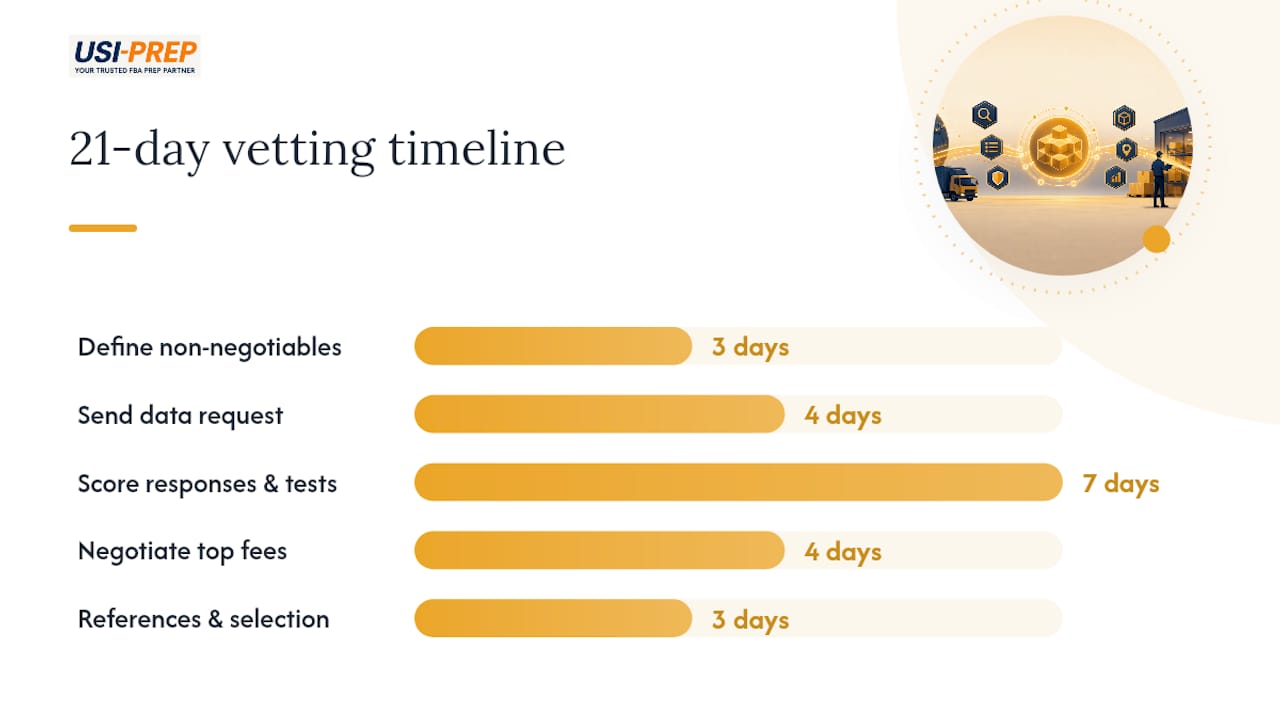
21-day vetting timeline:
- Days 1–3: Define non-negotiables: minimum order accuracy rate, required integrations, geographic coverage, and contract term limits.
- Days 4–7: Send the structured data request packet to shortlisted providers.
- Days 8–14: Score responses using scenario-based tests (see below). Run a peak-day simulation and a failure-scenario question.
- Days 15–18: Negotiate on the three highest-exposure fee categories identified in your unit-economics model.
- Days 19–21: Reference checks with three clients in your revenue and SKU tier. Selection and contract redline.
What to include in the structured data request:
- Filled standardized pricing sheet (all rows completed, no blanks)
- One sample invoice from a comparable client
- 90-day order accuracy metrics and same-day ship rate, broken down by category
- WMS uptime percentage for the past 12 months
- Three customer references in your revenue and SKU tier
- Ability to run a peak-day and failure-scenario simulation
The 10 pricing questions the pricing sheet must answer:
- Storage billing unit and measurement timing
- Peak-season storage surcharge threshold and rate
- Receiving fee basis (pallet / carton / SKU / unit) and non-compliant inbound rate
- First-pick rate and additional-pick rate
- Multi-SKU order pricing method
- Shipping passthrough method and carrier margin disclosure
- Per-return processing fee and restock policy
- Kitting and subscription fulfillment fee structure
- Monthly minimum billing commitment and inactivity penalty
- Onboarding and setup fees, itemized
Top-quartile 3PLs report order accuracy above 99.5% and on-time ship rates above 97%. Use those as your scoring floor, not your aspirational target. Providers who cannot share recent metrics broken down by category are telling you something about their confidence in those numbers.
Your RFP should also include a business snapshot: annual order volume, SKU count, average order profile, inbound format, and returns complexity. Providers who price without that information are guessing, and their quote will not hold once they see your actual inventory.
How does WMS technology affect your bill?
The WMS is not just an operational tool. It is the system that generates your invoice. How it defines billable events, syncs inventory, and exports data directly determines whether your bill is accurate and auditable.
- Integration type: Ask whether the WMS connects to your platform via a native connector or middleware. Native connectors sync faster and reduce the risk of inventory discrepancies that generate phantom storage charges.
- Inventory sync frequency: Ask how often inventory counts update. A provider that syncs once daily can show you as holding inventory you already shipped, which can inflate storage billing.
- Billing event triggers: Ask exactly which system event triggers each billable action. Does “receiving” bill when the pallet is put away or when it is inspected and confirmed? Does a return inspection automatically trigger a processing fee, or does it require a manual flag?
- Reporting exports: Ask what event-level data is included in standard reporting vs. what sits behind a paywall or requires a custom extract. You need raw event logs to audit invoices.
Pro Tip: Ask for a sample webhook or API payload during vetting. The timestamp on status changes, specifically when “received,” “shipped,” and “returned” events fire, tells you exactly when billing triggers. If the provider cannot show you that payload, you cannot independently verify the timing of charges.
Good warehouse technology features also include real-time inventory visibility and automated billing reconciliation. Those two capabilities alone reduce invoice disputes significantly.
What SLA metrics and liability terms should you negotiate into the MSA?
SLA language without a financial remedy is a promise, not a commitment. The master service agreement (MSA) is where you convert operational promises into enforceable terms.
SLA metrics to require in writing:
- Order accuracy rate at the order level (not the unit level, which inflates the percentage)
- Same-day ship percentage with explicit cutoff times stated in the contract
- Inventory accuracy rate with a defined measurement method
- WMS and integration uptime with response-time windows for Sev-1 outages
Credit mechanisms: Per-order credits should be tied to the actual cost to reship affected orders, not a flat nominal credit. Automatic credits for missed SLAs, with a clear calculation example in the MSA, are the standard to hold providers to. If the contract says “we will work with you to resolve issues,” that is not a credit mechanism.
Liability and insurance: Negotiate replacement-cost caps for high-AOV SKUs. Require proof of insurance limits and ask whether your inventory is covered under the provider’s policy or requires a separate rider.
Escalation path: Require named contacts with response-time commitments for Sev-1 outages. “Contact support” is not an escalation path. A named operations manager with a direct line and a 2-hour response SLA is.
What hidden fees commonly inflate your fulfillment bill?
The fees that hurt most are the ones that never appear in the initial proposal. Providers who avoid sharing sample invoices or customer references are often obscuring accessorials or irregular billing practices. That behavior is a data point, not a coincidence.
Common hidden fees to ask about explicitly:
- Per-SKU management fees (monthly charge per active SKU in the system)
- Rework fees for non-compliant inbound shipments
- Oversized item fees triggered by dimensional weight thresholds
- Fuel surcharges and peak-season carrier surcharges passed through at a markup
- Special packaging fees for fragile, hazmat, or temperature-sensitive items
- Storage overage fees when inventory exceeds allocated space
- Account setup fees that are not listed on the standard rate card
Red flags that should end the conversation:
- Refusal to fill your standardized pricing sheet
- Vague answers about how specific fees are calculated
- No sample invoice available, or a sample invoice that does not match the rate card
- Sales reps who redirect reference requests or offer only hand-picked testimonials
- SLA language with no financial remedy attached
Every line item on the pricing sheet should map to a corresponding line on the sample invoice. If the pricing sheet has a “non-compliant inbound” row and the sample invoice does not, ask where that charge appears. The answer will tell you whether billing is transparent or bundled.
For a deeper look at hidden fees in fulfillment contracts, the patterns are consistent across providers: the charges that hurt most are the ones defined loosely in the contract and applied broadly on the invoice.
What does transparent pricing actually look like from a provider?
Transparency is not a value statement. It is a set of deliverables. A provider that claims to be transparent but cannot produce the following items within five business days of your request is not operating transparently.
Concrete indicators of pricing transparency:
- An itemized rate card with a named rate for every fee category, including accessorials
- A sample invoice that matches the rate card line-for-line
- Stated SLA metrics with credit mechanisms written into the MSA
- Three customer references in your revenue and SKU tier, available on request
- Raw data export rights for inventory events and billing activity
What a compliant provider response looks like:
A best-practice provider delivers a filled pricing sheet covering all fee categories, a sample invoice from a comparable client, SLA metrics with credit terms, and two references in your revenue tier, all within five business days of your RFP. That response set is the minimum bar for moving to contract negotiation.
Usiprep was founded by former Amazon sellers who built the service around the exact frustrations described above: opaque billing, slow inventory check-ins, and no visibility into what was actually happening with their stock. Usiprep achieves a 98.9% on-time delivery rate and has helped brands reduce fulfillment costs by 30%. The pricing page at Usiprep shows the itemized structure the service operates on, which is the same structure this guide recommends you require from any provider you evaluate.
A practitioner’s perspective on fulfillment pricing
The cheapest per-pick price is almost never the cheapest overall. Every operator who has modeled this across two or three providers reaches the same conclusion: the pick rate is the number sales reps lead with because it is the easiest to compare. Storage, receiving, and returns are where the real spread between providers lives, and those numbers require your actual SKU data to calculate.
One prioritization tip that most guides skip: if more than 35% of your orders cross four or more shipping zones, or your per-order carrier cost is running above $7.50, model a geographic split across two fulfillment nodes before you commit to a single-location provider. The carrier savings can offset the added complexity of managing two relationships, and some providers support multi-node operations under a single contract.
Three operational behaviors that predict trouble before you sign:
- Slow responses during the sales cycle (if they are slow now, they will be slower when you have a problem)
- Refusal to share references or offering only pre-screened testimonials
- Missing or incomplete sample invoices after multiple requests
The cost reduction strategies that actually move the needle are almost always in receiving and storage optimization, not in negotiating the pick rate down by $0.10.
Usiprep gives you the pricing transparency this checklist demands
Most brands spend weeks chasing down pricing details that a transparent provider should hand over in the first conversation.
Usiprep was built by former Amazon sellers who knew exactly what opaque billing costs a growing brand. The service delivers itemized rate cards, sample invoices matched to your SKU profile, and a named onboarding plan with milestone dates, before you commit to anything.
To get started, visit the Usiprep pricing page to see the itemized fee structure, or request a filled pricing sheet and a 15-minute pricing review with a client rep. If you are preparing FBA inbound shipments, the FBA prep requirements checklist covers the exact compliance details that affect your receiving fees.
Sources
The checklists, RFP structure, and unit-economics framework in this guide draw from the following sources. Each one offers deeper templates, benchmarks, or frameworks for the specific areas covered above.
- 3PL in Ecommerce: How to Choose the Right Partner (2026) – Shopify
- How to build a 3PL selection framework that actually scales in 2026
- How to Choose a 3PL — 8-Step Selection Guide (2026)
- Warehousingcosts