
Why fast fulfillment reduces costs: the core answer
Speed in fulfillment does more than satisfy customers. It directly cuts what you spend to run your operation. When orders move from receipt to shipment in hours rather than days, four cost categories shrink at once.
- Labor costs drop because faster workflows mean fewer hours spent per order, less overtime, and smaller headcounts needed to hit the same output.
- Shipping fees fall because quick processing opens up more carrier options and lets you avoid expensive expedited services to compensate for slow prep.
- Inventory carrying costs shrink because stock turns over faster, freeing up warehouse space and reducing the capital tied up in unsold goods.
- Error-related expenses decrease because automated, high-speed processes catch mistakes before packages leave the building, cutting return rates and costly corrections.
Together, these savings compound. A brand that ships hundreds of orders daily and reduces its cost per order by a small margin can save a substantial amount annually. That is not a rounding error. It is the difference between a margin that funds growth and one that barely covers overhead.
Why speed matters in ecommerce fulfillment

Customer expectations have moved faster than most fulfillment operations. Two-day delivery is now a baseline assumption for a large share of online shoppers, not a premium feature. When you fall short, the cost shows up in cart abandonment, canceled orders, and customers who simply do not come back.
The revenue side of speed is measurable. Rapid fulfillment can boost order conversion by up to 20%, which translates into meaningful additional weekly revenue for online retailers with substantial visitor traffic and average order values. That uplift often exceeds the incremental cost of running a faster operation, which means speed pays for itself before you even count the cost savings.
Speed also affects inventory management in ways that are easy to overlook. Faster fulfillment means stock moves through your warehouse more quickly, which reduces the risk of dead stock and the storage fees that come with it. Brands that treat fulfillment speed as a cost-control lever, not just a customer-experience metric, tend to run leaner and more profitably.
Pro Tip: Track your fulfillment cycle time separately from your shipping transit time. Most brands focus on the carrier leg, but the time between order receipt and label generation is where the biggest operational savings hide.
How faster fulfillment reduces operational and shipping costs
Automation is the engine behind most of the cost savings from fast fulfillment. Automating order processing reduces operational headcount and errors, increasing throughput without adding staff. Label printing, workflow routing, and carrier selection handled by software instead of people means fewer mistakes and a lower cost per package shipped.
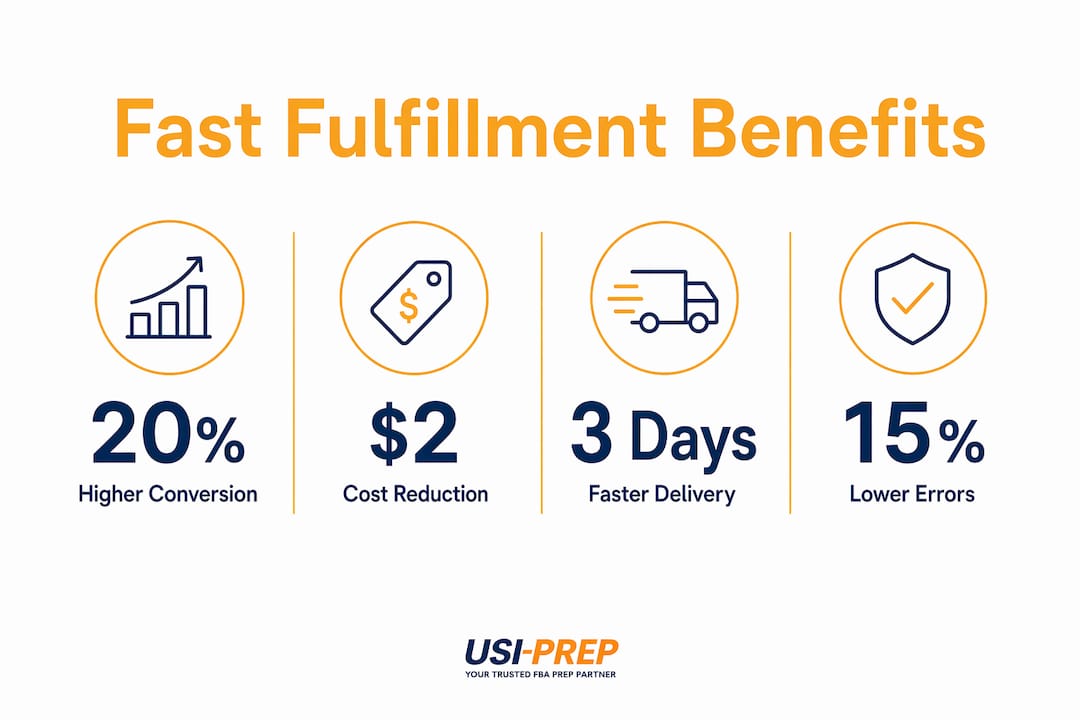
The inventory side matters just as much. Holding stock closer to your customers shortens transit times, but it requires careful planning. Distributed inventory networks can reduce shipping costs by 28% once order volumes exceed 200–300 per day. Below that threshold, a single well-run fulfillment center is usually more cost-effective than splitting inventory across multiple nodes.
Faster processing also gives you more flexibility with carriers. When your warehouse clears orders within hours, you can choose standard ground services instead of paying for overnight air to compensate for a slow prep cycle. That single shift in carrier selection can cut per-shipment costs meaningfully across thousands of orders.
- Automated label generation and carrier selection eliminate manual rate shopping and reduce per-order processing time.
- Batch, zone, and wave picking strategies cut travel time inside the warehouse and lower labor cost per order.
- Accurate package dimensioning prevents costly carrier adjustment fees triggered by incorrect weight or size data.
- Real-time inventory systems reduce emergency reorders and the expedite fees that come with stockouts.
Pro Tip: Audit your packaging workflow. Oversized boxes are one of the most common sources of avoidable carrier surcharges, and fixing them costs nothing but a few hours of analysis.
Steps to optimize fulfillment processes for speed and cost efficiency
Getting faster without spending more requires changes at every stage of the fulfillment cycle, not just at the shipping dock.
- Automate order intake. Connect your sales channels directly to your warehouse management system so orders flow in without manual entry. Real-time order management systems adjust stock counts dynamically and trigger supplier reorders before a stockout happens.
- Redesign your pick path. Position your top-selling SKUs closest to packing stations. This single layout change can cut pick time per order without any new technology investment.
- Use flexible staffing. Align labor to demand signals rather than fixed schedules. Cross-trained staff who can shift between picking, packing, and receiving keep throughput high during volume spikes without permanent headcount increases.
- Implement zone or batch picking. Rather than sending one picker per order, group orders by warehouse zone or batch similar items together. This reduces total travel distance and increases orders processed per labor hour.
- Invest in AI-driven process automation. Platforms built for fulfillment workflow automation can identify bottlenecks in real time and reroute work before delays compound.
- Analyze your shipping data regularly. Zone distribution analysis tells you what percentage of orders ship into high-cost zones. If more than 40% of your volume lands in zones 4 through 7, distributed inventory likely pencils out at your volume level.
For brands managing FBA inventory, understanding efficient FBA restocking is a direct extension of these principles. Faster inbound processing means less time out of stock and fewer lost sales.
Hidden costs of slower or self-fulfillment in ecommerce
Slow fulfillment does not just cost you in shipping fees. The damage spreads across your entire operation in ways that rarely show up as a single line item.
- WISMO calls pile up. “Where is my order?” inquiries are the most common and most expensive form of reactive customer service. Fast fulfillment dramatically reduces WISMO tickets, freeing your support team to handle issues that actually require human judgment.
- Manual errors are expensive. About 1 in 5 shipments contains an address mistake when orders are entered by hand, with correction fees averaging $24 per package. Incorrect package dimensions trigger additional carrier adjustments on top of that.
- Returns spike with slow delivery. Customers who wait too long sometimes cancel or refuse delivery entirely. Each return costs you reverse logistics fees, restocking labor, and often a lost customer.
- Inventory inaccuracy compounds. Self-fulfillment operations without real-time tracking frequently oversell or undersell, leading to either stockouts that kill revenue or excess inventory that ties up cash.
- Labor overhead inflates. Without automation, every additional order requires proportionally more staff time. That model breaks down fast during peak season, when overtime rates and temp staffing costs can erase months of margin.
The fulfillment cost components that hurt most are often the ones brands do not measure. Tracking the full cost of a slow order, including customer service time, return processing, and lost repeat purchases, usually reveals that self-fulfillment is far more expensive than it appears on the surface.
How Usiprep delivers fast, cost-saving fulfillment for ecommerce brands in 2026
Usiprep was founded by former Amazon sellers who understood the specific frustrations of ecommerce logistics from the inside. That background shapes how the company approaches fulfillment: with transparency, speed, and a focus on the metrics that actually affect your bottom line.
The results are concrete. Usiprep customers achieve a 98.9% on-time delivery rate and average fulfillment cost reductions of 30%. Those numbers come from automation, transparent processes, and fulfillment strategies built around each brand’s specific product mix and order volume, not a one-size-fits-all model.
- Faster inventory check-ins mean your stock is available for sale sooner, reducing the window between receiving and revenue.
- Complete logistics visibility gives you real-time status on every order, which cuts down on internal inquiries and lets your team focus on growth rather than firefighting.
- Tailored FBA prep solutions reduce the risk of Amazon rejection fees and delays that add cost and slow your supply chain.
- Scalable infrastructure means Usiprep’s operation grows with your order volume without creating the bottlenecks that typically appear when brands outgrow self-fulfillment.
For brands preparing to scale their FBA operations, Usiprep’s FBA prep requirements checklist is a practical starting point for identifying where prep inefficiencies are costing you money right now.
How faster fulfillment affects customer satisfaction and repeat business
Customer satisfaction improves directly with faster fulfillment through three mechanisms: fewer cancellations, higher repeat purchase rates, and greater lifetime value per customer. A buyer who receives an order quickly and accurately is far more likely to return than one who waited longer than expected and had to chase down a tracking update.
Repeat business is where the real financial payoff lives. Acquiring a new customer costs several times more than retaining an existing one, so any improvement in post-purchase experience has an outsized effect on profitability. Fast, accurate fulfillment is one of the most direct ways to improve that experience without a marketing spend increase.
Speed also functions as a competitive differentiator in markets where product and price are nearly identical across sellers. When two brands sell the same item at the same price, the one that ships faster wins the repeat order. That advantage compounds over time into a customer base that is both larger and more loyal.
Real-world cost savings from faster fulfillment
The economics of faster fulfillment show up clearly when you look at what changes operationally. A brand moving from manual order entry to automated processing eliminates costly address correction fees associated with manual errors, and those savings accumulate quickly across thousands of monthly shipments.
On the inventory side, brands that have adopted distributed fulfillment at sufficient volume have seen shipping cost reductions of 28% compared to single-node operations, driven by shorter shipping zones and reduced reliance on expedited carrier services. The breakeven point for that model sits around 200–300 orders per day, which is within reach for many mid-market ecommerce brands.
The conversion uplift from faster delivery also generates measurable revenue. The model is straightforward: a 0.4 percentage point increase in conversion on meaningful traffic translates to tens of thousands of dollars in incremental weekly revenue, often exceeding the cost of the fulfillment improvements that made it possible. For brands using AI-driven business automation to connect their order management and fulfillment systems, the gains in throughput and accuracy tend to appear within the first few weeks of implementation.
Taken together, these examples point to the same conclusion. Faster fulfillment is not a cost center. When executed with the right processes and technology, it is one of the highest-return investments an ecommerce operation can make.
Key Takeaways
Fast fulfillment reduces costs by cutting labor, shipping, and error expenses while simultaneously increasing conversion, repeat purchases, and inventory efficiency.
| Point | Details |
|---|---|
| Conversion uplift offsets cost | A conversion increase of up to 20% on substantial visitor traffic and average order values generates meaningful additional weekly revenue. |
| Automation cuts errors and labor | Automated order processing lowers headcount needs and eliminates the $24 address correction fee affecting roughly 1 in 5 manual shipments. |
| Distributed inventory saves on shipping | Brands shipping 200–300+ orders per day can reduce per-shipment costs by 28% using multi-node inventory strategies. |
| Usiprep delivers proven results | Usiprep customers average a 98.9% on-time delivery rate and a 30% reduction in fulfillment costs. |
| Hidden costs make slow fulfillment expensive | WISMO calls, return processing, and inventory inaccuracy inflate the true cost of slow or self-managed fulfillment well beyond visible line items. |