
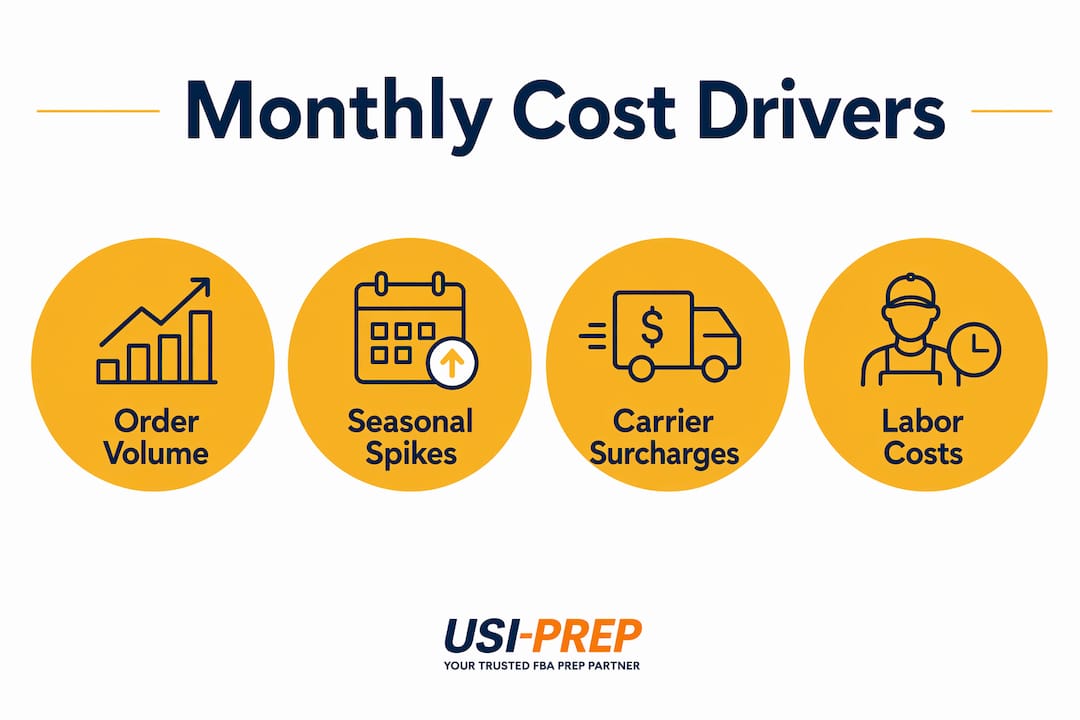
Fulfillment costs change every month because the inputs that drive them are almost entirely variable. Order volume swings, seasonal labor surcharges, shifting storage utilization, carrier fee updates, and your product mix all move independently, and they rarely move in the same direction at the same time. The result is an invoice that looks different in October than it did in July, even when your business feels the same. Here is what is actually driving those swings:
- Order volume fluctuations directly scale labor and shipping costs up or down
- Seasonal demand peaks trigger Q4 surcharges and temporary labor costs from most 3PLs
- Storage utilization changes alter your monthly warehousing bill based on inventory levels
- Carrier surcharge variability, including fuel and residential delivery fees, adds unpredictable layers
- Contract minimums mean you pay a floor regardless of how few orders you ship
Fixed costs like warehouse rent and technology fees stay constant, but they get spread across however many orders you actually ship. In a slow month, those fixed costs hit harder per order. That interplay between fixed and variable elements is the core reason your fulfillment bill rarely matches last month’s.
What makes up your fulfillment costs?
Understanding fulfillment cost components is the first step toward predicting them. Your invoice typically breaks into four main buckets:
- Labor (pick and pack): The cost to pull items from shelves, pack them, and prepare them for shipment. This scales directly with order count and order complexity.
- Storage fees: Charged per pallet, bin, or cubic foot depending on your 3PL’s measurement method. These vary with your inventory levels and the 3PL’s billing cycle (month-end snapshot vs. daily average).
- Shipping charges: The carrier cost for the actual parcel label, usually passed through at a negotiated rate. This is often the largest single line item.
- Packaging materials: Boxes, poly mailers, dunnage, and tape. Some 3PLs include these in pick-and-pack fees; others bill them separately or mark them up.
Beyond those four, most invoices carry additional line items: account management fees, technology or warehouse management system (WMS) access fees, receiving fees per pallet or unit, and returns handling charges. These extras are where hidden fees in fulfillment contracts tend to accumulate quietly.
Why fulfillment costs vary monthly: the real drivers
Monthly cost variation comes from several forces working simultaneously, and they rarely cancel each other out.
Order volume is the biggest lever. When you ship more orders, labor and carrier costs rise proportionally. But fixed costs, like your warehouse footprint and account management fees, stay flat. That means your cost per order actually falls as volume rises, and climbs when volume drops. Brands shipping under 500 orders per month often pay $6.00–$9.00 per fulfillment order, while high-volume brands at 50,000+ orders per month can reach $2.50–$4.50 per order, purely because fixed costs amortize differently.

Seasonal demand creates predictable but steep spikes. Most 3PLs apply Q4 peak surcharges of 15–30% on fulfillment rates from October through December to cover seasonal labor: temporary hires, overtime for permanent staff, and accelerated training. This applies even if your own volume does not spike, because the 3PL’s per-order cost rises across its entire operation.
Storage utilization shifts with your inventory cycle. If you pre-position inventory before a product launch or holiday push, your storage bill jumps before the orders arrive to offset it. Long-term storage surcharges kick in after six months at most providers, adding another variable layer.
Dimensional weight and product mix matter more than most sellers realize. Carriers charge based on whichever is greater: actual weight or dimensional weight. A lightweight but bulky item, like a throw pillow or a foam roller, can cost as much to ship as a dense item twice its actual weight. Changing your product mix, even slightly, can shift your blended shipping cost per order.
“The new DAS sub-tiering alone is adding $0.80 to $1.40 per package for brands with rural customer bases. That’s not a rounding error, that’s a margin event.” — Jana Falkenstein, VP of Carrier Strategy, Extensiv
Carrier surcharges are the least predictable variable. UPS residential surcharges reached $7.28 per package in early 2026, a 34.8% increase from early 2025. Fuel surcharges, residential delivery fees, and delivery area surcharges for rural ZIP codes all move on their own schedules, often with less than 45 days’ notice.
How to calculate your monthly fulfillment cost per order
The formula most operators use is straightforward, but the inputs require discipline to track:
| Cost Element | Example Monthly Total | Per-Order Calculation |
|---|---|---|
| Pick and pack labor | — | — ÷ 600 orders = $4.00 |
| Storage fees | — | — ÷ 600 orders = $0.80 |
| Packaging materials | — | — ÷ 600 orders = $0.50 |
| Carrier shipping costs | — | — ÷ 600 orders = $7.00 |
| Returns processing | — | — ÷ 600 orders = $0.60 |
| Account/tech fees | — | — ÷ 600 orders = $0.50 |
| Total all-in cost | — | — |
The ISM defines fulfillment cost per order as a key supply chain metric precisely because it captures the full loaded cost, not just the quoted pick-and-pack rate. Run this calculation every month, not quarterly. A monthly view catches surcharge creep before it compounds.
Common pricing models and fees used by fulfillment providers
3PL pricing structures vary widely, and the model you are on shapes how your costs fluctuate:
- Per-order pricing: A flat fee per shipment, often $3.50–$8.00 for standard single-item orders before shipping. Simple to forecast, but surcharges still stack on top.
- Per-pick pricing: Charged per item picked from a shelf, typically $0.20–$0.75 per pick. Multi-item orders get expensive fast under this model.
- Monthly minimums: Mid-market 3PLs commonly charge $500–$2,500 per month as a floor. If your orders do not generate enough fees to hit the minimum, you pay the difference regardless.
- Peak season uplifts: Applied october through december by most providers, structured as either a percentage uplift or a flat per-package add.
- Residential delivery fees: Passed through from UPS, FedEx, or USPS. These have risen sharply in 2026.
- Dimensional weight fees: Applied when a package’s volume exceeds its actual weight threshold, calculated by the carrier’s DIM divisor.
The fees that most often surprise sellers are monthly minimums (charged even in slow months), account management fees billed separately from pick-and-pack, and fuel surcharges that can add 25–40% on top of headline rates when carrier pass-throughs stack up.
How to manage and reduce monthly fulfillment costs
Controlling fulfillment cost fluctuations starts with visibility, then moves to negotiation and operational changes.
- Audit your invoices monthly. Pull carrier surcharge line items separately from base rates. Residential, extended area, and fuel surcharges should each be quantified on their own before any renegotiation conversation.
- Negotiate Q4 peak surcharge caps. Ask your 3PL whether they have negotiated caps with UPS and FedEx or are passing surcharges through at cost. The answer changes your exposure significantly.
- Right-size your packaging. Reducing box dimensions even slightly can drop packages below dimensional weight thresholds, cutting per-shipment costs across thousands of orders.
- Distribute inventory strategically. Placing inventory closer to your customers’ ZIP codes reduces zone-based shipping costs. The tradeoff is added complexity and storage costs at multiple nodes.
- Track your order volume against minimums. If you consistently exceed your 3PL’s monthly minimum, you have negotiating leverage. If you rarely hit it, you are paying for capacity you do not use.
Pro Tip: Set up a monthly cost-per-order tracker in a spreadsheet or your order management system. Flag any month where the figure moves more than 10% from the prior month and trace it to a specific line item. Most cost spikes have a single cause, and finding it fast is what separates brands that control costs from those that absorb them.
How bundled pricing and carrier volatility are reshaping costs in 2026
3PL pricing bundles measure space, labor, materials, and shipping differently each month, which means apparent cost spikes often reflect bundle dynamics rather than billing errors. That disconnect is getting harder to manage as carriers move away from predictable annual rate cards.
Carriers are increasingly shifting to dynamic, weekly-indexed pricing models with less than 45 days’ notice, amplifying monthly cost volatility for 3PLs and the brands they serve.
FedEx’s Variable Demand Surcharge (VDS) model, effective July 2026, replaces the legacy peak surcharge calendar with tiered weekly fees of $0.38, $0.72, or $1.15 per package depending on regional hub utilization. A brand shipping 4,000 units weekly could see per-package costs jump $1.15 with 72 hours’ notice during a demand spike. Meanwhile, FedEx’s revised Delivery Area Surcharge now breaks rural zones into four sub-tiers, adding up to $1.40 per package for rural deliveries.
For ecommerce brands, the practical response involves a few concrete steps:
- Review your 3PL contract for surcharge passthrough language, specifically clauses referencing “network” or “operational” surcharges
- Request a multi-carrier rate comparison from your 3PL or shipping platform to identify cheaper routing options
- Consider splitting inventory across two warehouse nodes if more than 60% of your volume ships to high-surcharge zones
- Build mid-year contract renegotiation into your calendar, not just annual reviews
What fulfillment costs actually cover
Fulfillment costs are the fees a 3PL charges to receive, store, pick, pack, and ship your orders. The fulfillment-only portion, covering pick, pack, and packaging before any postage label, runs $3.50–$8.00 for a standard single-item order in 2026. Add domestic ground shipping and the all-in number lands in the $8–$15 range per order. Layer on surcharges, account management, and peak uplifts, and the realistic loaded cost moves to $10–$15 or higher for many brands. That gap between the quoted rate and the actual invoice is where most budget surprises live.
How returns drive monthly cost spikes
Returns are a direct cost multiplier that most brands underestimate when building fulfillment budgets. Average return processing costs have risen above $12.50 per unit for apparel brands in 2026, covering inbound shipping, inspection labor, and restocking. A month with a 20% return rate on 600 orders means 120 returns at $12.50 each, adding $1,500 to your bill before any other variable moves. High-return categories like apparel, footwear, and electronics see the most pronounced monthly swings from this factor alone. Building a per-order returns cost into your monthly model, rather than treating returns as an occasional exception, gives you a far more accurate budget baseline.
How warehouse location and distribution affect your monthly bill
Geographic distribution is one of the most underappreciated factors affecting fulfillment expenses month to month. Shipping from a single warehouse in, say, Nevada means that orders going to the Northeast travel through zones 6, 7, and 8, where carrier rates are highest. Adding a second node on the East Coast can cut average zone distance and reduce per-shipment costs, but it introduces split-inventory complexity and doubles your storage footprint.
Multiple warehouse locations also mean multiple sets of receiving fees, storage billing cycles, and potentially different 3PL contracts with different surcharge structures. A month where you rebalance inventory between nodes adds receiving and transfer costs that do not appear in a typical month. The math on multi-node fulfillment only works in your favor once your volume is high enough to offset those structural costs, generally above 50–100 orders per day per node.
Key Takeaways
Monthly fulfillment costs vary because order volume, carrier surcharges, storage utilization, and seasonal labor costs all move independently, and fixed costs like minimums and account fees amplify the swings in low-volume months.
| Point | Details |
|---|---|
| Order volume drives per-order cost | Fixed costs spread across fewer orders in slow months, pushing cost per order up to $6.00–$9.00 at low volumes. |
| Q4 surcharges add 15–30% | Most 3PLs apply a seasonal uplift october through december regardless of your own volume changes. |
| Carrier fees are increasingly volatile | UPS residential surcharges hit $7.28 per package in 2026, a 34.8% jump from early 2025. |
| Returns add real monthly cost | Processing a return costs apparel brands above $12.50 per unit, compounding in high-return months. |
| Audit monthly, not quarterly | Tracking cost per order monthly catches surcharge creep before it becomes a margin problem. |
Usiprep was founded by former Amazon sellers who experienced these exact cost swings firsthand. With a 98.9% on-time delivery rate and transparent pricing that has helped brands cut fulfillment costs by 30%, Usiprep gives ecommerce businesses the visibility and control that most 3PLs do not offer. If unpredictable monthly invoices are eating your margins, the FBA prep requirements checklist is a practical starting point for getting costs under control.